Advertisements
Advertisements
प्रश्न
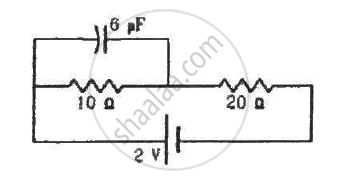
Find the charge on the capacitor shown in the figure.
Advertisements
उत्तर
In steady state, the capacitor is fully charged and then, it offers infinite resistance to the direct current flow. So, no current can flow through the capacitor in steady state.
The effective resistance of the circuit,
Reff = 10 + 20 = 30 Ω
The current i through the circuit,
\[i = \frac{2}{30} = \frac{1}{15} A\]
Voltage drop across the 10 Ω resistor,
V = i × r
\[= \frac{1}{15} \times 10\]
\[ = \frac{10}{15} = \frac{2}{3} V\]
Since the potential drops across the capacitor and the 10 Ω resistor are the same,
the charge stored on the capacitor,
Q = CV
\[= 6 \times {10}^{- 6} \times \frac{2}{3}\]
\[ = 4 \times {10}^{- 6} C = 4 mC\]
APPEARS IN
संबंधित प्रश्न
A 600 pF capacitor is charged by a 200 V supply. It is then disconnected from the supply and is connected to another uncharged 600 pF capacitor. How much electrostatic energy is lost in the process?
Find the ratio of energy stored in the two configurations if they are both connected to the same source.
How many time constants will elapse before the charge on a capacitors falls to 0.1% of its maximum value in a discharging RC circuit?
A capacitance C charged to a potential difference V is discharged by connecting its plates through a resistance R. Find the heat dissipated in one time constant after the connections are made. Do this by calculating ∫ i2R dt and also by finding the decrease in the energy stored in the capacitor.
By evaluating ∫i2Rdt, show that when a capacitor is charged by connecting it to a battery through a resistor, the energy dissipated as heat equals the energy stored in the capacitor.
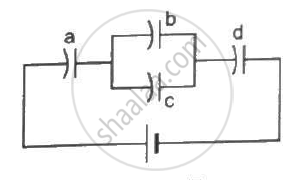
Each capacitor in figure has a capacitance of 10 µF. The emf of the battery is 100 V. Find the energy stored in each of the four capacitors.
A capacitor of capacitance 100 μF is connected across a battery of emf 6 V through a resistance of 20 kΩ for 4 s. The battery is then replaced by a thick wire. What will be the charge on the capacitor 4 s after the battery is disconnected?
A capacitor of capacitance C is given a charge Q. At t = 0, it is connected to an uncharged capacitor of equal capacitance through a resistance R. Find the charge on the second capacitor as a function of time.
A large conducting plane has a surface charge density `1.0 xx 10^-4 "Cm"^-2` . Find the electrostatic energy stored in a cubical volume of edge 1⋅0 cm in front of the plane.
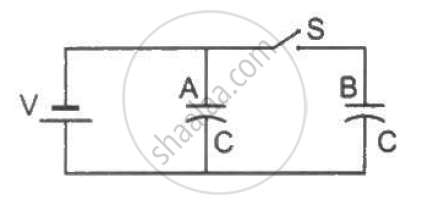
Figure shows two identical parallel plate capacitors connected to a battery through a switch S. Initially, the switch is closed so that the capacitors are completely charged. The switch is now opened and the free space between the plates of the capacitors is filled with a dielectric of dielectric constant 3. Find the ratio of the initial total energy stored in the capacitors to the final total energy stored.
Choose the correct option:
Energy stored in a capacitor and dissipated during charging a capacitor bear a ratio.
A 2µF capacitor is charge to 100 volt and then its plate are connected by a conducting wire. The heat produced is:-
Do free electrons travel to region of higher potential or lower potential?
Prove that, if an insulated, uncharged conductor is placed near a charged conductor and no other conductors are present, the uncharged body must be intermediate in potential between that of the charged body and that of infinity.
A fully charged capacitor C with initial charge q0 is connected to a coil of self-inductance L at t = 0. The time at which the energy is stored equally between the electric and magnetic fields is ______.
A parallel plate capacitor (A) of capacitance C is charged by a battery to voltage V. The battery is disconnected and an uncharged capacitor (B) of capacitance 2C is connected across A. Find the ratio of total electrostatic energy stored in A and B finally and that stored in A initially.
Electrostatic energy of 4 x 10⁻⁴ J is stored in a charged 25 pF capacitor. Find the charge on the capacitor.
If the charge on the parallel plate capacitor is increased by 3 C, the energy stored in it increases by 44%. The original charge on the capacitor is ______.
A parallel combination of two capacitors of capacities ‘C’ and ‘`C/3`’ respectively is connected across a battery of 12 volt. When both capacitors are fully charged, the charge and energy stored in them is Q1, Q2 and E1, E2 respectively. Then the ratio of (E1 − E2) to (Q1 − Q2) is ______.
What is called the energy stored in a capacitor?
