Advertisements
Advertisements
प्रश्न
A capacitor of capacitance 12.0 μF is connected to a battery of emf 6.00 V and internal resistance 1.00 Ω through resistanceless leads. 12.0 μs after the connections are made, what will be (a) the current in the circuit (b) the power delivered by the battery (c) the power dissipated in heat and (d) the rate at which the energy stored in the capacitor is increasing?
Advertisements
उत्तर
Given,
Capacitance of capacitor, C= 12.0 μF = 12 × 10−6 F
Emf of battery, V0 = 6.00 V
Internal resistance of battery, R = 1 Ω
Time interval, t = 12 μs
(a) Charging current in the circuit is given as,
i = i0e−t/RC
Current at, t = 12.0 μs
\[i = \frac{V_0}{R} e^{- t/RC} \]
\[i = \frac{6}{1} \times e^{- 1} \]
\[i = 2 . 207 = 2 . 21 A\]
(b) During charging, charge on the capacitor at any time ''t'' is given as
\[Q = C V_0 (1 - e^{- \frac{t}{RC}} )\]
Work done by battery in in time delivering this charge is,
W = QV0
Power deliver by the battery in time ''t'' is,
\[P = \frac{C {V_0}^2 (1 - e^{- \frac{t}{RC}} )}{t}\]
Putting, t = 12 μs
\[P = \frac{12 \times {10}^{- 6} {V_0}^2 (1 - e^{- 1} )}{12 \times {10}^{- 6}}\]
\[ \Rightarrow P = 13 . 25 W\]
(c) Energy stroed in the capacitor at any instant of time is given as,
\[U = \frac{1}{2}\frac{Q^2}{C}\]
\[ \Rightarrow U = \frac{1}{2}\frac{C^2 {V_0}^2 (1 - e^{- \frac{t}{RC}} )^2}{C}\]
\[ \Rightarrow U = \frac{1}{2}C {V_0}^2 (1 - e^{- \frac{t}{RC}} )^2\]
Rate at which the energy stored in the capacitor is,
\[\frac{dU}{dt} = \frac{1}{2}C {V_0}^2 \times 2(1 - e^{- \frac{t}{RC}} ) \times ( e^{- \frac{t}{RC}} ) \times \frac{1}{RC}\]
\[\Rightarrow \frac{dU}{dt} = \frac{{V_0}^2}{R}( e^{- \frac{t}{RC}} - e^{- \frac{2t}{RC}} )\]
\[ \Rightarrow \frac{dU}{dt} = \frac{6 \times 6}{1}( e^{- 1} - e^{- 2} )\]
\[ \Rightarrow \frac{dU}{dt} = 8 . 37 W\]
So, the power dissipated in heat = \[P - \frac{dU}{dt}= 13.25-8.37 = 4.87 W\]
(d) Rate at which the energy stored in the capacitor is increasing
\[\Rightarrow \frac{dU}{dt} = 8 . 37 W\]
APPEARS IN
संबंधित प्रश्न
A 12 pF capacitor is connected to a 50 V battery. How much electrostatic energy is stored in the capacitor?
Find the charge on the capacitor as shown in the circuit.
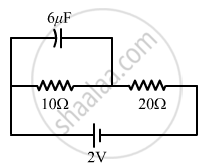
Find the ratio of energy stored in the two configurations if they are both connected to the same source.
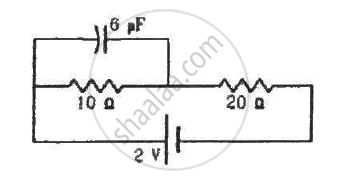
Find the charge on the capacitor shown in the figure.
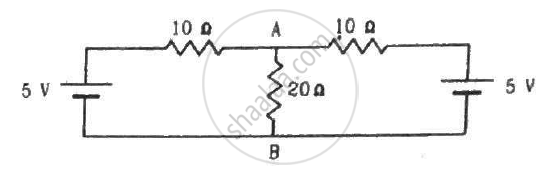
(a) Find the current in the 20 Ω resistor shown in the figure. (b) If a capacitor of capacitance 4 μF is joined between the points A and B, what would be the electrostatic energy stored in it in steady state?
A capacitance C charged to a potential difference V is discharged by connecting its plates through a resistance R. Find the heat dissipated in one time constant after the connections are made. Do this by calculating ∫ i2R dt and also by finding the decrease in the energy stored in the capacitor.
A point charge Q is placed at the origin. Find the electrostatic energy stored outside the sphere of radius R centred at the origin.
A metal sphere of radius R is charged to a potential V.
- Find the electrostatic energy stored in the electric field within a concentric sphere of radius 2 R.
- Show that the electrostatic field energy stored outside the sphere of radius 2 R equals that stored within it.
Obtain the expression for the energy stored in a capacitor connected across a dc battery.
A parallel plate capacitor has a uniform electric field ‘`vec "E"`’ in the space between the plates. If the distance between the plates is ‘d’ and the area of each plate is ‘A’, the energy stored in the capacitor is ______
(ε0 = permittivity of free space)
Electrostatic energy of 4 x 10⁻⁴ J is stored in a charged 25 pF capacitor. Find the charge on the capacitor.
In a capacitor of capacitance 20 µF, the distance between the plates is 2 mm. If a dielectric slab of width 1 mm and dielectric constant 2 is inserted between the plates, what is the new capacitance?
If the charge on the parallel plate capacitor is increased by 3 C, the energy stored in it increases by 44%. The original charge on the capacitor is ______.
A parallel combination of two capacitors of capacities ‘C’ and ‘`C/3`’ respectively is connected across a battery of 12 volt. When both capacitors are fully charged, the charge and energy stored in them is Q1, Q2 and E1, E2 respectively. Then the ratio of (E1 − E2) to (Q1 − Q2) is ______.
Where is the electrical potential energy stored when a capacitor is charged?
What is the SI unit of energy stored in a capacitor?
If an additional small charge \(dq\) is supplied to a capacitor when its potential difference is \(V\), what is the small work done?
