Advertisements
Advertisements
प्रश्न
Find the missing value:
| Base | Height | Area of parallelogram |
| ______ | 8.4 cm | 48.72 cm2 |
Advertisements
उत्तर
| Base | Height | Area of parallelogram |
| 5.8 | 8.4 cm | 48.72 cm2 |
Explanation:
b = ?
h = 8.4 cm
Area = 48.72 cm2
b × 8.4 = 48.72
b = `48.72/8.4`
b = 5.8 cm
Therefore, the base of such parallelogram is 5.8 cm.
संबंधित प्रश्न
The perimeter of a right triangle is 60 cm. Its hypotenuse is 25 cm. Find the area of the triangle.
Find the area of the triangle formed by joining the mid-points of the sides of the triangle whose vertices are (0, -1), (2, 1) and (0, 3). Find the ratio of this area to the area of the given triangle
Find a relation between x and y if the points (x, y), (1, 2) and (7, 0) are collinear.
Find the area of the following triangle:
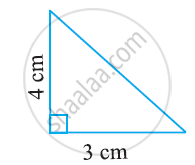
Prove that the points A(2, 4), B(2, 6) and `C(2 + sqrt(3), 5)` are the vertices of an equilateral triangle.
Show that the points (a + 5, a – 4), (a – 2, a + 3) and (a, a) do not lie on a straight line for any value of a.
Points A(–6, 10), B(–4, 6) and C(3, –8) are collinear such that AB = `2/9` AC.
The area of ∆ABC is 8 cm2 in which AB = AC = 4 cm and ∠A = 90º.
Area of triangle MNO in the following figure is ______.

In the following figure, triangle AEC is right-angled at E, B is a point on EC, BD is the altitude of triangle ABC, AC = 25 cm, BC = 7 cm and AE = 15 cm. Find the area of triangle ABC and the length of DB.

