Advertisements
Advertisements
प्रश्न
Find the missing value:
| Base | Height | Area of parallelogram |
| ______ | 8.4 cm | 48.72 cm2 |
Advertisements
उत्तर
| Base | Height | Area of parallelogram |
| 5.8 | 8.4 cm | 48.72 cm2 |
Explanation:
b = ?
h = 8.4 cm
Area = 48.72 cm2
b × 8.4 = 48.72
b = `48.72/8.4`
b = 5.8 cm
Therefore, the base of such parallelogram is 5.8 cm.
संबंधित प्रश्न
If A(−4, 8), B(−3, −4), C(0, −5) and D(5, 6) are the vertices of a quadrilateral ABCD, find its area.
Find the area of the following triangle:
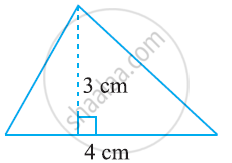
Find the area of a triangle whose vertices are
(6,3), (-3,5) and (4,2)
Two vertices of a triangle are (1, 2), (3, 5) and its centroid is at the origin. Find the coordinates of the third vertex.
Show that the points A(3, 0), B(6, 4) and C(–1, 3) are the vertices of an isosceles right triangle.
Prove that the points A(2, 4), B(2, 6) and `C(2 + sqrt(3), 5)` are the vertices of an equilateral triangle.
If the centroid of ΔABC having vertices A(a, b), B(b, c) and C(c, a) is the origin, then find the value of (a + b + c).
Using integration, find the area of triangle ABC, whose vertices are A(2, 5), B(4, 7) and C(6, 2).
If the sides of a triangle are 3 cm, 4 cm and 5 cm, then the area is
The table given below contains some measures of the right angled triangle. Find the unknown values.
| Base | Height | Area |
| ? | 12 m | 24 sq.m |
