Advertisements
Advertisements
प्रश्न
Find the missing value:
| Base | Height | Area of parallelogram |
| ______ | 15 cm | 154.5 cm2 |
Advertisements
उत्तर
| Base | Height | Area of parallelogram |
| 10.3 | 15 cm | 154.5 cm2 |
Explanation:
b = ?
h = 15 cm
Area = 154.5 cm2
b × 15 = 154.5
b = `154.5/15`
b = 10.3 cm
Therefore, the base of such parallelogram is 10.3 cm.
संबंधित प्रश्न
If D, E and F are the mid-points of sides BC, CA and AB respectively of a ∆ABC, then using coordinate geometry prove that Area of ∆DEF = `\frac { 1 }{ 4 } "(Area of ∆ABC)"`
Find the area of a triangle with vertices at the point given in the following:
(1, 0), (6, 0), (4, 3)
Find the area of the following triangle:
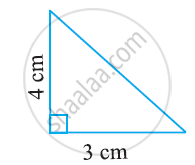
Four points A (6, 3), B (–3, 5), C (4, –2) and D (x, 3x) are given in such a way that `(ΔDBC)/(ΔABC) = 1/2`, find x.
A(7, –3), B(5, 3) and C(3, –1) are the vertices of a ΔABC and AD is its median. Prove that the median AD divides ΔABC into two triangles of equal areas.
For what value of k(k > 0) is the area of the triangle with vertices (–2, 5), (k, –4) and (2k + 1, 10) equal to 53 square units?
If the points P(–3, 9), Q(a, b) and R(4, –5) are collinear and a + b = 1, find the values of a and b.
Find the value(s) of k so that the quadratic equation x2 − 4kx + k = 0 has equal roots.
If the points (a1, b1), (a2, b2) and(a1 + a2, b1 + b2) are collinear, then ____________.
Find the missing value:
| Base | Height | Area of parallelogram |
| ______ | 8.4 cm | 48.72 cm2 |
