Advertisements
Advertisements
प्रश्न
Find the shortest distance between the lines
Advertisements
उत्तर
\[\text{ The given equations of the lines are } \]
\[\frac{x - 2}{- 1} = \frac{y - 5}{2} = \frac{z - 0}{3} . . . \left( 1 \right)\]
\[\frac{x - 0}{2} = \frac{y + 1}{- 1} = \frac{z - 1}{2} . . . \left( 2 \right)\]
\[\text{ Clearly (2) passes through the pointP(0, -1, 1).} \]
\[\text{ Let the direction ratios of the plane be proportional to a, b, c . } \]
\[\text{ Since the plane containing line (1) should pass through (2, 5, 0) and is parallel to the line (1) } ,\]
\[\text{ equation of the plane passing through (1) is } \]
\[a \left( x - 2 \right) + b \left( y - 5 \right) + c \left( z - 0 \right) = 0 . . . \left( 3 \right), \]
\[\text{ where} -a + 2b + 3c = 0 . . . \left( 4 \right)\]
\[\text{ Since the plane is parallel to line (2), } \]
\[2a - b + 2c = 0 . . . \left( 5 \right)\]
\[\text{ Solving (4) and (5) using cross-multiplication, we get } \]
\[\frac{a}{7} = \frac{b}{8} = \frac{c}{- 3}\]
\[\text{ Substitutinga, b and c in (3), we get} \]
\[7 \left( x - 2 \right) + 8 \left( y - 5 \right) - 3 \left( z - 0 \right) = 0\]
\[ \Rightarrow 7x + 8y - 3z - 54 = 0 . . . \left( 6 \right), \]
\[\text{ which is the equation of the plane containing line (1) and parallel to line (2).} \]
\[\text{ Shortest distance between (1) and (2) } \]
\[ = \text{ Distance between the point P(0, -1, 1) and plane (6) } \]
\[ = \left| \frac{7 \left( 0 \right) + 8 \left( - 1 \right) - 3 \left( 1 \right) - 54}{\sqrt{49 + 64 + 9}} \right|\]
\[ = \frac{65}{\sqrt{122}} \text{ units } \]
APPEARS IN
संबंधित प्रश्न
If the lines
`(x-1)/-3=(y-2)/(2k)=(z-3)/2 and (x-1)/(3k)=(y-5)/1=(z-6)/-5`
are at right angle then find the value of k
Find the shortest distance between the lines
`bar r = (4 hat i - hat j) + lambda(hat i + 2 hat j - 3 hat k)`
and
`bar r = (hat i - hat j + 2 hat k) + mu(hat i + 4 hat j -5 hat k)`
where λ and μ are parameters
Find the distance between the planes 2x - y + 2z = 5 and 5x - 2.5y + 5z = 20
Find the shortest distance between the lines whose vector equations are `vecr = (hati + 2hatj + 3hatk) + lambda(hati - 3hatj + 2hatk)` and `vecr = 4hati + 5hatj + 6hatk + mu(2hati + 3hatj + hatk)`.
Find the shortest distance between the lines whose vector equations are `vecr = (1-t)hati + (t - 2)hatj + (3 -2t)hatk` and `vecr = (s+1)hati + (2s + 1)hatk`.
Find the shortest distance between the lines `(x+1)/7=(y+1)/(-6)=(z+1)/1 and (x-3)/1=(y-5)/(-2)=(z-7)/1`
Find the shortest distance between the lines `vec r = hat i + 2hat j + 3 hat k + lambda(2 hat i + 3hatj + 4hatk)` and `vec r = 2hat i + 4 hat j + 5 hat k + mu (4hat i + 6 hat j + 8 hat k)`
Find the shortest distance between the lines
Find the shortest distance between the lines given by `vec"r" = (8 + 3lambdahat"i" - (9 + 16lambda)hat"j" + (10 + 7lambda)hat"k"` and `vec"r" = 15hat"i" + 29hat"j" + 5hat"k" + mu(3hat"i" + 8hat"j" - 5hat"k")`
|
The fuel cost per hour for running a train is proportional to the square of the speed it generates in km per hour. If the fuel costs ₹ 48 per hour at a speed of 16 km per hour and the fixed charges to run the train amount to ₹ 1200 per hour. Assume the speed of the train as v km/h. |
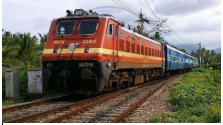
Given that the fuel cost per hour is k times the square of the speed the train generates in km/h, the value of k is:
|
The fuel cost per hour for running a train is proportional to the square of the speed it generates in km per hour. If the fuel costs ₹ 48 per hour at a speed of 16 km per hour and the fixed charges to run the train amount to ₹ 1200 per hour. Assume the speed of the train as v km/h. |
If the train has travelled a distance of 500 km, then the total cost of running the train is given by the function:
|
The fuel cost per hour for running a train is proportional to the square of the speed it generates in km per hour. If the fuel costs ₹ 48 per hour at a speed of 16 km per hour and the fixed charges to run the train amount to ₹ 1200 per hour. Assume the speed of the train as v km/h. |
The most economical speed to run the train is:
|
The fuel cost per hour for running a train is proportional to the square of the speed it generates in km per hour. If the fuel costs ₹ 48 per hour at a speed of 16 km per hour and the fixed charges to run the train amount to ₹ 1200 per hour. Assume the speed of the train as v km/h. |
The fuel cost for the train to travel 500 km at the most economical speed is:
Find the shortest distance between the following lines:
`vecr = (hati + hatj - hatk) + s(2hati + hatj + hatk)`
`vecr = (hati + hatj - 2hatk) + t(4hati + 2hatj + 2hatk)`
Find the angle between the following pair of lines:- `(x - 2)/ = (y - 1)/5 = (z + 3)/(-3)` and `(x + 2)/(-1) = (y - 4)/8 = (z - 5)/4`
Determine the distance from the origin to the plane in the following case x + y + z = 1
Find the shortest distance between the lines, `vecr = 6hati + 2hatj + 2hatk + lambda(hati - 2hatj + 2hatk)` and `vecr = - 4hati - hatk + mu(3hati - 2hatj - 2hatk)`
Find the shortest distance between the following lines:
`vecr = 3hati + 5hatj + 7hatk + λ(hati - 2hatj + hatk)` and `vecr = (-hati - hatj - hatk) + μ(7hati - 6hatj + hatk)`.
If the shortest distance between the lines `vecr_1 = αhati + 2hatj + 2hatk + λ(hati - 2hatj + 2hatk)`, λ∈R, α > 0 `vecr_2 = - 4hati - hatk + μ(3hati - 2hatj - 2hatk)`, μ∈R is 9, then α is equal to ______.
The shortest distance between the line y = x and the curve y2 = x – 2 is ______.
If the shortest distance between the lines `(x - 1)/2 = (y - 2)/3 = (z - 3)/λ` and `(x - 2)/1 = (y - 4)/4 = (z - 5)/5` is `1/sqrt(3)`, then the sum of all possible values of λ is ______.
The shortest distance between the z-axis and the line x + y + 2z – 3 = 0 = 2x + 3y + 4z – 4, is ______.
Find the distance between the lines:
`vecr = (hati + 2hatj - 4hatk) + λ(2hati + 3hatj + 6hatk)`;
`vecr = (3hati + 3hatj - 5hatk) + μ(4hati + 6hatj + 12hatk)`
The lines `vecr = hati + hatj - hatk + λ(2hati + 3hatj - 6hatk)` and `vecr = 2hati - hatj - hatk + μ(6hati + 9hatj - 18hatk)`; (where λ and μ are scalars) are ______.
For parallel lines with common direction vector \[\vec{b}\], which expression gives \[SD\]?
Which vector form gives the distance \[\mathbf d\] between skew lines?
For \[\vec a_1=\hat i+\hat j\] and \[\vec a_2=2\hat i+\hat j-\hat k\], what is \[\vec a_2-\vec a_1\]?
What is the distance between \[\vec r=(\hat i+\hat j)+\lambda(2\hat i-\hat j+\hat k)\] and \[\vec r=(2\hat i+\hat j-\hat k)+\mu(3\hat i-5\hat j+2\hat k)\]?
What is the distance between \[\vec r=(\hat i+2\hat j-4\hat k)+\lambda(2\hat i+3\hat j+6\hat k)\] and \[\vec r=(3\hat i+3\hat j-5\hat k)+\mu(2\hat i+3\hat j+6\hat k)\]?
What is \[SD\] for intersecting lines?
For skew lines, which expression gives \[SD\]?
