Advertisements
Advertisements
प्रश्न
Find the lower quartile, the upper quartile, the interquartile range and the semi-interquartile range for the following frequency distributions:
| Variate | 10 | 11 | 12 | 13 | 14 | 15 | 16 | 17 | 18 | 19 | 20 |
| Frequency | 1 | 2 | 3 | 1 | 2 | 4 | 2 | 1 | 1 | 2 | 1 |
Advertisements
उत्तर
| Variate | Frequency (f) | Cumulative frequency |
| 10 | 1 | 1 |
| 11 | 2 | 3 |
| 12 | 3 | 6 |
| 13 | 1 | 7 |
| 14 | 2 | 9 |
| 15 | 4 | 13 |
| 16 | 2 | 15 |
| 17 | 1 | 16 |
| 18 | 1 | 17 |
| 19 | 2 | 19 |
| 20 | 1 | 20 |
No. of terms = 20
Lower Quartile (Q1) = `"n"/4 = 20/4` = 5th term = 12
Upper Quartile (Q3) = `("n" xx 3)/4 = (20 xx 3)/4` = 15th term = 16
Interquartile range = Q3 - Q1 = 16- 12 = 4
Semi-Interquartile range = `(Q_3 - Q_1)/2 = (16-12)/2 = 2`
Hence, Lower quartile = 12, upper quartile = 16, interquartile range = 4, semi-interquartile range = 2
APPEARS IN
संबंधित प्रश्न
Find the correct answer from the alternatives given.
|
No. of trees planted by each student |
1 - 3 | 4 - 6 | 7 - 9 | 10 - 12 |
| No. of students | 7 | 8 | 6 | 4 |
The above data is to be shown by a frequency polygon. The coordinates of the points to show number of students in the class 4-6 are . . . .
Given below is the frequency distribution of the heights of 50 students of a class:
| Class interval: | 140−145 | 145−150 | 150−155 | 155−160 | 160−165 |
| Frequency: | 8 | 12 | 18 | 10 | 5 |
Draw a histogram representing the above data.
Draw a histogram of the following data:
| Class interval: | 10−15 | 15−20 | 20−25 | 25−30 | 30−35 | 34−40 |
| Frequency: | 30 | 98 | 80 | 58 | 29 | 50 |
The following histogram shows the number of literate females in the age group of 10 to 40 years in a town: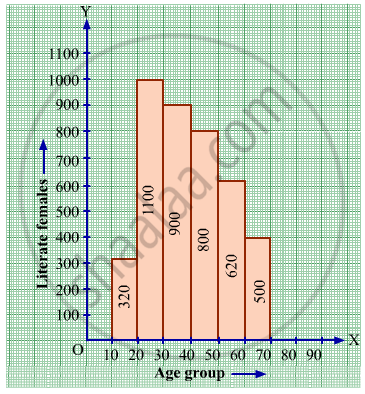
(i) Write the age group in which the number of literate female is the highest.
(ii) What is the class width?
(iii) What is the lowest frequency?
(iv) What are the class marks of the classes?
(v) In which age group literate females are the least?
Below is the histogram depicting marks obtained by 43 students of a class:
(i) Write the number of students getting the highest marks.
(ii) What is the class size?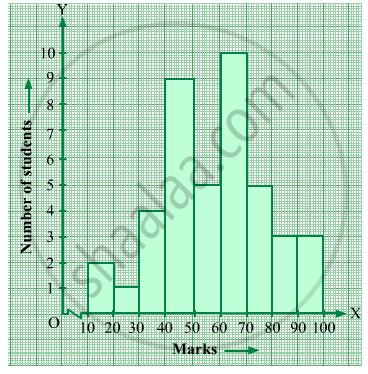
Draw a histogram for the following data.
| Class Interval | 0 − 10 | 10 − 20 | 20 − 30 | 30 − 40 | 40 − 50 | 50 − 60 |
| No. of students | 5 | 15 | 23 | 20 | 10 | 7 |
The graphical representation of grouped data is _________
Form a continuous frequency distribution table and draw histogram from the following data.
| Age (in years) | No. of persons |
| Under 5 | 1 |
| Under 10 | 12 |
| Under 15 | 19 |
| Under 20 | 26 |
| Under 25 | 27 |
| Under 30 | 35 |
| Under 35 | 38 |
| Under 40 | 45 |
| Under 45 | 48 |
| Under 50 | 53 |
In a histogram, class intervals and frequencies are taken along ______ axis and ______ axis.
Draw a histogram for the following data.
| Class interval | 10 – 15 | 15 – 20 | 20 – 25 | 25 – 30 | 30 – 35 | 35 – 40 |
| Frequency | 30 | 98 | 80 | 58 | 29 | 50 |
