Advertisements
Advertisements
प्रश्न
Find the height of a trapezium, the sum of the lengths of whose bases (parallel sides) is 60 cm and whose area is 600 cm2.
Advertisements
उत्तर
Given:
Sum of the parallel sides of a trapezium = 60 cm
\[ {\text{ Area of the trapezium }= 600 cm}^2 \]
\[\text{ Area of trapezium }=\frac{1}{2}\times(\text{ Sum of the parallel sides })\times(\text{ Height })\]
On putting the values:
\[600 = \frac{1}{2} \times 60 \times (\text{ Height })\]
\[600 = 30 \times (\text{ Height })\]
\[\text{ Height }=\frac{600}{30}= 20 cm\]
संबंधित प्रश्न
Find the area, in square metres, of the trapezium whose bases and altitude is as under:
bases = 28 cm and 3 dm, altitude = 25 cm
Find the area, in square metres, of the trapezium whose bases and altitude is as under:
bases = 8 m and 60 dm, altitude = 40 dm
Find the area of trapezium with base 15 cm and height 8 cm, if the side parallel to the given base is 9 cm long.
Find the area of a trapezium whose parallel sides of lengths 10 cm and 15 cm are at a distance of 6 cm from each other. Calculate this area as the difference of the area of a rectangle and the sum of the areas of two triangles.
The area of a trapezium is 91 cm2 and its height is 7 cm. If one of the parallel sides is longer than the other by 8 cm, find the two parallel sides.
Find the area enclosed by each of the following figures [Fig. 20.49 (i)-(iii)] as the sum of the areas of a rectangle and a trapezium: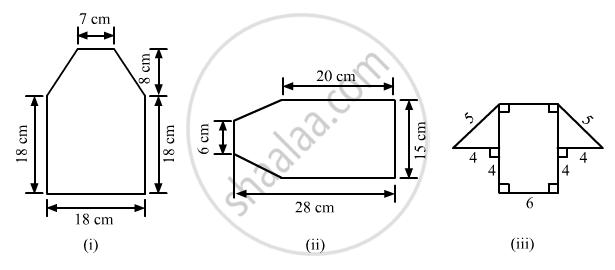
☐ PQRS is an isosceles trapezium l(PQ) = 7 cm. seg PM ⊥ seg SR, l(SM) = 3 cm, Distance between two parallel sides is 4 cm, find the area of ☐ PQRS.

The area of a trapezium is 1080 sq.cm. If the lengths of its parallel sides are 55.6 cm and 34.4 cm. Find the distance between them
The sunshade of a window is in the form of isosceles trapezium whose parallel sides are 81 cm and 64 cm and the distance between them is 6 cm. Find the cost of painting the surface at the rate of ₹ 2 per sq.cm
A trapezium with 3 equal sides and one side double the equal side can be divided into ______ equilateral triangles of ______ area.
