Advertisements
Advertisements
प्रश्न
Fill in the blank with appropriate alternatives given below:
Perfectly elastic demand curve is ________________.
पर्याय
horizontal to OX axis
horizontal to OY axis
flatter
steeper
Advertisements
उत्तर
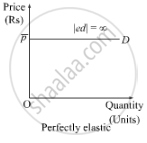
Perfectly elastic demand curve is horizontal to OX axis.
Explanation:
Demand for a good is said to be perfectly elastic when the demand is infinitely responsive to changes in price. In other words, even a small change in price brings about a large change in demand. Such a demand curve is a horizontal straight line parallel to x-axis.
APPEARS IN
संबंधित प्रश्न
Income elasticity of demand for inferior goods is negative.
Income elasticity of demand for inferior goods is negative.
Demand for the commodity having multiple uses has elastic demand.
Explain the factors determining the elasticity of demand.
A consumer buys 18 units of a good at a price of Rs 9 per unit. The price elasticity of demand for the good is (–) 1. How many units the consumer will buy at a price of Rs 10 per unit? Calculate.
The price elasticity of demand for a good is - 0.4. If its price increases by 5 percent, by what percentage will its demand fall? Calculate.
What will be the effect of 10 percent rise in price of a good on its demand if price elasticity of demand is (a) Zero, (b)-1, (c)-2.
When the price of a commodity X falls by 10 percent. Its demand rises from 150 units to 180
units. Calculate is price elasticity of demand. How much should be the percentage fall in its
price so that its demand rises from 150 to 210 units?
When the price of good rise from Rs 10 per unit to Rs 12 per unit, its quantity demanded falls by 20 percent. Calculate its price elasticity of demand. How much would be the percentage change in its quantity demanded, if the price rises from Rs 10 per unit to Rs 13 per unit?
The measure of price elasticity of demand of a normal good carries minus sign while price elasticity of supply carries plus sign. Explain why?
A consumer spends Rs 60 on a good priced at Rs 5 per unit. When price rises by 20 percent, the consumer continues to spend Rs 60 on the good. Calculate the price elasticity of demand by percentage method.
A consumer spends Rs 100 on a good priced at Rs 4 per unit. When price rises by 50 percent, the consumer continues to spend Rs 100 on the good. Calculate the price elasticity of demand by percentage method
A consumer spends Rs 400 on a good priced at Rs 8 per unit. When its price rises by 25 percent, the consumer spends Rs 500 on the good. Calculate the price elasticity of demand by the Percentage method.
A consumer buys 30 units of a good at a price of the Rs10per unit. The price elasticity of demand for the good is (-) 1. How many units will the consumer buy at a price of Rs 9 per unit? Calculate.
When the price of a good falls from Rs 10 to Rs 8 per unit, its demand rises from 20 units to 24 units. What can you say about price elasticity of demand of the good through the expenditure approach?
When the price of good rises from Rs10 to Rs12 per unit, its demand falls from 25 units to 20 units. What can you say about price elasticity of demand of the good through the 'expenditure approach'?
A consumer buys 27 units of a good at a price of Rs 10 per unit. When the price falls to Rs 9 per unit, the demand rises to 30 units. What can you say about price elasticity of demand of the good through the 'expenditure approach'?
Price elasticity of demand of a good is (-) 1. Calculate the percentage change in price that will raise the demand from 20 units to 30 units.
Explain any 'two methods' of measuring price elasticity of demand.
A consumer spends Rs 400 on a good priced at Rs 4 per unit. When the price rises by 25 percent, the consumer continues to spend Rs 400. Calculate the price elasticity of demand by percentage method.
A consumer buys 10 units of a commodity at a price of Rs. 10 per unit. He incurs an expenditure of Rs 200 on buying 20 units. Calculate price elasticity of demand by the percentage method. Comment upon the shape of demand curve based on this information.
8 units of a good are demanded at a price of Rs 7 per unit. Price elasticity of demand is (−) 1. How many units will be demanded if the price rises to Rs 8 per unit? Use expenditure approach of price elasticity of demand to answer this question.
Define or explain the following concept.
Unitary elastic demand.
State whether the following statement is True or False :
Concept of elasticity of demand is useful for finance minister.
Give reasons or explain the following statements
Demand for basic necessities is inelastic.
State whether the following statements are TRUE or FALSE :
The demand of foodgrains is inelastic.
Fill in the blanks with appropriate alternatives given in the bracket.
Demand elasticity can be measured from demand curve by ___________ method.
What do you mean by a normal good?
What do you mean by an ‘inferior good’? Give some examples.
What do you mean by substitutes? Give examples of two goods which are complements of each other.
What do you mean by complements? Give examples of two goods which are complements of each other.
Consider the demand for a good. At price Rs 4, the demand for the good is 25 units. Suppose the price of the good increases to Rs 5, and as a result, the demand for the good falls to 20 units. Calculate the price elasticity.
Consider the demand curve D(p) = 10 − 3p. What is the elasticity at price `5/3` ?
Give reason or explain the following statement.
All desires are not demand.
The demand for salt is ______.
Fill in the blank with appropriate alternatives given below:
Income elasticity of demand for inferior goods is __________.
Fill in the blank with appropriate alternatives given below:
Cross elasticity of demand is applicable to ____________ goods.
Fill in the blank with appropriate alternatives given below:
The slope of demand curve is _______________ in case of inelastic demand.
State whether the following statement is TRUE and FALSE.
Demand for luxuries is elastic.
State whether the following statement is TRUE and FALSE.
Perfectly inelastic demand curve is parallel to the X axis.
State whether the following statement is TRUE and FALSE.
Total outlay is price multiplied by quantity.
State whether the following statement is TRUE and FALSE.
Unitary Elastic Demand rarely occurs in practice.
State whether the following statement is TRUE and FALSE.
Concept of Elasticity of Demand is useful for finance minister.
Define or explain the following concept:
Unitary Elastic Demand
Define or explain the following concept:
Income Elasticity of Demand
Give reason or explain the following statement:
Demand for goods having snob appeal has elastic demand.
Write short answer for the following question :
Total outlay method of measuring price elasticity of demand.
Draw a diagram to show the elasticity of demand when it is greater than one.
Define price elasticity of demand.
Answer the following question.
If the price of a commodity rises by 40% and its quantity demanded falls from150 units to 120 units, calculate the coefficient of price elasticity of demand for the commodity.
State whether the following statement is true or false. Give valid reasons in support of your answer.
The coefficient of price elasticity of demand for the commodity is inversely related to the number of alternative uses of the commodity.
State whether the following statement is true or false. Give valid reasons in support of your answer.
Luxury goods often have lower price elasticity of demand.
Choose the correct answer from given options.
The expenditure on a good would change in the opposite direction as the price changes only when demand is ______
Answer the following question.
When the price of X doubles, its quantity demanded falls by 60 percent. Calculate its price elasticity of demand. What should be the percentage change in price so that its quantity demanded doubles?
Give economic term:
Elasticity resulting from infinite change in quantity demanded.
Give an economic term:
Elasticity resulting from a proportionate change in quantity demanded due to a proportionate change in price.
Assertion (A): Elasticity of demand explains that one variable is influenced by another variable.
Reasoning (R): The concept of elasticity of demand indicates the effect of price and changes in other factors on demand.
The concept of elasticity of demand was introduced by
Elasticity of demand is equal to one indicates
What are the methods of measuring Elasticity of demand?
Identify the correct pair of items from the following Columns I and II:
| Columns I | Columns II |
| (1) Perfectly elastic supply | (a) Es > 1 |
| (2) Perfectly inelastic supply | (b) Es < 1 |
| (3) Unitary elastic supply | (c) Es = 1 |
| (4) Relatively elastic supply | (d) Es = 0 |
If a good takes up a significant share of consumers' budget, its demand will be ______.
Elasticity of the demand is available when:
What will be the effect on price elasticity of demand, if the time required to find the substitute product is more.
Assertion (A): The elastic demand curve for luxuries is flatter than normal.
Reason (R): The coefficient of Elasticity ranges between 0 and 1.
Identify the correctly matched pair from the items in Column A by matching them to the items in column B:
| Column A | Column B |
| 1. Increase or decrease in demand for a commodity does not cause any change in its price. | (a) Effect on supply, in the case of Perfectly Elastic Demand. |
| 2. Increase or decrease in demand causes a change in the price of the commodity. Equilibrium quantity remains constant. | (b) Effect on demand, in the case of Perfectly Inelastic Supply. |
| 3. Increase or decrease in demand cause a change in the price of the commodity. Equilibrium quantity remains constant. | (c) Effect on demand, in the case of Perfectly Elastic Supply. |
| 4. Increase or decrease in demand for a commodity does not cause any change in its price. | (d) Effect on supply, in the case of Perfectly Elastic Demand. |
Identify the correctly matched pair from the items in Column A by matching them to the items in Column B:
| Column A | Column B | ||
| 1 | Relatively Inelastic Demand | (a) | ed > 1 |
| 2 | Relatively Elastic Demand | (b) | ed < 1 |
| 3 | Perfectly Inelastic Demand | (c) | ed = 0 |
| 4 | Perfectly Elastic Demand | (d) | ed = 1 |
Assertion (A): Elasticity of demand explains that one variable is influenced by another variable.
Reasoning (R): The concept of elasticity of demand indicates the effect of price and changes in other factors on demand.
Study the following table and answer the questions:
| Price of Pen (₹) | Demand for Pen |
| 10 | 500 |
| `square` | 400 |
| 30 | `square` |
| `square` | 200 |
| 50 | `square` |
Questions:
- Complete the above table.
- Which type of relationship is found between the price of a pen and demand for the pen?
Mention any two examples of composite demand.
The price of a good decreases from ₹100 to 80 per unit. If the price elasticity of demand for the good is 2 and the original quantity demanded is 30 units, calculate the new quantity demanded.
As a result of 5% fall in the price of a good, its demand rises by 12%, the demand for the good will said be ______.
When change in price is greater than the change in quantity demand it is a case of elastic demand.
- Luxuries goods have generally elastic demand.
- Goods whose close substitutes are available have inelastic demand.
Define elasticity of demand.
When is the demand for a good said to be elastic?
What is meant by elastic demand?
Who introduced the concept of elasticity of demand?
Which type of good typically has inelastic demand?
What is unit elasticity of demand?
Which statement about the law of demand and elasticity of demand is true?
