Advertisements
Advertisements
प्रश्न
Explain in brief types of extraction of moderately reactive metals according to their reactivity.
Advertisements
उत्तर
Extraction of moderately reactive metals:
- Moderately reactive metals such as iron, zinc, lead, copper usually occur in the form of their sulphide salts or carbonate.
- It is easier to obtain metals from their oxides rather than sulphides or carbonates.
- Therefore, the sulphide ores are strongly heated in excess of air to transform them into oxides. This process is called roasting.
E.g. \[\ce{\underset{\text{Zinc sulphide}}{2ZnS_{(s)}} + 3O_{2(g)} -> \underset{\text{Zinc oxide}}{2ZnO_{(s)}} + \underset{\text{Sulphur dioxide}}{2SO2\uparrow}}\] - Carbonate ores are strongly heated in a limited supply of air to transform them into oxides. This process is called calcination.
E.g. \[\ce{\underset{\text{Zinc carbonate}}{ZnCO_{3(s)}} ->[Heat] \underset{\text{Zinc oxide}}{ZnO_{(s)}} + \underset{\text{Carbon dioxide}}{CO2}}\] - The oxide so obtained is reduced to metal by using suitable reductant such as carbon.
\[\ce{\underset{\text{Zinc oxide}}{ZnO_{(s)}} + \underset{\text{Carbon}}{C_{(s)}} ->[Heat] \underset{\text{Zink}}{Zn_{(s)}} + \underset{\text{Carbon monoxide}}{CO\uparrow}}\] - The metal thus obtained can be further refined electrolysis.
APPEARS IN
संबंधित प्रश्न
Name the following:
The property possessed by metals by which they can be beaten into sheets.
Name three other metals which are extracted in a manner similar to sodium.
Name the metal which is extracted from haematite ore.
Name the metal which is extracted from the ore called ‘rock salt’.
Name two ores of zinc. Write the names of the chemical compounds present in them and give their chemical formulae.
A metal which exists as a liquid at room temperature is obtained by heating its sulphide ore in the presence of air.
- Name the metal and write its chemical symbol.
- Write the name and formula of the sulphide ore.
- Give the equations of chemical reactions involved in the production of metal from its sulphide ore.
- Name a common device in which this metal is used.
- Can this metal displace copper from copper sulphate solution? Why?
State three objectives achieved during the roasting of ores.
Give the principles of the froth floatation process.
Some metallic oxides can be reduced by hydrogen, carbon and carbon monoxide and some cannot. Explain.
Give reasons, why aluminum is used in:
In making ships
Aluminum is used in thermite welding:
write reaction for process?
Define the following term.
Mineral
Give the chemical formula of :
Bauxite
Complete the incomplete statement with missing word:
Metals form positive ions while non- metals ______.
Heating an ore in a limited supply of air or in the absence of air at a temperature just below its melting point is known as ______.
Sulphide ores : Roasting : : Carbonate ores : _______
Explain the characteristics of ionic compounds.
Explain the following reaction with the balanced equation.
Dry aluminium hydroxide is ignited at 1000 °C
Observe the following diagram and write answers.
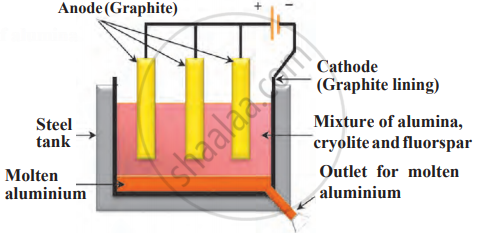
- Name the method.
- Write anode reaction and cathode reaction.
- Why fluorspar and cryolite are added in the mixture?
