Advertisements
Advertisements
प्रश्न
Dos and Don’ts for delivering a speech. Add some more points.
| Dos | Don'ts |
| Talk slowly | Don’t mumble |
| Emphasize keywords | Don’t look up /down |
Advertisements
उत्तर
| Dos | Don'ts |
| Talk slowly | Don’t mumble |
| Emphasize keywords | Don’t look up /down |
| Be confident | Don’t use too many hand gestures |
| Maintain a good posture | Don’t keep your speech too lengthy |
| Make eye contact with the entire audience | Don’t repeat the same words multiple times |
APPEARS IN
संबंधित प्रश्न
Does the poet use the literary devices in the poem?
Is there any significance of the logs of wood in the hands of the six people?
Mention the two moods of the poet?
But a BIRD that stalks down his narrow cage
Can seldom see through his bars of rage
His wings are clipped and his feet are tied
So he opens his throat to sing.
Read the above lines and answer the question that follow.
What docs the word “clipped” mean in this poem?
What thought makes him feel safer?
What thoughts are uppermost in the soldier’s mind as he talks with the old man?
Besides being an amusing tale about a failure to communicate the story “A Horse and Two Goats” makes some crucial points also. Justify.
Discuss with reference to the story An Angel in Disguise how love has the power to transform.
What is the central conflict of the story “All Summer in a Day”?
Referring closely to the play, trace Don John's plots against Claudio and Don Pedro from their earliest beginnings. How do the plots end?
Think of a time when you found yourself in an embarrassing situation. Narrate how you got into that situation, how you dealt with it and the lesson you learned from it.
You are the President of the Nature Club in your school which is hosting the Earth Day Celebrations. Write a letter to the Principal of a neighbouring school inviting the school to participate in the event. State when, why and how you plan to celebrate Earth Day.
Fill in the blanks with an appropriate word:
- The teacher spoke for Raju when he was wrongly accused of stealing money.
- We can visit her at the hostel at 3 pm and 6 pm on Saturdays.
- The Sinha's have lived in New Delhi 1943.
- Little children are often afraid of the dark.
- Sneha has applied for a scholarship.
- It took Ahmed many months to get the loss of his friend.
- She turned the generous offer made by the manager.
- We were asked to take our footwear as we were entering a place of worship.
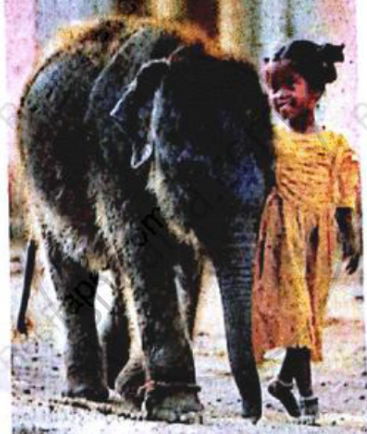
Study the picture given below. Write a story or a description or an account of what it suggests to you. Your composition may be about the subject of the picture or you may take suggestions from it; however, there must be a clear connection between the picture and your composition.
Give reasons for the following.
List the advances in technology that have improved forensic analysis.
Distinguish between the following pairs of sentences.
The team played the two matches successfully.
The traits of the characters you meet in the extract are jumbled. Sort them out and write them in the appropriate columns.
(Shy, bold, gruff, friendly, withdrawn, perceptive, empathetic, playful, lonely, happy, gentlemanly, frank, mature, dull, sharp, adventurous.)
| Jo | Laurie | Grandpa |
‘Even small things in nature play a big role. So protect nature!’
Frame some slogans based on the above topic.
'Agriculture is the backbone of the Indian economy'. Fill in the boxes supporting this statement. Complete the following web diagram.
In the play, two devices that make use of wheels are given. The devices are:
- _______________
- _______________
From the internet or other sources, trace the history of the use of the wheel. Write ‘An Autobiography of a Wheel’.
Imagine Taffy comes to you for help to write a letter of apology, in the modern script we use. She wants to express her regret to the stranger-man for her mother’s action. Write that letter of apology (informal) on her behalf.
When you open a savings account at the bank you need to fill up Deposit forms/slips. Observe the following forms and fill up your details.

Prepare and present a short speech on the following.
An inspiring incident in the life of a great leader.
Create a poster for the following.
Say ‘No to Drugs’ – Design a poster for it is not more than 50 words. You may use slogans/ phrases.
“I met you yesterday.” Sam told me that he had met me ______
“I will pay tomorrow.” He said that he would pay ______.
The red tea cups are filled with a particular word. Fill in the yellow tea cups with similar sounding words. Note the example given.

In the sentence below the capital letter, comma, full stop and question mark are missing. Put these in the correct place.
on monday i will go to school
Find out stories about other great people’s lives and their childhood and write these in your notebook. Collect at least two such stories and share them with your friends.
You could think of famous
- scientists
- religious people
- freedom fighters
- brave children
- astronauts
- artists
How is school education in the village different from that in the city?
Why was Miss Meadows upset and dejected?
Briefly explain the cause of Miss Meadows' joy at the end.
Aunt Jane seemed to think that there was a mistake in the wedding present she had given Jack. Why?
Write a composition in approximately 350 – 400 words on the following subject:
(You are reminded that you will be rewarded for orderly and coherent presentation of material, use of appropriate style and general accuracy of spelling, punctuation, and grammar.)
Online education during the pandemic has been a blessing in disguise.
Give your views on the above statement.
Write the full form for the following.
wasn’t - ______
Write letter to your father asking permission to go on a educational tour.
Suppose a foreigner comes to visit your place and you have to accompany him for sightseeing. Prepare a dialogue between you and the foreigner.
Write points and counterpoints on the following topic:
You should study all subjects in your mother tongue
Write a letter to your father asking permission to go on an educational tour.
