Advertisements
Advertisements
प्रश्न
Depict the galvanic cell in which the reaction \[\ce{Zn(s) + 2Ag+(aq) → Zn^{2+}(aq) + 2Ag(s)}\] takes place. Further show:
- Which of the electrode is negatively charged?
- The carriers of the current in the cell.
- Individual reaction at each electrode.
Advertisements
उत्तर
The set-up will be similar to as shown below:
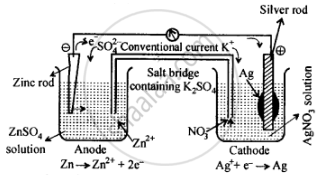
The cell will be represented as:
\[\ce{Zn(s) | Zn^{2+}(aq) || Ag^+(aq) | Ag(s)}\]
- Anode, i.e., zinc electrode, will be negatively charged.
- The current will flow from silver to zinc in the external circuit.
- At anode: \[\ce{Zn(s) -> Zn^{2+}(aq) + 2e–}\]
At cathode: \[\ce{Ag+(aq) + e– -> Ag(s)}\]
APPEARS IN
संबंधित प्रश्न
Draw a neat and well labelled diagram of primary reference electrode.
Can copper sulphate solution be stored in an iron vessel? Explain.
Calculate emf of the following cell at 25°C:
\[\ce{Sn/Sn^2+ (0.001 M) || H+ (0.01 M) | H2_{(g)} (1 bar) | Pt_{(s)}}\]
Given: \[\ce{E^\circ(Sn^2+/sn) = -0.14 V, E^\circ H+/H2 = 0.00 V (log 10 = 1)}\]
Calculate e.m.f of the following cell at 298 K:
2Cr(s) + 3Fe2+ (0.1M) → 2Cr3+ (0.01M) + 3 Fe(s)
Given: E°(Cr3+ | Cr) = – 0.74 VE° (Fe2+ | Fe) = – 0.44 V
In the representation of the galvanic cell, the ions in the same phase are separated by a _______.
Galvanic or a voltaic cell converts the chemical energy liberated during a redox reaction to ____________.
Standard electrode potential is measured taking the concentrations of all the species involved in a half-cell is ____________.
Standard hydrogen electrode operated under standard conditions of 1 atm H2 pressure, 298 K, and pH = 0 has a cell potential of ____________.
The positive value of the standard electrode potential of Cu2+/Cu indicates that:
(i) this redox couple is a stronger reducing agent than the H+/H2 couple.
(ii) this redox couple is a stronger oxidising agent than H+/H2 .
(iii) Cu can displace H2 from acid.
(iv) Cu cannot displace H2 from acid.
What does the negative sign in the expression `"E"^Θ ("Zn"^(2+))//("Zn")` = − 0.76 V mean?
Value of standard electrode potential for the oxidation of \[\ce{Cl-}\] ions is more positive than that of water, even then in the electrolysis of aqueous sodium chloride, why is \[\ce{Cl-}\] oxidised at anode instead of water?
Consider the figure and answer the following question.
If cell ‘A’ has ECell = 0.5V and cell ‘B’ has ECell = 1.1V then what will be the reactions at anode and cathode?
Represent the cell in which the following reaction takes place.The value of E˚ for the cell is 1.260 V. What is the value of Ecell?
\[\ce{2Al (s) + 3Cd^{2+} (0.1M) -> 3Cd (s) + 2Al^{3+} (0.01M)}\]
The emf of a galvanic cell, with electrode potential of Zn2+ = - 0.76 V and that of Cu2+ = 0.34 V, is ______.
