Advertisements
Advertisements
प्रश्न
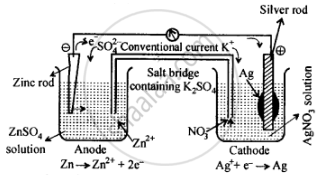
Depict the galvanic cell in which the reaction \[\ce{Zn(s) + 2Ag+(aq) → Zn^{2+}(aq) + 2Ag(s)}\] takes place. Further show:
- Which of the electrode is negatively charged?
- The carriers of the current in the cell.
- Individual reaction at each electrode.
Advertisements
उत्तर
The set-up will be similar to as shown below:

The cell will be represented as:
\[\ce{Zn(s) | Zn^{2+}(aq) || Ag^+(aq) | Ag(s)}\]
- Anode, i.e., zinc electrode, will be negatively charged.
- The current will flow from silver to zinc in the external circuit.
- At anode: \[\ce{Zn(s) -> Zn^{2+}(aq) + 2e–}\]
At cathode: \[\ce{Ag+(aq) + e– -> Ag(s)}\]
APPEARS IN
संबंधित प्रश्न
Calculate Ecell and ΔG for the following at 28°C :
Mg(s) + Sn2+( 0.04M ) → Mg2+( 0.06M ) + Sn(s)
E°cell = 2.23V. Is the reaction spontaneous ?
Calculate E°cell for the following reaction at 298 K:
2Al(s) + 3Cu+2(0.01M) → 2Al+3(0.01M) + 3Cu(s)
Given: Ecell = 1.98V
Calculate emf of the following cell at 25°C:
\[\ce{Sn/Sn^2+ (0.001 M) || H+ (0.01 M) | H2_{(g)} (1 bar) | Pt_{(s)}}\]
Given: \[\ce{E^\circ(Sn^2+/sn) = -0.14 V, E^\circ H+/H2 = 0.00 V (log 10 = 1)}\]
Calculate e.m.f of the following cell at 298 K:
2Cr(s) + 3Fe2+ (0.1M) → 2Cr3+ (0.01M) + 3 Fe(s)
Given: E°(Cr3+ | Cr) = – 0.74 VE° (Fe2+ | Fe) = – 0.44 V
Calculate emf of the following cell at 25 °C :
Fe|Fe2+(0.001 M)| |H+(0.01 M)|H2(g) (1 bar)|Pt (s)
E°(Fe2+| Fe)= −0.44 V E°(H+ | H2) = 0.00 V
Calculate e.m.f. and ∆G for the following cell:
Mg (s) |Mg2+ (0.001M) || Cu2+ (0.0001M) | Cu (s)
`"Given :" E_((Mg^(2+)"/"Mg))^0=−2.37 V, E_((Cu^(2+)"/"Cu))^0=+0.34 V.`
In the representation of the galvanic cell, the ions in the same phase are separated by a _______.
Galvanic or a voltaic cell converts the chemical energy liberated during a redox reaction to ____________.
Standard electrode potential is measured taking the concentrations of all the species involved in a half-cell is ____________.
Which cell will measure standard electrode potential of copper electrode?
The difference between the electrode potentials of two electrodes when no current is drawn through the cell is called ______.
Use the data given in below find out which of the following is the strongest oxidising agent.
`"E"_("Cr"_2"O"_7^(2-)//"Cr"^(3+))^⊖`= 1.33 V `"E"_("Cl"_2//"Cl"^-)^⊖` = 1.36 V
`"E"_("MnO"_4^-//"Mn"^(2+))^⊖` = 1.51 V `"E"_("Cr"^(3+)//"Cr")^⊖` = - 0.74 V
The positive value of the standard electrode potential of Cu2+/Cu indicates that:
(i) this redox couple is a stronger reducing agent than the H+/H2 couple.
(ii) this redox couple is a stronger oxidising agent than H+/H2 .
(iii) Cu can displace H2 from acid.
(iv) Cu cannot displace H2 from acid.
Consider the figure and answer the following question.
If cell ‘A’ has ECell = 0.5V and cell ‘B’ has ECell = 1.1V then what will be the reactions at anode and cathode?
The potential of a hydrogen electrode at PH = 10 is
Standard reduction potentials (E°) of Cd2+, respectively which is the strongest reducing agent
The emf of a galvanic cell, with electrode potential of Zn2+ = - 0.76 V and that of Cu2+ = 0.34 V, is ______.