Advertisements
Advertisements
प्रश्न
Define work.
Define the term work
Advertisements
उत्तर
The work done by a force on a body is equal to the product of the force applied and the distance moved by the body in the direction of force i.e.,
Work done = Force × distance moved in the direction of force
APPEARS IN
संबंधित प्रश्न
A coolie is moving on a road with a luggage on his head. Does he perform work against the force of gravity? Give reason for your answer.
State two factors on which the work done on a body depends.
What are the two kinds of mechanical energy?
Give reasons for the following. No work is done if a man is pushing against a wall.
Express joule in terms of erg.
Differentiate between energy and power.
A machine raises a load of 750 N through a height of 16 m in 5 s. calculate:
- energy spent by machine,
- power at which the machine works.
.A man raises a box of mass 50kg to a height of 2m in 20s, while another man raises the same box to the same height in 50s. Compare:
(i) the work done, and
(ii) the power developed by them.
A body of mass 5 kg falls from a height of 10 m to 4 m. Calculate:
The loss in potential energy of the body,
A bullet of mass 0.5 kg slows down from a speed of 5 m s-1 to that of 3 m s-1. Calculate the change in kinetic energy of the ball.
If the work done by a force in moving an object through a distance of 20 cm is 24.2 J, what is the magnitude of the force?
A person of mass 50 kg climbs a tower of height 72 metres. Calculate the work done. (g = 9.8 m s−2).
What happens to the work done when the dispacement of body is at right angles to the direction of force acting on it? Explain your answer.
A girl weighing 400 N climbs a vertical ladder. If the value of g be 10 m s−2, the work by her after climbing 2 m will be :
Is the motion of moon around the earth in circular path an accelerated motion?
Define 'joule'.
Distinguish between work and power.
Complete the following sentences:
Kilowatt is the unit of ....... and kWh is the unit of
An object is dropped from a height H. when is its
(i) P.E. maximum,
(ii) K.E. maximum,
(iii) P.E. = K.E.?
A 100 W electric lamp emits energy in the form of light at the rate 10 J per second. What percentage of electric energy does the lamp transform into light energy?
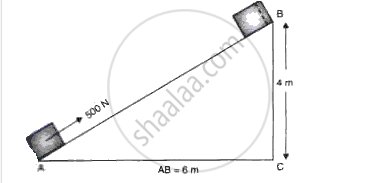
A block of mass 20 kg is pulled up a slope (fig.12) with a constant speed by applying a force of 500 N parallel to the slope. A and B are initial and final positions of the block.
(a) Calculate the work done by the force in moving the block from A and B.
(b) Calculate the potential energy gained by the block.
State the energy changes which take place when A piece of magnesium wire is burnt in a jar of oxygen.
State the amount of work done by an object when it moves in a circular path for one complete rotation. Give a reason to justify your answer.
Explain, why submarines are able to dive underwater as well as a sail on the surface of the water?
A block of mass 30 kg is pulled up a slope, as shown in diagram with a constant speed, by applying a force of 200 N parallel to slope.
A and B are initial and final positions of block.

(i) Calculate the work done by force in moving the block from A to B.
(ii) Calculate P.E. gained by block. [g=10ms-2]
Look at the activity below. Reason out whether or not work is done in the light of your understanding of the term ‘work’.
A wind-mill is lifting water from a well.
A proton is kept at rest. A positively charged particle is released from rest at a distance d in its field. Consider two experiments; one in which the charged particle is also a proton and in another, a positron. In the same time t, the work done on the two moving charged particles is ______.
State whether work is done or not, by writing yes or no, in the following case:
A man pushes a wall.
