Advertisements
Advertisements
प्रश्न
Define the following term:
Osmoregulation
Advertisements
उत्तर
The kidney while removing wastes like urea from the blood also regulates its composition, i.e., the percentage of water and salts. This function is called osmoregulation.
APPEARS IN
संबंधित प्रश्न
Match structures given in Column I with functions given in Column II.
| Column I | Column II | ||
| (i) | Stomata | (a) | Absorption of water |
| (ii) | Xylem | (b) | Transpiration |
| (iii) | Root hairs | (c) | Transport of food |
| (iv) | Phloem | (d) | Transport of water |
| (e) | Synthesis of carbohydrates |
The diagram given below shows the male urinogenital system of a human being. Study the diagram and answer the questions that follow:

(i) Label the parts numbered 1 to 8.
(ii) Name the corresponding structure of part (4) in female reproductive system.
(iii) What is the role of part 7?
The diagram given alongside is that of a structure present in a human kidney:
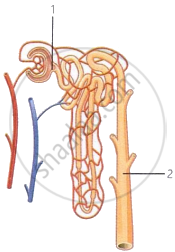
Study the same and answer the questions that follow:
- Name the structure represented in the diagram.
- What is the liquid entering part ‘1’ called?
Name two substances present in this liquid that are reabsorbed in the tubule - What is the fluid that comes to part ‘2’ called? Name the main nitrogenous waste in it.
- Mention the three main steps involved in the formation of the fluid mentioned in (c) above.
- Name the substance which may be present in the fluid in part ‘2’ if a person suffers from Diabetes mellitus
The excretory unit in the human excretory system is called ______.
Why is excretion necessary in living beings?
Explain in your own words with suitable examples.
How does excretion occur in human beings?
Choose the correct answer:
The smallest functional unit of the kidney is ____________
Write the functional activity of the following structure: Vasopressin
Give two examples of the following:
Nitrogenous waste
