मराठी

Construct a Combined Histogram and Frequency Polygon for the Following Frequency Distribution: - Mathematics

Advertisements
Advertisements

प्रश्न

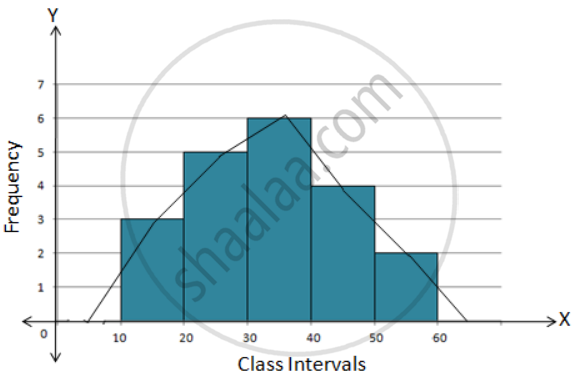
Construct a combined histogram and frequency polygon for the following frequency distribution:

Class-Intervals 10 - 20 20 - 30 30 - 40 40 - 50 50 - 60
Frequency 3 5 6 4 2
आलेख
बेरीज
Advertisements

उत्तर

Steps:

1. Draw a histogram for the given data.

2. Mark the mid-point at the top of each rectangle of the histogram drawn.

3. Also, mark the mid-point of the immediately lower class-interval and mid-point of the immediately higher class-interval.

4. Join the consecutive mid-point marked by straight lines to obtain the required frequency polygon.

5. The require combined histogram and frequency polygon are shown in the following figure:
shaalaa.com
  या प्रश्नात किंवा उत्तरात काही त्रुटी आहे का?
पाठ 18: Statistics - Exercise 18 (B) [पृष्ठ २३३]

APPEARS IN

सेलिना Concise Mathematics [English] Class 9 ICSE
पाठ 18 Statistics
Exercise 18 (B) | Q 2 | पृष्ठ २३३

संबंधित प्रश्‍न

The following data on the number of girls (to the nearest ten) per thousand boys in different sections of Indian society is given below.

Section Number of girls per thousand boys
Scheduled Caste (SC) 940
Scheduled Tribe (ST) 970
Non SC/ST 920
Backward districts 950
Non-backward districts 920
Rural 930
Urban 910
  1. Represent the information above by a bar graph.
  2. In the classroom discuss what conclusions can be arrived at from the graph.

Read the following bar graph and answer the following questions:

(i) What information is given by the bar graph?
(ii) Which state is the largest producer of rice?
(iii) Which state is the largest producer of wheat?
(iv) Which state has total production of rice and wheat as its maximum?
(v) Which state has the total production of wheat and rice minimum?


Read the bar graph given in Fig. 23.20 and answer the fol1owing questions:

(i) What information is given by the bar graph?
(ii) What was the expenditure on health and family planning in the year 1982-83?
(iii) In which year is the increase in expenditure maximum over the expenditure in previous year? What is the maximum increase?


Explain the reading and interpretation of bar graphs.


The following bar graph shows the results of an annual examination in a secondary school. Read the bar graph  and choose the correct alternative in each of the following:

(i) The pair of classes in which the results of boys and girls are inversely proportional are:
(a) VI, VIII (b) VI, IX (c) VIII, IX (d) VIII, X
(ii) The class having the lowest failure rate of girls is
(a) VII (b) X (c) IX (d) VIII
(iii)The class having the lowest pass rate of students is
(a) VI (b) VII (c) VIII (d) IX


The following table shows the interest paid by a company (in lakhs):

Year 1995-96 1996-97 1997-98 1998-99 1999-2000
Interest (in lakhs of rupees 20 25 15 18 30

Draw the bar graph to represent the above information.


The following tables gives the quantity of goods (in crore tonnes)

Year 1950-51 1960-61 1965-66 1970-71 1980-81 1982-83
Quantity of Goods
(in crore tonnes)
9   16 20 20 22 26
Represent this information with the help of a bar graph.
Explain through the bar graph if the quantity of goods carried by the Indian Railways in 1965-66 is more than double the quantity of goods carried in the year 1950-51.

In a frequency distribution, ogives are graphical representation of


In a histogram the class intervals or the group are taken along


Manoj appeared for ICSE examination 2018 and secured percentage of marks as shown in the following table:

Subject Hindi English Maths Science Social Study
Marks as percent 60 45 42 48 75

Represent the above data by drawing a suitable bar graph.


Share
Notifications

Englishहिंदीमराठी


      Forgot password?
Use app×