Advertisements
Advertisements
प्रश्न
Can you think of any scientists, who have also been statesmen?
Advertisements
उत्तर
There have been many other scientists who have ventured into the field of politics. Some of them are Benjamin Franklin, Stephen Chu and Claude Allègre.
(The list is only indicative. It is strongly recommended that students prepare the answer on their own.)
संबंधित प्रश्न
Answer the following question in one or two sentences.
Who were the people in Kezia’s family?
Here are some words with silent letters. Learn their spelling. Your teacher will dictate these words to you. Write them down and underline the silent letters.
| knock | wrestle | walk | wrong |
| knee | half | honest | daughter |
| hours | return | hornet | calm |
| could | sign | island | button |
After you have made a choice do you always think about what might have been, or do you accept the reality?
Thinking about the Poem
In stanza 1, find five ways in which we all are alike. Pick out the words.
Some are meet for a maiden's wrist,
Silver and blue as the mountain mist,
Some are flushed like the buds that dream
On the tranquil brow of a woodland stream,
Some are aglow with the bloom that cleaves
To the limpid glory of new born leaves
Read the lines given above and answer the question that follow.
Explain ‘silver and blue as the mountain mist’
The horse was nearly life-size, moulded out of clay, baked, burnt, and brightly coloured, and reared its head proudly, prancing its forelegs in the air and flourishing its tail in a loop; beside the horse stood a warrior with scythelike mustachios, bulging eyes, and aquiline nose. The old image-makers believed in indicating a man of strength by bulging out his eyes and sharpening his moustache tips, and also decorated the man’s chest with beads which looked today like blobs of mud through the ravages of sun and wind and rain (when it came), but Muni would insist that he had known the beads to sparkle like the nine gems at one time in his life.
Read the extract given below and answer the question that follow.
Why had the image makers given the warrior bulging eyes and aquiline nose?
“I love the West,” said the girl irrelevantly. Her eyes were shining softly. She looked away out the car window. She began to speak truly and simply without the gloss of style and manner: “Mamma and I spent the summer in Deliver. She went home a week ago
because father was slightly ill. I could live and be happy in the West. I think the air here agrees with me. Money isn’t everything. But people always misunderstand things and remain stupid—” “Say, Mr. Marshal,” growled the glum-faced man. “This isn’t quite fair. I’m needing a drink, and haven’t had a smoke all day. Haven’t you talked long enough? Take me in the smoker now, won’t you? I’m half dead for a pipe.”
The bound travellers rose to their feet, Easton with the Same slow smile on his face. “I can’t deny a petition for tobacco,” he said, lightly. “It’s the one friend of the unfortunate. Good-bye, Miss Fairchild. Duty calls, you know.” He held out his hand for a farewell. “It’s too bad you are not going East,” she said, reclothing herself with manner and style. “But you must go on to Leavenworth, I suppose?” “Yes,” said Easton, “I must go on to Leavenworth.”
The two men sidled down the aisle into the smoker. The two passengers in a seat near by had heard most of the conversation. Said one of them: “That marshal’s a good sort of chap. Some of these Western fellows are all right.” “Pretty young to hold an office like that, isn’t he?” asked the other. “Young!” exclaimed the first speaker, “why—Oh! didn’t you catch on? Say—did you ever know an officer to handcuff a prisoner to his right hand?”
Read the extract given below and answer the question that follow.
What ironical twist is revealed by the other passenger in the end?
Beside him in the shoals as he lay waiting glimmered a blue gem. It was not a gem, though: it was sand—?worn glass that had been rolling about in the river for a long time. By chance, it was perforated right through—the neck of a bottle perhaps?—a blue bead. In the shrill noisy village above the ford, out of a mud house the same colour as the ground came a little girl, a thin starveling child dressed in an earth—?coloured rag. She had torn the rag in two to make skirt and sari. Sibia was eating the last of her meal, chupatti wrapped round a smear of green chilli and rancid butter; and she divided this also, to make
it seem more, and bit it, showing straight white teeth. With her ebony hair and great eyes, and her skin of oiled brown cream, she was a happy immature child—?woman about twelve years old. Bare foot, of course, and often goosey—?cold on a winter morning, and born to toil. In all her life, she had never owned anything but a rag. She had never owned even one anna—not a pice.
Why does the writer mention the blue bead at the same time that the crocodile is introduced?
Ans. The author mentions the blue bead at the same time that the crocodile is introduced to create suspense and a foreshadowing of the events’to happen.
Read the extract given below and answer the question that follow.
Describe the blue bead.
Why was everyone in the Control Room greatly excited?
What did Mr Nath thought Nishad had come to his place the second time for?
Why did the python help Golu?
When and how did Timothy become unfriendly?
Do you think the man would ever come back to pick up the watch?
What surprises do the meadows have to offer you?
Why do you think the child ran away on seeing the snake?
There are twelve words hidden in this table. Six can be found horizontally and the remaining six vertically. All of them are describing words like ‘good’, ‘happy’, etc. The first letters of the words are given below:
Horizontal: H R F F S G
Vertical: A W S F L Q 2020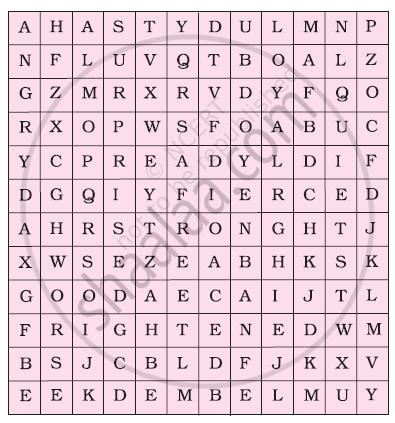
Find pictures of beautiful things you have seen or heard of.
Here the child wants to become _______.
Use the word, ‘run’ in a sentence of your own.
The Medicine Bag traces the narrator’s attitude to his Sioux Grandfather, from mild embarrassment to appreciation. Summarise the reasons for this embarrassment and the change. Write your answer in 100-150 words incorporating the following details.
- Reasons for embarrassment
- Specific reasons for the change in attitude
