Advertisements
Advertisements
प्रश्न
Answer the following question in one or two sentences.
Why was Kezia afraid of her father?
Advertisements
उत्तर
Kezia was afraid of her father because he was very strict who always used to give commands to everybody else in the house. He never played with her. He had big hands and heavy face especially his mouth when he yawned were big and she was especially terrified with the manner in which he looked at her over his spectacles.
संबंधित प्रश्न
Thinking about the Text
Here are some headings for paragraphs in the text. Write the number(s) of the
paragraph(s) for each title against the heading. The first one is done for you.
| (i) | Einstein’s equation 9 |
| (ii) | Einstein meets his future wife |
| (iii) | The making of a violinist |
| (iv) | Mileva and Einstein’s mother |
| (v) | A letter that launched the arms race |
| (vi) | A desk drawer full of ideas |
| (vii) | Marriage and divorce |
Thinking about the Poem
What do the following phrases mean to you? Discuss in class.
(i) humid shadows
(ii) starry spheres
(iii) what a bliss
(iv) a thousand dreamy fancies into busy being start
(v) a thousand recollections weave their air-threads into woof
Why do the courtiers call the prince ‘the Happy Prince’? Is he really happy? What does he see all around him?
Reporting verbs
Did you know?
Sometimes it is not necessary to report everything that is said word for word. It may be better to use “reporting verbs” which summarise what was communicated. Below are some of the most commonly used verbs of this kind.
| accept | advice | apologise | ask | assure | blame |
| complain | compliment | congratulate | explain | greet | hope |
| introduce | invite | offer | order | persuade | promise |
| refuse | regret | remind | say | suggest | tell |
| sympathise | thank | threaten | answer | warn | encourage |
|
A |
B | C |
|
can you hear me? (speaker) |
what did she say? (you) | she asked if you could hear her? (friend) (ask) |
| you should go to the doctor now? (speaker) | what did he say? (you) | he advice you to go to the doctor now? (friend) (advice) |
It was a summer evening,
Old Kaspar's work was done,
And he before his cottage door
Was sitting in the sun,
And by him sported on the green
His little grandchild Wilhelmine.
She saw her brother Peterkin
Roll something large and round,
Which he beside the rivulet
In playing there had found;
He came to ask what he had found,
That was so large, and smooth, and round.
Read the lines given above and answer the question that follow.
What did Peterkin find?
“You haven’t brought home that sick brat!” Anger and astonishment were in the tones of Mrs. Joe Thompson; her face was in a flame.
“I think women’s hearts are sometimes very hard,” said Joe. Usually Joe Thompson got out of his wife’s way, or kept rigidly silent and non-combative when she fired up on any subject; it was with some surprise, therefore, that she now encountered a firmly-set countenance and a resolute pair of eyes.
“Women’s hearts are not half so hard as men’s!”
Joe saw, by a quick intuition, that his resolute bearing h«d impressed his wife and he answered quickly, and with real indignation, “Be that as it may, every woman at the funeral turned her eyes steadily from the sick child’s face, and when the cart went off with her dead mother, hurried away, and left her alone in that old hut, with the sun not an hour in the sky.”
“Where were John and Kate?” asked Mrs. Thompson.
“Farmer Jones tossed John into his wagon, and drove off. Katie went home with Mrs. Ellis; but nobody wanted the poor sick one. ‘Send her to the poorhouse,’ was the cry.”
“Why didn’t you let her go, then. What did you bring her here for?”
“She can’t walk to the poorhouse,” said Joe; “somebody’s arms must carry her, and mine are strong enough for that task.”
Read the extract given below and answer the question that follow.
What was Mrs. Thompson’s reaction on seeing Maggie?
When Mabel Dancy later requests De Levis to withdraw the charge, how does he respond? What declaration does Dancy wish De Levis to sign?
Why did it make Mr. Purcell feel “vaguely insulted”?
Imagine you are the king. Narrate the incident of your meeting the hermit. Begin like this: The wise men answered my questions, but I was not satisfied with their answers. One day I decided to go and meet the hermit.
Why did the lady chain the bear on Sundays?
What impressed the king when he spent a night in the cave?
What does the last sentence of the story suggest? What would the crocodile tell his wife?
What does the phrase, “he ran as still as Water” mean?
State an adjective used to describe the tree.
There are twelve words hidden in this table. Six can be found horizontally and the remaining six vertically. All of them are describing words like ‘good’, ‘happy’, etc. The first letters of the words are given below:
Horizontal: H R F F S G
Vertical: A W S F L Q 2020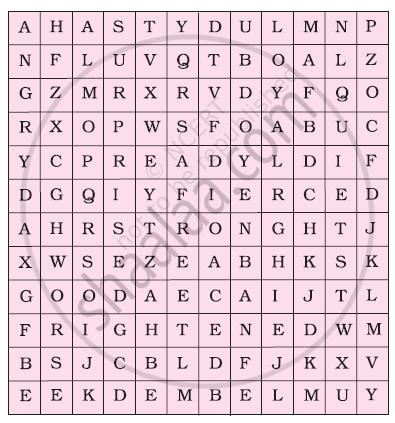
What does the writer say about the friendship between man and dog?
Answer the following question:
Why did Taro run in the direction of the stream?
Multiple Choice Question:
What does the word harvest mean?
What is the mystery about the child’s school teacher? How does it plan to discover the truth?
Can there be a good reason behind speaking when everybody else is silent?
