Advertisements
Advertisements
प्रश्न
An organic compound 'A' with the molecular formula C4H8O2 undergoes acid hydrolysis to form two compounds 'B' and 'C'. Oxidation of 'C' with acidified potassium permanganate also produces 'B'. Sodium salt of 'B' on heating with soda lime gives methane.
- Identify 'A', 'B' and 'C'.
- Out of 'B' and 'C', which will have higher boiling point? Give reason.
Advertisements
उत्तर
- A = C4H8O2 [CH3COOC2H5] ester Reactions involved are
\[\ce{\underset{A}{CH3-COOC2H5} + H2O ->[dil H2SO4] \underset{B}{CH3COOH} + \underset{C}{CH3CH2OH}}\]
Then
\[\ce{\underset{C}{CH3CH2OH} ->[KMnO4][{[O]}] \underset{B}{CH3COOH}}\]
So A = CH3COOC2H5, B = CH3COOH, C = CH3CH2OH - B has a higher boiling point than C. Because of their propensity to generate intermolecular H-bonds, carboxylic acids have higher boiling temperatures than alcohols.
APPEARS IN
संबंधित प्रश्न
Predict the products of the following reactions :

How will you convert ethanal into the following compound?
But-2-enoic acid
Give a simple chemical test to distinguish between the following pair of compounds:
Phenol and Benzoic acid
Oxidation of ketones involves carbon-carbon bond cleavage. Name the products formed on oxidation of 2, 5-dimethylhexan-3-one.
Which sugar does not reduce Fehling's solution?
Acetone and acetaldehyde are differentiated by
Write chemical test to distinguish between the following compounds:
Phenol and Benzoic acid
What is the composition of Fehling's reagent?
The correct set of products obtained in the following reactions:
- \[\ce{RCN ->[reduction]}\]
- \[\ce{RCN ->[(i) CH3MgBr][(ii) H2O]}\]
- \[\ce{RNC ->[hydrolysis]}\]
- \[\ce{RNH2 ->[HNO2]}\]
Match List-I with List-II:
| List-I (Reaction) |
List-II (Reagents/Condition) |
||
| A. | 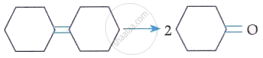 |
I. | 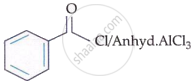 |
| B. | 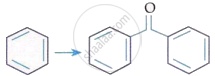 |
II. | CrO3 |
| C. | 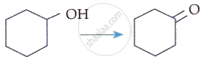 |
III. | KMnO4/KOH, Δ |
| D. | 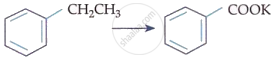 |
IV. | (i) O3 (ii) Zn-H2O |
Choose the correct answer from the options given below:
