Advertisements
Advertisements
प्रश्न
ABCD is a parallelogram with vertices \[A ( x_1 , y_1 ), B \left( x_2 , y_2 \right), C ( x_3 , y_3 )\] . Find the coordinates of the fourth vertex D in terms of \[x_1 , x_2 , x_3 , y_1 , y_2 \text{ and } y_3\]
Advertisements
उत्तर
Suppose the coordinates of D be (x, y).
Since diagonals of a parallelogram bisect each other.
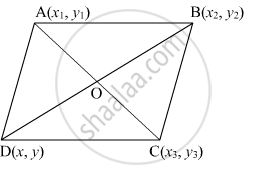
Therefore the midpoint of AC is the midpoint of BD, i.e
\[\Rightarrow x_1 + x_3 = x_2 + x \text{ and } y_1 + y_3 = y_2 + y\]
\[ \Rightarrow x = x_1 + x_3 - x_2 \text{ and } y = y_1 + y_3 - y_2 \]
\[\text{ Thus coordinates of D are } \left( x_1 + x_3 - x_2 , y_1 + y_3 - y_2 \right)\]
APPEARS IN
संबंधित प्रश्न
Find the coordinates of the circumcentre of the triangle whose vertices are (3, 0), (-1, -6) and (4, -1). Also, find its circumradius.
Find a point on the x-axis which is equidistant from the points (7, 6) and (−3, 4).
Find the co-ordinates of the point which divides the join of A(-5, 11) and B(4,-7) in the ratio 7 : 2
Points P, Q, R and S divide the line segment joining the points A(1,2) and B(6,7) in five equal parts. Find the coordinates of the points P,Q and R
Find the ratio in which the point P(m, 6) divides the join of A(-4, 3) and B(2, 8) Also, find the value of m.
If the point `P (1/2,y)` lies on the line segment joining the points A(3, -5) and B(-7, 9) then find the ratio in which P divides AB. Also, find the value of y.
Find the area of the triangle formed by joining the midpoints of the sides of the triangle whose vertices are A(2,1) B(4,3) and C(2,5)
If the point P(x, 3) is equidistant from the point A(7, −1) and B(6, 8), then find the value of x and find the distance AP.
Show that A (−3, 2), B (−5, −5), C (2,−3), and D (4, 4) are the vertices of a rhombus.
Find the value of k, if the points A(7, −2), B (5, 1) and C (3, 2k) are collinear.
If the point P (m, 3) lies on the line segment joining the points \[A\left( - \frac{2}{5}, 6 \right)\] and B (2, 8), find the value of m.
Find the value of a for which the area of the triangle formed by the points A(a, 2a), B(−2, 6) and C(3, 1) is 10 square units.
The perimeter of the triangle formed by the points (0, 0), (0, 1) and (0, 1) is
If three points (0, 0), \[\left( 3, \sqrt{3} \right)\] and (3, λ) form an equilateral triangle, then λ =
The line segment joining points (−3, −4), and (1, −2) is divided by y-axis in the ratio.
If the points P (x, y) is equidistant from A (5, 1) and B (−1, 5), then
If segment AB is parallel Y-axis and coordinates of A are (1, 3), then the coordinates of B are ______
The points (–5, 2) and (2, –5) lie in the ______.
(–1, 7) is a point in the II quadrant.
Assertion (A): The ratio in which the line segment joining (2, -3) and (5, 6) internally divided by x-axis is 1:2.
Reason (R): as formula for the internal division is `((mx_2 + nx_1)/(m + n) , (my_2 + ny_1)/(m + n))`
