Advertisements
Advertisements
प्रश्न
The points \[A \left( x_1 , y_1 \right) , B\left( x_2 , y_2 \right) , C\left( x_3 , y_3 \right)\] are the vertices of ΔABC .
(i) The median from A meets BC at D . Find the coordinates of the point D.
(ii) Find the coordinates of the point P on AD such that AP : PD = 2 : 1.
(iii) Find the points of coordinates Q and R on medians BE and CF respectively such thatBQ : QE = 2 : 1 and CR : RF = 2 : 1.
(iv) What are the coordinates of the centropid of the triangle ABC ?
Advertisements
उत्तर
(i) Median AD of the triangle will divide the side BC in two equal parts.
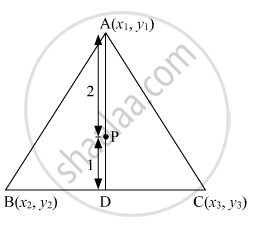
Therefore, D is the midpoint of side BC.
Coordinates of D are \[\left( \frac{x_2 + x_3}{2}, \frac{y_2 + y_3}{2} \right)\]
(ii)THe point P divided the side AD in the ratio 2: 1.
Coordinates of P are \[\left( \frac{2 \times \left( \frac{x_2 + x_3}{2} \right) + 1 \times x_1}{2 + 1}, \frac{2 \times \left( \frac{y_2 + y_3}{2} \right) + 1 \times y_1}{2 + 1} \right) = \left( \frac{x_1 + x_2 + x_3}{3}, \frac{y_1 + y_2 + y_3}{3} \right)\]
(iii)
Median BE of the triangle will divide the side AC in two equal parts.
Therefore, E is the midpoint of side AC.
Coordinates of E are \[\left( \frac{x_1 + x_3}{2}, \frac{y_1 + y_3}{2} \right)\] The point Q divided the side BE in the ratio 2: 1.
Coordinates of Q are \[\left( \frac{2 \times \left( \frac{x_1 + x_3}{2} \right) + 1 \times x_2}{2 + 1}, \frac{2 \times \left( \frac{y_1 + y_3}{2} \right) + 1 \times y_2}{2 + 1} \right) = \left( \frac{x_1 + x_2 + x_3}{3}, \frac{y_1 + y_2 + y_3}{3} \right)\]
Similarly, Coordinates of Q are R are \[\left( \frac{x_1 + x_2 + x_3}{3}, \frac{y_1 + y_2 + y_3}{3} \right)\]
(iv)
The points P, Q and R coincides and is the centroid of the triangle ABC.
So, coordinates of the centroid is \[\left( \frac{x_1 + x_2 + x_3}{3}, \frac{y_1 + y_2 + y_3}{3} \right)\]
APPEARS IN
संबंधित प्रश्न
Find the distance between the following pair of points:
(a, 0) and (0, b)
Find a point on the x-axis which is equidistant from the points (7, 6) and (−3, 4).
Name the quadrilateral formed, if any, by the following points, and given reasons for your answers:
A(-1,-2) B(1, 0), C (-1, 2), D(-3, 0)
Prove that the points A(-4,-1), B(-2, 4), C(4, 0) and D(2, 3) are the vertices of a rectangle.
Determine the ratio in which the point (-6, a) divides the join of A (-3, 1) and B (-8, 9). Also, find the value of a.
Find the coordinates of the midpoints of the line segment joining
P(-11,-8) and Q(8,-2)
Find the area of a quadrilateral ABCD whose vertices area A(3, -1), B(9, -5) C(14, 0) and D(9, 19).
Find the area of the quadrilateral ABCD, whose vertices are A(−3, −1), B (−2, −4), C(4, − 1) and D (3, 4).
In \[∆\] ABC , the coordinates of vertex A are (0, - 1) and D (1,0) and E(0,10) respectively the mid-points of the sides AB and AC . If F is the mid-points of the side BC , find the area of \[∆\] DEF.
If the points A(−2, 1), B(a, b) and C(4, −1) ae collinear and a − b = 1, find the values of aand b.
What is the area of the triangle formed by the points O (0, 0), A (6, 0) and B (0, 4)?
Write the condition of collinearity of points (x1, y1), (x2, y2) and (x3, y3).
Find the area of triangle with vertices ( a, b+c) , (b, c+a) and (c, a+b).
The ratio in which the line segment joining points A (a1, b1) and B (a2, b2) is divided by y-axis is
Find the point on the y-axis which is equidistant from the points (S, - 2) and (- 3, 2).
The line segment joining the points A(2, 1) and B (5, - 8) is trisected at the points P and Q such that P is nearer to A. If P also lies on the line given by 2x - y + k= 0 find the value of k.
In which quadrant, does the abscissa, and ordinate of a point have the same sign?
The coordinates of the point where the line 2y = 4x + 5 crosses x-axis is ______.
Assertion (A): The point (0, 4) lies on y-axis.
Reason (R): The x-coordinate of a point on y-axis is zero.
