Advertisements
Advertisements
प्रश्न
ABCD is a parallelogram with vertices \[A ( x_1 , y_1 ), B \left( x_2 , y_2 \right), C ( x_3 , y_3 )\] . Find the coordinates of the fourth vertex D in terms of \[x_1 , x_2 , x_3 , y_1 , y_2 \text{ and } y_3\]
Advertisements
उत्तर
Suppose the coordinates of D be (x, y).
Since diagonals of a parallelogram bisect each other.
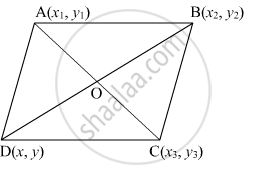
Therefore the midpoint of AC is the midpoint of BD, i.e
\[\Rightarrow x_1 + x_3 = x_2 + x \text{ and } y_1 + y_3 = y_2 + y\]
\[ \Rightarrow x = x_1 + x_3 - x_2 \text{ and } y = y_1 + y_3 - y_2 \]
\[\text{ Thus coordinates of D are } \left( x_1 + x_3 - x_2 , y_1 + y_3 - y_2 \right)\]
APPEARS IN
संबंधित प्रश्न
Find the distance between the following pair of points:
(a, 0) and (0, b)
Two vertices of an isosceles triangle are (2, 0) and (2, 5). Find the third vertex if the length of the equal sides is 3.
The coordinates of the point P are (−3, 2). Find the coordinates of the point Q which lies on the line joining P and origin such that OP = OQ.
Find the centre of the circle passing through (5, -8), (2, -9) and (2, 1).
Name the quadrilateral formed, if any, by the following points, and given reasons for your answers:
A(4, 5) B(7, 6), C (4, 3), D(1, 2)
If the point A (4,3) and B ( x,5) lies on a circle with the centre o (2,3) . Find the value of x.
Points P, Q, and R in that order are dividing line segment joining A (1,6) and B(5, -2) in four equal parts. Find the coordinates of P, Q and R.
If the points P (a,-11) , Q (5,b) ,R (2,15) and S (1,1). are the vertices of a parallelogram PQRS, find the values of a and b.
Find the area of the quadrilateral ABCD, whose vertices are A(−3, −1), B (−2, −4), C(4, − 1) and D (3, 4).
The area of the triangle formed by the points A(2,0) B(6,0) and C(4,6) is
If (0, −3) and (0, 3) are the two vertices of an equilateral triangle, find the coordinates of its third vertex.
Find the value(s) of k for which the points (3k − 1, k − 2), (k, k − 7) and (k − 1, −k − 2) are collinear.
What is the distance between the points (5 sin 60°, 0) and (0, 5 sin 30°)?
Find the values of x for which the distance between the point P(2, −3), and Q (x, 5) is 10.
The line segment joining points (−3, −4), and (1, −2) is divided by y-axis in the ratio.
The length of a line segment joining A (2, −3) and B is 10 units. If the abscissa of B is 10 units, then its ordinates can be
Point P(– 4, 2) lies on the line segment joining the points A(– 4, 6) and B(– 4, – 6).
If the perpendicular distance of a point P from the x-axis is 5 units and the foot of the perpendicular lies on the negative direction of x-axis, then the point P has ______.
Find the coordinates of the point which lies on x and y axes both.
Assertion (A): The point (0, 4) lies on y-axis.
Reason (R): The x-coordinate of a point on y-axis is zero.
