Advertisements
Advertisements
प्रश्न
A story can have more than one ending. Rewrite the end of the story you have just read. You can begin like this…….. “As he drove home, he felt guilty for having let his children down. He reached home, entered the house and saw his wife and children watching the television…”
Advertisements
उत्तर
As he drove home, he felt guilty for having let his children down. After parking his car, he walked towards his drawing room with heavy steps. He was expecting a strong reaction from his wife and children. But to his utter surprise he saw them engrossed in their favourite programme. Finally, he got some courage to say sorry for being late. Once his wife narrated the whole story of how the boss came and took them to exhibition. It was even more surprising for him. Deep in his heart he developed more respect for his boss.
Empathy of a leader is one of the important characteristics in his character.
APPEARS IN
संबंधित प्रश्न
Following dates were important in Charles Hooper’s life in some way. Complete the table by relating the description with the correct dates:

| Date | Description |
| News spread that Hooper and Duke had made it to an intersection | |
| Hooper walked independently from the clinic to the branch office | |
| Hooper planned to start a full day’s work at office | |
| Duke met with a fatal accident |
Many people are of the opinion that violent, physical sports such as boxing, kick boxing and wrestling, to name a few should be banned while others think otherwise. Express your opinion on the topic by either writing in favour of banning these sports or against banning them. While writing, you should also include the rebuttal to your questions. Try not to go beyond 200 words.
Based on your reading of the story, answer the following questions by choosing
the correct option.
Pescud felt that best-sellers were not realistic as.
The following is a flow chart showing the course of the brook. Can you fill in the
blank spaces with help from the phrases given below?
a) passes under fifty bridges; b) comes from the place where coots and herons live;
c) passes lawns filled with flowers; d) crosses both fertile and fallow land; e) goes
through wilderness full of thorny bushes
Answer the following questions:
How does the brook ‘sparkle’?
On the basis of your understanding of the poem, answer the following question
by ticking the correct choice.
The tone of the speaker in the first stanza is that of ______________.
Answer the following question briefly.
Describe the two roads that the poet comes across.
On the basis of your understanding of the poem, answer the following question
by ticking the correct choice.
The speaker says that she has paved the way for cavities and decay by __________.
Toothache
Doki : Oh! I'm in agony. I didn't sleep a wink last night!
Moki : Why don't you go to a dentist?
Doki : Even thinking about the dentist's waiting room gives me the willies.
Moki : It's because you haven't been to a dentist for ages.
Doki: What a reassuring person you are!
Moki : I'm now going to get Mom. She'll only crack the whip and make you go to the
dentist.
Doki: No, No! I'd better go with you. At least you'd save me from going into the surgery.
Moki : I can only take the horse to the water but I can't make it drink! I'm sure, you're going
to turn tail and go home.
Doki: Don't worry, I shall be led quietly into the dentist like a lamb because my tooth is so
sore.
Moki : If that happens, I would believe that wonders will never cease!
Doki: I wish I had taken proper care of my teeth!
Moki : I wish you had paid attention to the discipline that Mom had laid for all of us!
Doki: Yeah! But past can't be undone. I have to reap what I had sown.
Your teacher will read out the conversation between Doki and his
sister, Moki. As you listen complete the idioms and expressions listed below.(GIVEN ABOVE)
1. sleep…...….............………….
2. ………....……….me the willies
3. crack the…………..............….
4. take the……………….to water
5. …………...................…….tail.
6. wonders will……….........…….
7. ……………….can't be undone.
8. reap what I …………………….
Idioms are metaphorical expressions rather than literal. For example 'give someone
the willies' does not simply mean 'to handover something called willies to someone',
but 'to make someone feel nervous'. It is important for learners of English to
understand them and be able to use them.
The following is a time chart of Amelia's aviation record in her attempt to go around the world. Complete it with the missing dates and events.
| Date | Event |
| 1) June 1, 1937 | |
| 2) | Electra flew to Calcutta |
| 3) June 27 | |
| 4) | Reached Lae in New Guinea. |
| 5) | Amelia left Lae. |
| 6) July 2 (7:20 hrs) | |
| 7) | Amelia made her last radio contact. |
| 8) | Last voice transmissions from Amelia |
| 9) |
Read the following extract and answer the questions that follow by choosing the
correct options.
She sent little Jean to Monseigneur to ask for help.
(a) Who sent little Jean to the Bishop?
(i) Mere Gringoire
(ii) Marie
(iii) Persome
(iv) Marie's mother
(b) Why did she send Jean to the Bishop?
(i) so that he could pray for her.
(ii) as she knew that he was a generous person.
(iii) as she was a greedy woman.
(iv) as she was a poor woman.
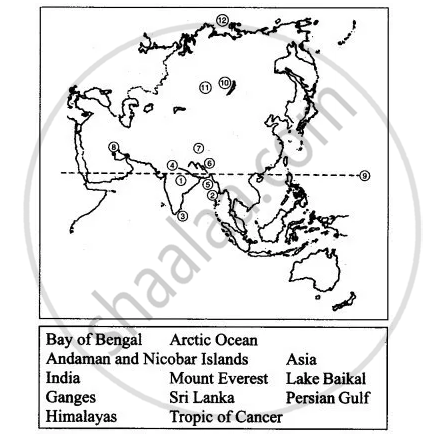
Look at the numbers on the map, and match them with the names given in the box below.
Compounds—someone, nothing etc.
| someone | anyone | none | everyone |
| somebody | anybody | nobody | everybody |
| something | anything | nothing | everything |
| somewhere | anywhere | nowhere | everywhere |
(Words ending with one and body mean the same.)
Fill in the gaps with some of the words from the table above:
- He can’t hear _____ . He’s completely deaf.
- _______ is going blurred. I can’t see!
- He’s looked ______ but he can’t find it.
- It must be _________ ! Look carefully.
- ______ must move or the horse will be scared.
- It doesn’t matter what you wear, ______ will do.
- She is very popular. _______ likes her.
- Shh! There is _____________ moving downstairs.
- Don’t worry! It’s _________ frightening. It is only the wind.
- It’s a public holiday, so____________ is open.
Is there enough variety of content?
Study the following sentences. Select one underlined word which is incorrect. Write the incorrect word in the box below, as shown in the example.
e.g. Sarawak is a beautiful place which lies almost on an Equator and is rich in natural resources.
(a) It has an Equatorial climate that mean it is hot with heavy rains almost every after-noon.
(b) Heavy clouds prevent the sun from heating the ground too intense.
(c) In an interior of Sarawak, there are huge reserves of hardwood timber.
(d) Sarawak is also an oil product.
(e) Great efforts are been made to conserve these resources.
Answer the following question by ticking the correct option.
John Douglas had won quite a reputation for himself in Birlstone because of his __________________
Complete the following passage on Dance by choosing the correct word from the given options. The first one has been done for you.
The fact that dance (a) is an art form is a well known fact. (b) ________ dance as a therapy is not known (c) ________ many. Dance therapy involves a synthesis of the grace and vigour (d) ________ Indian classical and folk dance movements into (e) ________ innovative and holistic therapy. It brings (f) ________ the inner feelings (g) ________ the participants and can help them (h) ________ develop a healthy personality.
| (a) (i) is (ii) been (iii) as (iv) being |
(b) (i) For (ii) Although (iii) But (iv) While |
(c) (i) by (ii) to (iii) in (iv) about |
(d) (i) on (ii) in (iii) of (iv) into |
| (e) (i) the (ii) a (iii) an (iv) as |
(f) (i) in (ii) of (iii) over (iv) out |
(g) (i) about (ii) for (iii) in (iv) of |
(h) (i) with (ii) in (iii) to (iv) into |
Given alongside are the pictures of two boys - Shravan Kumar and Narendra Kumar. (They are not related.) Working with a partner, look at their pictures and predict how each boys lives. Write your answer in points .

| Shravan Kumar | Narendra Kumar |
Choose the right word from the options given below and fill in the blank.
(a) He______________ breakfast yesterday.
(b) There______________orange juice in the refrigerator.
(c) My room can’t be dirty, I ______________it.
(d) Sneha wrote the programme_________ ; she didn’t need anybody’s help.
(e) If you had come to the theatre last night you______________the play.
| (a) (i) not had (ii) didn’t had (iii) didn’t have (iv) hadn’t |
(b) (i) aren’t any (ii) is no any (iii) wasn’t none (iv) isn’t any |
(c) (i) just clean (ii) is just cleaned (iii) has just clean (iv) have just cleaned |
| (d) (i) on her own (ii) on herself (iii) by himself (iv) by her own. |
(e) (i) would enjoy (ii) had enjoyed (iii) would have enjoyed (iv) must have enjoyed |
Adjectives and Prepositions
Look at the table below. Decide which of the adjectives in Column A commonly go with which preposition. Tick the table as shown. (There may be more then one tick for each adjective).
| A | at | to | about | for |
| worried |  |
 |
||
| good | ||||
| bad | ||||
| surprised | ||||
| happy | ||||
| sensitive | ||||
| puzzled | ||||
| married | ||||
| clever | ||||
| suitable | ||||
| curious | ||||
| due | ||||
| qualified | ||||
| famous |
