Advertisements
Advertisements
प्रश्न
A rectangular loop of wire ABCD is kept close to an infinitely long wire carrying a current I(t) = Io (1 – t/T) for 0 ≤ t ≤ T and I(0) = 0 for t > T (Figure). Find the total charge passing through a given point in the loop, in time T. The resistance of the loop is R.

Advertisements
उत्तर
To find the charge that passes through the circuit first we have to find the relation between instantaneous current and instantaneous magnetic flux linked with it. The emf induced can be obtained by differentiating the expression of magnetic flux linked w.r.t. t and then applying Ohm’s law, we get
`I = E/R = 1/R (dphi)/(dt)`
According to the problem electric current is given as a function of time.
`I(t) = (dQ)/(dt)` or `(dQ)/(dt) = 1/R (dphi)/(dt)`
Integrating the variable separately in the form of differential equation for finding the charge Q that passed in time t, we have
`Q(t_1) - Q(t_2) = 1/R[phi(t_1) - phi(t_2)]`
For magnetic flux in rectangle:
Magnetic flux due to current carrying conductor at a distance x'
`Q(t) = (mu_0I(t))/(2pix^')`
If length of strip is L1 so total flux on strip of length L1 at distance x' is
`Q(t) = (mu_0I(t))/(2pix^') L_1`
X' varies from x to (x + L2) so total flux in strip
`phi(t) = mu_0/(2pi) L_1 int_x^(x + L_2) (dx)/x^' I(t) = (mu_0L_1)/(2pi) I(t_1) log_e ((L_2 + x))/x`
The magnetic of charge is given on length L1
`int_Q_1 dQ = 1/R int dphi` from (III)
`int_0^Q dQ = 1/R * (mu_0L_1)/(2pi) log_e ((L_2 + x)/x) int_0^1 I(t_1)`
`Q = (mu_0L_1)/(R2pi) log_e ((L_2 + x)/x)(I - 0) = (mu_0L_1I_1)/(2piR) log ((L_2 + x)/x)`
APPEARS IN
संबंधित प्रश्न
A conducting disc of radius r rotates with a small but constant angular velocity ω about its axis. A uniform magnetic field B exists parallel to the axis of rotation. Find the motional emf between the centre and the periphery of the disc.
An aircraft of wing span of 50 m flies horizontally in the Earth's magnetic field of 6 x 10⁻⁵ T at a speed of 400 m/s. Calculate the emf generated between the tips of the wings of the aircraft.
The emf induced across the ends of a conductor due to its motion in a magnetic field is called motional emf. It is produced due to magnetic Lorentz force acting on the free electrons of the conductor. For a circuit shown in the figure, if a conductor of length l moves with velocity v in a magnetic field B perpendicular to both its length and the direction of the magnetic field, then all the induced parameters are possible in the circuit.
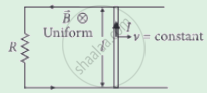
A conducting rod of length l is moving in a transverse magnetic field of strength B with velocity v. The resistance of the rod is R. The current in the rod is ______.
The emf induced across the ends of a conductor due to its motion in a magnetic field is called motional emf. It is produced due to magnetic Lorentz force acting on the free electrons of the conductor. For a circuit shown in the figure, if a conductor of length l moves with velocity v in a magnetic field B perpendicular to both its length and the direction of the magnetic field, then all the induced parameters are possible in the circuit.
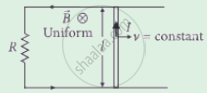
A bicycle generator creates 1.5 V at 15 km/hr. The EMF generated at 10 km/hr is ______.
A circular coil expands radially in a region of magnetic field and no electromotive force is produced in the coil. This can be because ______.
- the magnetic field is constant.
- the magnetic field is in the same plane as the circular coil and it may or may not vary.
- the magnetic field has a perpendicular (to the plane of the coil) component whose magnitude is decreasing suitably.
- there is a constant magnetic field in the perpendicular (to the plane of the coil) direction.
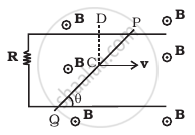
Find the current in the wire for the configuration shown in figure. Wire PQ has negligible resistance. B, the magnetic field is coming out of the paper. θ is a fixed angle made by PQ travelling smoothly over two conducting parallel wires separated by a distance d.
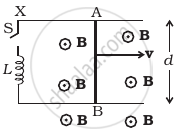
Find the current in the sliding rod AB (resistance = R) for the arrangement shown in figure. B is constant and is out of the paper. Parallel wires have no resistance. v is constant. Switch S is closed at time t = 0.
An aeroplane, with its wings spread 10 m, is flying at a speed of 180 km/h in a horizontal direction. The total intensity of earth's field at that part is 2.5 × 10⁻⁴ Wb/m2 and the angle of dip is 60°. The emf induced between the tips of the plane wings will be ______.
Derive an expression for the total emf induced in a conducting rotating rod.
What is the magnitude of motional emf for the perpendicular arrangement of a straight conductor?
In \[e=Blv\], what does \[v\] represent?
What is the magnitude of the induced EMF when the Faraday's Law derivation gives \[e=-Blv\]?
What Lorentz force does each free electron in the moving rod experience when \[\vec{v}\perp\vec{B}\]?
What happens to motional EMF if \[\vec{v}\parallel\vec{B}\]?
Which orientation gives maximum motional EMF?
For a rotating rod, what is the velocity of a small element at distance \[r\] from the centre?
What is the motional EMF across a small element \[dr\] of a rotating rod?
A wheel rotates at \[120\,\mathrm{rev/min}\]. What is its angular velocity?
