Advertisements
Advertisements
प्रश्न
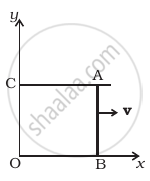
A magnetic field B = Bo sin ( ωt )`hatk` wire AB slides smoothly over two parallel conductors separated by a distance d (Figure). The wires are in the x-y plane. The wire AB (of length d) has resistance R and the parallel wires have negligible resistance. If AB is moving with velocity v, what is the current in the circuit. What is the force needed to keep the wire moving at constant velocity?
Advertisements
उत्तर
In this problem, the emf induced across AB is motional emf due to its motion, and emf induced by change in magnetic flux linked with the loop change due to a change of magnetic field.
In figure CA and OB are long parallel conducting wires, connected by d and conductor CO. The resistance of ACOB is negligible.
Let wire AB at t = 0 is at x = 0 i.e., on Y-axis.
Now AB moves with velocity `vhati`
Let at any time t, position of conductor AB is x(t) = `vhati t`
Motional e.m.f across AB
`V_(AB) = (W_(AB))/q = (D.d)/q = (qvi xx B)/q d`
`V_(AB) = vhati xx B_0 sin ωt. hatk xx d`
⇒ `e_1 = (B_0 sin ωt)vd (-hatj)`
And emf due to change in field (along OBAC)
`e_2 = (d(phi_B))/(dt)`
`phi_B = (B_0 sin ωt)(x(t)d)` ....(where, area A = xd)
`e_2 = - B_0 ω cos wtx(t)d`
Total emf in the circuit = emf due to change in field (along OBAC) + the emotional emf across AB
`e_1 + e_2 = - B_0d [ωx cos (t) + v sin (ωt)]`
The equivalent electrical diagram is shown in the diagram below.

Electric current in clockwise direction is given by
= `(B_0d)/R (ωx cos ωt + v sin ωt)`
The force acting on the conductor is given by F = `ilB` sin 90° = `ilB`
Substituting the values,
`vecF_m = (B_0d)/R (ωx cos ωt + v sin ωt)(d)(B_0 sin ωt)(-hati)`
External force needed on wire is along positive x-axis to keep moving it with constant velocity is given by,
`vecF_(ext) = (B_0^2d^2)/R (ωx cos ωt + v sin ωt)sin ωt(hati)`
This is the required expression for force.
APPEARS IN
संबंधित प्रश्न
A 20 cm long conducting rod is set into pure translation with a uniform velocity of 10 cm s−1 perpendicular to its length. A uniform magnetic field of magnitude 0.10 T exists in a direction perpendicular to the plane of motion. (a) Find the average magnetic force on the free electrons of the rod. (b) For what electric field inside the rod, the electric force on a free elctron will balance the magnetic force? How is this electric field created? (c) Find the motional emf between the ends of the rod.
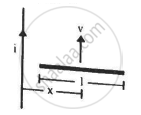
Figure shows a straight, long wire carrying a current i and a rod of length l coplanar with the wire and perpendicular to it. The rod moves with a constant velocity v in a direction parallel to the wire. The distance of the wire from the centre of the rod is x. Find the motional emf induced in the rod.
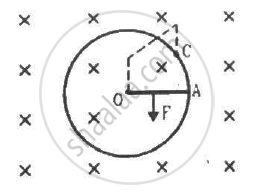
Consider the situation shown in the figure. Suppose the wire connecting O and C has zero resistance but the circular loop has a resistance Runiformly distributed along its length. The rod OA is made to rotate with a uniform angular speed ω as shown in the figure. Find the current in the rod when ∠ AOC = 90°.
A cycle wheel of radius 0.6 m is rotated with constant angular velocity of 15 rad/s in a region of magnetic field of 0.2 T which is perpendicular to the plane of the wheel. The e.m.f generated between its center and the rim is, ____________.
A conducting square loop of side l and resistance R moves in its plane with a uniform velocity v perpendicular to one of its side. A magnetic induction B constant in time and space, pointing perpendicular and into the plane of the loop exists everywhere. The current induced in the loop is ______.
A wire of length 50 cm moves with a velocity of 300 m/min, perpendicular to a magnetic field. If the e.m.f. induced in the wire is 2 V, the magnitude of the field in tesla is ______.
The emf induced across the ends of a conductor due to its motion in a magnetic field is called motional emf. It is produced due to magnetic Lorentz force acting on the free electrons of the conductor. For a circuit shown in the figure, if a conductor of length l moves with velocity v in a magnetic field B perpendicular to both its length and the direction of the magnetic field, then all the induced parameters are possible in the circuit.
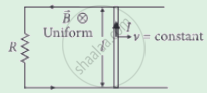
A conducting rod of length l is moving in a transverse magnetic field of strength B with velocity v. The resistance of the rod is R. The current in the rod is ______.
The emf induced across the ends of a conductor due to its motion in a magnetic field is called motional emf. It is produced due to magnetic Lorentz force acting on the free electrons of the conductor. For a circuit shown in the figure, if a conductor of length l moves with velocity v in a magnetic field B perpendicular to both its length and the direction of the magnetic field, then all the induced parameters are possible in the circuit.
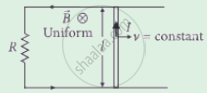
A bicycle generator creates 1.5 V at 15 km/hr. The EMF generated at 10 km/hr is ______.
Find the current in the sliding rod AB (resistance = R) for the arrangement shown in figure. B is constant and is out of the paper. Parallel wires have no resistance. v is constant. Switch S is closed at time t = 0.
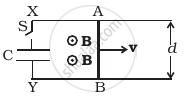
A wire of length 1 m moving with velocity 8 m/s at right angles to a magnetic field of 2 T. The magnitude of induced emf, between the ends of wire will be ______.
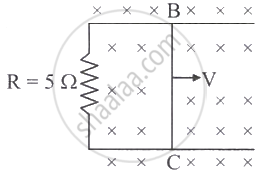
Figure shows a rectangular frame situated in a constant magnetic field. A wire BC of length 1 m is moved out with velocity 4 m/s. Magnetic field strength is 0.15 T. Force acting on the wire BC is:
In \[e=Blv\], what does \[B\] represent?
In \[e=Blv\], what does \[v\] represent?
If a rod moves a distance \[dx\] in time \[dt\], what is the change in magnetic flux used in the Faraday's Law derivation?
What component must the conductor's velocity have for motional EMF?
What happens to motional EMF if \[\vec{v}\parallel\vec{B}\]?
What happens to motional EMF if \[\vec{v}\parallel\vec{l}\]?
What is the motional EMF across a small element \[dr\] of a rotating rod?
