Advertisements
Advertisements
प्रश्न
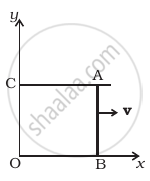
A magnetic field B = Bo sin ( ωt )`hatk` wire AB slides smoothly over two parallel conductors separated by a distance d (Figure). The wires are in the x-y plane. The wire AB (of length d) has resistance R and the parallel wires have negligible resistance. If AB is moving with velocity v, what is the current in the circuit. What is the force needed to keep the wire moving at constant velocity?
Advertisements
उत्तर
In this problem, the emf induced across AB is motional emf due to its motion, and emf induced by change in magnetic flux linked with the loop change due to a change of magnetic field.
In figure CA and OB are long parallel conducting wires, connected by d and conductor CO. The resistance of ACOB is negligible.
Let wire AB at t = 0 is at x = 0 i.e., on Y-axis.
Now AB moves with velocity `vhati`
Let at any time t, position of conductor AB is x(t) = `vhati t`
Motional e.m.f across AB
`V_(AB) = (W_(AB))/q = (D.d)/q = (qvi xx B)/q d`
`V_(AB) = vhati xx B_0 sin ωt. hatk xx d`
⇒ `e_1 = (B_0 sin ωt)vd (-hatj)`
And emf due to change in field (along OBAC)
`e_2 = (d(phi_B))/(dt)`
`phi_B = (B_0 sin ωt)(x(t)d)` ....(where, area A = xd)
`e_2 = - B_0 ω cos wtx(t)d`
Total emf in the circuit = emf due to change in field (along OBAC) + the emotional emf across AB
`e_1 + e_2 = - B_0d [ωx cos (t) + v sin (ωt)]`
The equivalent electrical diagram is shown in the diagram below.

Electric current in clockwise direction is given by
= `(B_0d)/R (ωx cos ωt + v sin ωt)`
The force acting on the conductor is given by F = `ilB` sin 90° = `ilB`
Substituting the values,
`vecF_m = (B_0d)/R (ωx cos ωt + v sin ωt)(d)(B_0 sin ωt)(-hati)`
External force needed on wire is along positive x-axis to keep moving it with constant velocity is given by,
`vecF_(ext) = (B_0^2d^2)/R (ωx cos ωt + v sin ωt)sin ωt(hati)`
This is the required expression for force.
APPEARS IN
संबंधित प्रश्न
A metal disc of radius 30 cm spins at 20 revolution per second about its transverse symmetry axis in a uniform magnetic field of 0.20 T. The field is parallel to the axis of rotation. Calculate
(a) the area swept out per second by the radius of the disc
(b) the flux cut per second by a radius of the disc
(c) the induced emf between the axle and rim of the disc.
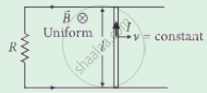
The emf induced across the ends of a conductor due to its motion in a magnetic field is called motional emf. It is produced due to magnetic Lorentz force acting on the free electrons of the conductor. For a circuit shown in the figure, if a conductor of length l moves with velocity v in a magnetic field B perpendicular to both its length and the direction of the magnetic field, then all the induced parameters are possible in the circuit.
A 0.1 m long conductor carrying a current of 50 A is held perpendicular to a magnetic field of 1.25 mT. The mechanical power required to move the conductor with a speed of 1 ms-1 is ______.
Motional e.m.f is the induced e.m.f. ______
An e.m.f is produced in a coil, which is not connected to an external voltage source. This can be due to ______.
- the coil being in a time varying magnetic field.
- the coil moving in a time varying magnetic field.
- the coil moving in a constant magnetic field.
- the coil is stationary in external spatially varying magnetic field, which does not change with time.
A rectangular loop of wire ABCD is kept close to an infinitely long wire carrying a current I(t) = Io (1 – t/T) for 0 ≤ t ≤ T and I(0) = 0 for t > T (Figure). Find the total charge passing through a given point in the loop, in time T. The resistance of the loop is R.

A rod of mass m and resistance R slides smoothly over two parallel perfectly conducting wires kept sloping at an angle θ with respect to the horizontal (Figure). The circuit is closed through a perfect conductor at the top. There is a constant magnetic field B along the vertical direction. If the rod is initially at rest, find the velocity of the rod as a function of time.

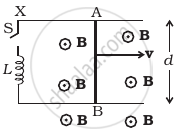
Find the current in the sliding rod AB (resistance = R) for the arrangement shown in figure. B is constant and is out of the paper. Parallel wires have no resistance. v is constant. Switch S is closed at time t = 0.
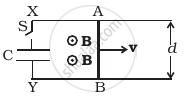
Find the current in the sliding rod AB (resistance = R) for the arrangement shown in figure. B is constant and is out of the paper. Parallel wires have no resistance. v is constant. Switch S is closed at time t = 0.
A simple pendulum with a bob of mass m and conducting wire of length L swings under gravity through an angle θ. The component of the earth's magnetic field in the direction perpendicular to the swing is B. Maximum emf induced across the pendulum is ______.
(g = acceleration due to gravity)

A wire of length 1 m moving with velocity 8 m/s at right angles to a magnetic field of 2 T. The magnitude of induced emf, between the ends of wire will be ______.
What is the magnitude of motional emf for the perpendicular arrangement of a straight conductor?
What component must the conductor's velocity have for motional EMF?
What happens to motional EMF if \[\vec{v}\parallel\vec{B}\]?
What happens to motional EMF if \[\vec{v}\parallel\vec{l}\]?
Which orientation gives maximum motional EMF?
