Advertisements
Advertisements
प्रश्न
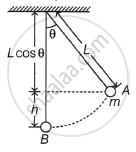
A simple pendulum with a bob of mass m and conducting wire of length L swings under gravity through an angle θ. The component of the earth's magnetic field in the direction perpendicular to the swing is B. Maximum emf induced across the pendulum is ______.
(g = acceleration due to gravity)

विकल्प
`BL sin(theta/2)(gL)`
`2BLsin(theta/2)(gL)^{3"/"2}`
`2BLsin(theta/2)(gL)^2`
`2BLsin(theta/2)(gL)^{1"/"2}`
Advertisements
उत्तर
A simple pendulum with a bob of mass m and conducting wire of length L swings under gravity through an angle θ. The component of the earth's magnetic field in the direction perpendicular to the swing is B. Maximum emf induced across the pendulum is `underlinebb(2BLsin(theta/2)(gL)^{1"/"2})`.
Explanation:
Height of the bob at max angle:
h = L - L cos θ = L(1 - cosθ)
Conversion to half-angle identity:
h = L(2sin2(`theta/2`))
Conservation of energy at the lowest point (max velocity):
mgh = `1/2` mv2maxgL(2sin2(`theta/2`)) = `1/2`v2max
Solve for maximum velocity:
v2max = 4gLsin2(`theta/2`)vmax = `sqrt(4gLsin^2(theta/2)) = 2sin(theta/2)sqrt(gL)`
Maximum induced EMF (Motional EMF):
Emax = BLvmax
Substitute vmax into EMF equation:
Emax = BL (2sin (`theta/2`)`sqrt(gL)`)Emax = 2BLsin(`theta/2`)(gL)1/2