Advertisements
Advertisements
प्रश्न
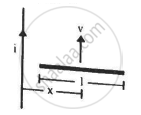
Figure shows a straight, long wire carrying a current i and a rod of length l coplanar with the wire and perpendicular to it. The rod moves with a constant velocity v in a direction parallel to the wire. The distance of the wire from the centre of the rod is x. Find the motional emf induced in the rod.
Advertisements
उत्तर
Here, the magnetic field \[\overrightarrow B\] due to the long wire varies along the length of the rod. We will consider a small element of the rod of length da at a distance a from the wire. The magnetic field at a distance a is given by
\[\vec{B} = \frac{\mu_0 i}{2\pi a}\]
Now,
Induced emf in the rod:-
\[de = Bvda\]
\[= \frac{\mu_0 i}{2\pi a} \times v \times da\]
Integrating from `x-l/2` to `x+l/2,` we get
\[e = \int\limits_{x - \frac{l}{2}}^{x + \frac{l}{2}} de\]
\[ = \int\limits_{x - \frac{l}{2}}^{x + \frac{l}{2}} \frac{\mu_0 i}{2\pi a} vda\]
\[ = \frac{\mu_0 iv}{2\pi}\left[ \ln\left( x + \frac{l}{2} \right) - \ln\left( x - \frac{l}{2} \right) \right]\]
\[ = \frac{\mu_0 iv}{2\pi}\ln\left[ \frac{x + \frac{l}{2}}{x - \frac{l}{2}} \right]\]
APPEARS IN
संबंधित प्रश्न
A 20 cm long conducting rod is set into pure translation with a uniform velocity of 10 cm s−1 perpendicular to its length. A uniform magnetic field of magnitude 0.10 T exists in a direction perpendicular to the plane of motion. (a) Find the average magnetic force on the free electrons of the rod. (b) For what electric field inside the rod, the electric force on a free elctron will balance the magnetic force? How is this electric field created? (c) Find the motional emf between the ends of the rod.
A conducting disc of radius r rotates with a small but constant angular velocity ω about its axis. A uniform magnetic field B exists parallel to the axis of rotation. Find the motional emf between the centre and the periphery of the disc.
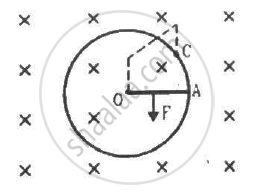
Consider the situation shown in the figure. Suppose the wire connecting O and C has zero resistance but the circular loop has a resistance Runiformly distributed along its length. The rod OA is made to rotate with a uniform angular speed ω as shown in the figure. Find the current in the rod when ∠ AOC = 90°.
A straight conductor of length 2 m moves in a uniform magnetic field of induction 2.5 x `10^-3` T with a velocity. of 4 m/s in a direction perpendicular to its length and also perpendicular to the field. The e.m.f. induced between the ends of the conductor is ______.
A wire of length 50 cm moves with a velocity of 300 m/min, perpendicular to a magnetic field. If the e.m.f. induced in the wire is 2 V, the magnitude of the field in tesla is ______.
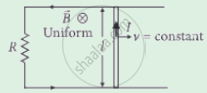
The emf induced across the ends of a conductor due to its motion in a magnetic field is called motional emf. It is produced due to magnetic Lorentz force acting on the free electrons of the conductor. For a circuit shown in the figure, if a conductor of length l moves with velocity v in a magnetic field B perpendicular to both its length and the direction of the magnetic field, then all the induced parameters are possible in the circuit.
Direction of current induced in a wire moving in a magnetic field is found using ______.
The emf induced across the ends of a conductor due to its motion in a magnetic field is called motional emf. It is produced due to magnetic Lorentz force acting on the free electrons of the conductor. For a circuit shown in the figure, if a conductor of length l moves with velocity v in a magnetic field B perpendicular to both its length and the direction of the magnetic field, then all the induced parameters are possible in the circuit.
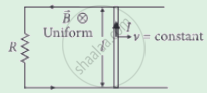
A conducting rod of length l is moving in a transverse magnetic field of strength B with velocity v. The resistance of the rod is R. The current in the rod is ______.
The emf induced across the ends of a conductor due to its motion in a magnetic field is called motional emf. It is produced due to magnetic Lorentz force acting on the free electrons of the conductor. For a circuit shown in the figure, if a conductor of length l moves with velocity v in a magnetic field B perpendicular to both its length and the direction of the magnetic field, then all the induced parameters are possible in the circuit.
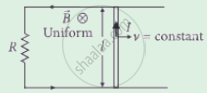
A bicycle generator creates 1.5 V at 15 km/hr. The EMF generated at 10 km/hr is ______.
Motional e.m.f is the induced e.m.f. ______
A circular coil expands radially in a region of magnetic field and no electromotive force is produced in the coil. This can be because ______.
- the magnetic field is constant.
- the magnetic field is in the same plane as the circular coil and it may or may not vary.
- the magnetic field has a perpendicular (to the plane of the coil) component whose magnitude is decreasing suitably.
- there is a constant magnetic field in the perpendicular (to the plane of the coil) direction.
A rectangular loop of wire ABCD is kept close to an infinitely long wire carrying a current I(t) = Io (1 – t/T) for 0 ≤ t ≤ T and I(0) = 0 for t > T (Figure). Find the total charge passing through a given point in the loop, in time T. The resistance of the loop is R.

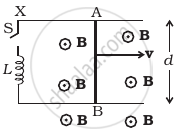
Find the current in the sliding rod AB (resistance = R) for the arrangement shown in figure. B is constant and is out of the paper. Parallel wires have no resistance. v is constant. Switch S is closed at time t = 0.
A simple pendulum with a bob of mass m and conducting wire of length L swings under gravity through an angle θ. The component of the earth's magnetic field in the direction perpendicular to the swing is B. Maximum emf induced across the pendulum is ______.
(g = acceleration due to gravity)

A magnetic flux associated with a coil changes by 0.04 Wb in 0.2 second. The induced emf with coil is ______.
Figure shows a rectangular frame situated in a constant magnetic field. A wire BC of length 1 m is moved out with velocity 4 m/s. Magnetic field strength is 0.15 T. Force acting on the wire BC is:
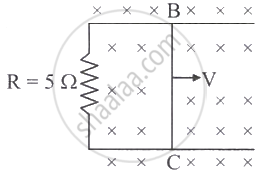
In \[e=Blv\], what does \[l\] represent?
What component must the conductor's velocity have for motional EMF?
A metallic rod rotates at \[50\,\mathrm{rev/s}\]. What is its angular velocity?
