Advertisements
Advertisements
प्रश्न
A farmer mixes two brands P and Q of cattle feed. Brand P, costing Rs 250 per bag contains 3 units of nutritional element A, 2.5 units of element B and 2 units of element C. Brand Q costing Rs 200 per bag contains 1.5 units of nutritional elements A, 11.25 units of element B, and 3 units of element C. The minimum requirements of nutrients A, B and C are 18 units, 45 units and 24 units respectively. Determine the number of bags of each brand which should be mixed in order to produce a mixture having a minimum cost per bag? What is the minimum cost of the mixture per bag?
Advertisements
उत्तर
Let the farmer mix x bags of brand P and y bags of brand Q.
The given information can be compiled in a table as follows.
| Vitamin A (units/bag) | Vitamin B (units/bag) | Vitamin C (units/bag) | Cost (Rs/bag) | |
| Food P | 3 | 2.5 | 2 | 250 |
| Food Q | 1.5 | 11.25 | 3 | 200 |
| Requirement (units/bag) | 18 | 45 | 24 |
The given problem can be formulated as follows.
Minimize z = 250x + 200y … (1)
subject to the constraints,
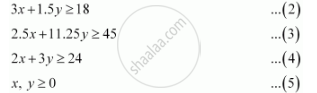
The feasible region determined by the system of constraints is as follows
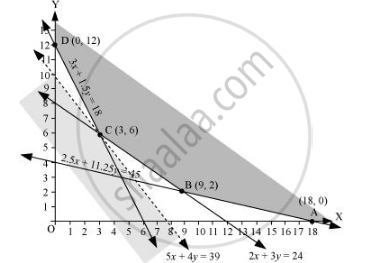
The corner points of the feasible region are A (18, 0), B (9, 2), C (3, 6), and D (0, 12).
The values of z at these corner points are as follows.
| Corner point | z = 250x + 200y | |
| A (18, 0) | 4500 | |
| B (9, 2) | 2650 | |
| C (3, 6) | 1950 | → Minimum |
| D (0, 12) | 2400 |
As the feasible region is unbounded, therefore, 1950 may or may not be the minimum value of z.
For this, we draw a graph of the inequality, 250x + 200y < 1950 or 5x + 4y < 39, and check whether the resulting half plane has points in common with the feasible region or not.
It can be seen that the feasible region has no common point with 5x + 4y < 39
Therefore, the minimum value of z is 1950 at (3, 6).
Thus, 3 bags of brand P and 6 bags of brand Q should be used in the mixture to minimize the cost to Rs 1950.
APPEARS IN
संबंधित प्रश्न
Solve the following Linear Programming Problems graphically:
Minimise Z = – 3x + 4 y
subject to x + 2y ≤ 8, 3x + 2y ≤ 12, x ≥ 0, y ≥ 0.
Solve the following Linear Programming Problems graphically:
Minimise Z = 3x + 5y
such that x + 3y ≥ 3, x + y ≥ 2, x, y ≥ 0.
Show that the minimum of Z occurs at more than two points.
Minimise and Maximise Z = 5x + 10 y
subject to x + 2y ≤ 120, x + y ≥ 60, x – 2y ≥ 0, x, y ≥ 0.
A small firm manufactures necklaces and bracelets. The total number of necklaces and bracelets that it can handle per day is at most 24. It takes one hour to make a bracelet and half an hour to make a necklace. The maximum number of hours available per day is 16. If the profit on a necklace is Rs 100 and that on a bracelet is Rs 300. Formulate on L.P.P. for finding how many of each should be produced daily to maximize the profit?
It is being given that at least one of each must be produced.
If the feasible region for a linear programming problem is bounded, then the objective function Z = ax + by has both a maximum and a minimum value on R.
Maximise the function Z = 11x + 7y, subject to the constraints: x ≤ 3, y ≤ 2, x ≥ 0, y ≥ 0.
Determine the maximum value of Z = 3x + 4y if the feasible region (shaded) for a LPP is shown in Figure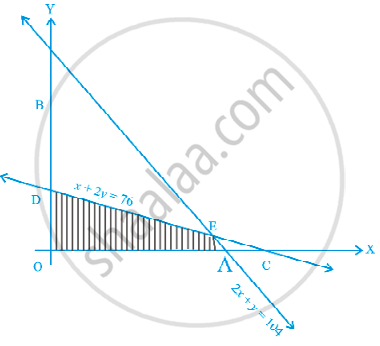
Refer to Exercise 7 above. Find the maximum value of Z.
In figure, the feasible region (shaded) for a LPP is shown. Determine the maximum and minimum value of Z = x + 2y.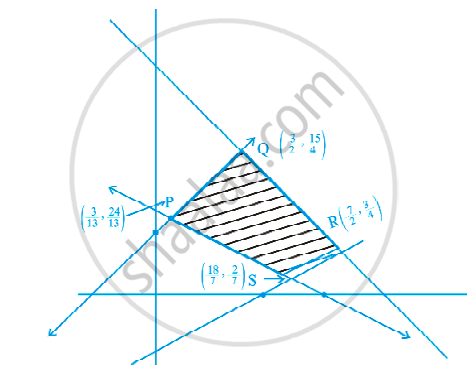
Refer to question 13. Solve the linear programming problem and determine the maximum profit to the manufacturer
A manufacturer produces two Models of bikes-Model X and Model Y. Model X takes a 6 man-hours to make per unit, while Model Y takes 10 man-hours per unit. There is a total of 450 man-hour available per week. Handling and Marketing costs are Rs 2000 and Rs 1000 per unit for Models X and Y respectively. The total funds available for these purposes are Rs 80,000 per week. Profits per unit for Models X and Y are Rs 1000 and Rs 500, respectively. How many bikes of each model should the manufacturer produce so as to yield a maximum profit? Find the maximum profit.
A company makes 3 model of calculators: A, B and C at factory I and factory II. The company has orders for at least 6400 calculators of model A, 4000 calculator of model B and 4800 calculator of model C. At factory I, 50 calculators of model A, 50 of model B and 30 of model C are made every day; at factory II, 40 calculators of model A, 20 of model B and 40 of model C are made everyday. It costs Rs 12000 and Rs 15000 each day to operate factory I and II, respectively. Find the number of days each factory should operate to minimise the operating costs and still meet the demand.
Corner points of the feasible region for an LPP are (0, 2), (3, 0), (6, 0), (6, 8) and (0, 5). Let F = 4x + 6y be the objective function. The Minimum value of F occurs at ______.
Refer to Question 32, Maximum of F – Minimum of F = ______.
A corner point of a feasible region is a point in the region which is the ______ of two boundary lines.
In a LPP, the minimum value of the objective function Z = ax + by is always 0 if the origin is one of the corner point of the feasible region.
A linear programming problem is as follows:
Minimize Z = 30x + 50y
Subject to the constraints: 3x + 5y ≥ 15, 2x + 3y ≤ 18, x ≥ 0, y ≥ 0
In the feasible region, the minimum value of Z occurs at:
In linear programming, optimal solution ____________.
A maximum or a minimum may not exist for a linear programming problem if ____________.
In Corner point method for solving a linear programming problem, one finds the feasible region of the linear programming problem, determines its corner points, and evaluates the objective function Z = ax + by at each corner point. Let M and m respectively be the largest and smallest values at corner points. In case feasible region is unbounded, M is the maximum value of the objective function if ____________.
In Corner point method for solving a linear programming problem, one finds the feasible region of the linear programming problem, determines its corner points, and evaluates the objective function Z = ax + by at each corner point. Let M and m respectively be the largest and smallest values at corner points. In case the feasible region is unbounded, m is the minimum value of the objective function.
Maximize Z = 3x + 5y, subject to x + 4y ≤ 24, 3x + y ≤ 21, x + y ≤ 9, x ≥ 0, y ≥ 0.
Maximize Z = 10 x1 + 25 x2, subject to 0 ≤ x1 ≤ 3, 0 ≤ x2 ≤ 3, x1 + x2 ≤ 5.
Z = 6x + 21 y, subject to x + 2y ≥ 3, x + 4y ≥ 4, 3x + y ≥ 3, x ≥ 0, y ≥ 0. The minimum value of Z occurs at ____________.
The feasible region for an LPP is shown shaded in the figure. Let Z = 3x - 4y be the objective function. Minimum of Z occurs at ____________.

Maximize Z = 10×1 + 25×2, subject to 0 ≤ x1 ≤ 3, 0 ≤ x2 ≤ 3, x1 + x2 ≤ 5.
Which statement best describes a Linear Programming Problem (LPP)?
In the expression \[Z=250x+75y\], which quantities are the decision variables?
What are constraints in a Linear Programming Problem?
Which statement defines an Optimisation Problem?
Which inequality is one of the given resource constraints in the formulation with objective function \[Z=250x+75y\]?
Which set gives the complete non-negative restrictions for the profit-maximization formulation?
Linear Programming is a method of optimisation under which type of constraints?
