Advertisements
Advertisements
प्रश्न
A farmer mixes two brands P and Q of cattle feed. Brand P, costing Rs 250 per bag contains 3 units of nutritional element A, 2.5 units of element B and 2 units of element C. Brand Q costing Rs 200 per bag contains 1.5 units of nutritional elements A, 11.25 units of element B, and 3 units of element C. The minimum requirements of nutrients A, B and C are 18 units, 45 units and 24 units respectively. Determine the number of bags of each brand which should be mixed in order to produce a mixture having a minimum cost per bag? What is the minimum cost of the mixture per bag?
Advertisements
उत्तर
Let the farmer mix x bags of brand P and y bags of brand Q.
The given information can be compiled in a table as follows.
| Vitamin A (units/bag) | Vitamin B (units/bag) | Vitamin C (units/bag) | Cost (Rs/bag) | |
| Food P | 3 | 2.5 | 2 | 250 |
| Food Q | 1.5 | 11.25 | 3 | 200 |
| Requirement (units/bag) | 18 | 45 | 24 |
The given problem can be formulated as follows.
Minimize z = 250x + 200y … (1)
subject to the constraints,
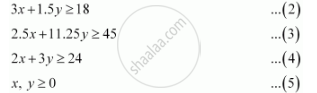
The feasible region determined by the system of constraints is as follows
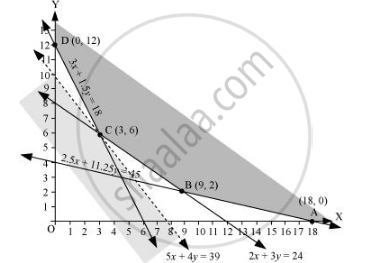
The corner points of the feasible region are A (18, 0), B (9, 2), C (3, 6), and D (0, 12).
The values of z at these corner points are as follows.
| Corner point | z = 250x + 200y | |
| A (18, 0) | 4500 | |
| B (9, 2) | 2650 | |
| C (3, 6) | 1950 | → Minimum |
| D (0, 12) | 2400 |
As the feasible region is unbounded, therefore, 1950 may or may not be the minimum value of z.
For this, we draw a graph of the inequality, 250x + 200y < 1950 or 5x + 4y < 39, and check whether the resulting half plane has points in common with the feasible region or not.
It can be seen that the feasible region has no common point with 5x + 4y < 39
Therefore, the minimum value of z is 1950 at (3, 6).
Thus, 3 bags of brand P and 6 bags of brand Q should be used in the mixture to minimize the cost to Rs 1950.
APPEARS IN
संबंधित प्रश्न
Show that the minimum of Z occurs at more than two points.
Minimise and Maximise Z = 5x + 10 y
subject to x + 2y ≤ 120, x + y ≥ 60, x – 2y ≥ 0, x, y ≥ 0.
An aeroplane can carry a maximum of 200 passengers. A profit of Rs 1000 is made on each executive class ticket and a profit of Rs 600 is made on each economy class ticket. The airline reserves at least 20 seats for executive class. However, at least 4 times as many passengers prefer to travel by economy class than by the executive class. Determine how many tickets of each type must be sold in order to maximize the profit for the airline. What is the maximum profit?
Determine the maximum value of Z = 11x + 7y subject to the constraints : 2x + y ≤ 6, x ≤ 2, x ≥ 0, y ≥ 0.
Determine the maximum value of Z = 3x + 4y if the feasible region (shaded) for a LPP is shown in Figure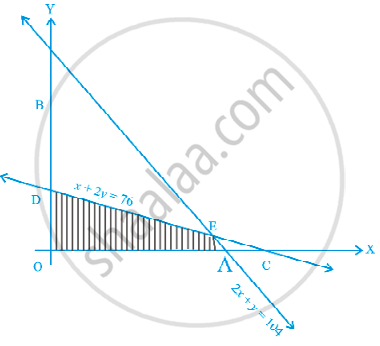
Refer to question 14. How many sweaters of each type should the company make in a day to get a maximum profit? What is the maximum profit.
The feasible solution for a LPP is shown in Figure. Let Z = 3x – 4y be the objective function. Minimum of Z occurs at ______.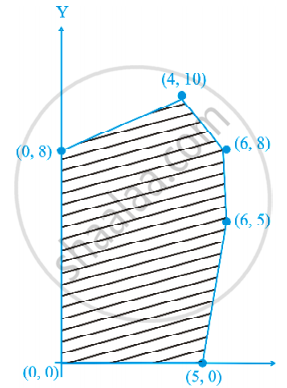
Refer to Question 27. (Maximum value of Z + Minimum value of Z) is equal to ______.
Corner points of the feasible region for an LPP are (0, 2), (3, 0), (6, 0), (6, 8) and (0, 5). Let F = 4x + 6y be the objective function. The Minimum value of F occurs at ______.
Refer to Question 32, Maximum of F – Minimum of F = ______.
In a LPP, the objective function is always ______.
If the feasible region for a LPP is ______ then the optimal value of the objective function Z = ax + by may or may not exist.
In a LPP if the objective function Z = ax + by has the same maximum value on two corner points of the feasible region, then every point on the line segment joining these two points give the same ______ value.
In a LPP, the maximum value of the objective function Z = ax + by is always finite.
Based on the given shaded region as the feasible region in the graph, at which point(s) is the objective function Z = 3x + 9y maximum?

In the given graph, the feasible region for an LPP is shaded. The objective function Z = 2x – 3y will be minimum at:

For an objective function Z = ax + by, where a, b > 0; the corner points of the feasible region determined by a set of constraints (linear inequalities) are (0, 20), (10, 10), (30, 30) and (0, 40). The condition on a and b such that the maximum Z occurs at both the points (30, 30) and (0, 40) is:
Z = 7x + y, subject to 5x + y ≥ 5, x + y ≥ 3, x ≥ 0, y ≥ 0. The minimum value of Z occurs at ____________.
A linear programming problem is one that is concerned with ____________.
In linear programming infeasible solutions
A maximum or a minimum may not exist for a linear programming problem if ____________.
In Corner point method for solving a linear programming problem, one finds the feasible region of the linear programming problem, determines its corner points, and evaluates the objective function Z = ax + by at each corner point. Let M and m respectively be the largest and smallest values at corner points. In case feasible region is unbounded, M is the maximum value of the objective function if ____________.
If two corner points of the feasible region are both optimal solutions of the same type, i.e., both produce the same maximum or minimum.
In a LPP, the objective function is always ____________.
Maximize Z = 6x + 4y, subject to x ≤ 2, x + y ≤ 3, -2x + y ≤ 1, x ≥ 0, y ≥ 0.
Maximize Z = 10 x1 + 25 x2, subject to 0 ≤ x1 ≤ 3, 0 ≤ x2 ≤ 3, x1 + x2 ≤ 5.
Z = 6x + 21 y, subject to x + 2y ≥ 3, x + 4y ≥ 4, 3x + y ≥ 3, x ≥ 0, y ≥ 0. The minimum value of Z occurs at ____________.
Maximize Z = 10×1 + 25×2, subject to 0 ≤ x1 ≤ 3, 0 ≤ x2 ≤ 3, x1 + x2 ≤ 5.
Which statement best describes a Linear Programming Problem (LPP)?
Which condition represents non-negative restrictions for two decision variables?
Which statement defines an Optimisation Problem?
Which other constraint must be satisfied together with \[5x+y\leq 100\] in the profit-maximization formulation?
