Advertisements
Advertisements
प्रश्न
Refer to question 15. Determine the maximum distance that the man can travel.
Advertisements
उत्तर
Referring to the solution of Question No.15, we have
Maximise Z = x + y subject to the constraints
Let 2x + 3y = 120
| x | 0 | 60 |
| y | 40 | 0 |
Let 8x + 5y = 400
| x | 0 | 50 |
| y | 80 | 0 |

2x + 3y ≤ 120 ......(i)
8x + 5y ≤ 400 ......(ii)
x ≥ 0, y ≥ 0
On solving eq. (i) and (ii) we get
x = `300/7` and y = `80/7`
Here, OABC is the feasible region whose corner points are O(0, 0), A(50, 0), `"B"(300/7, 80/7)` and C(0, 40).
Let us evaluate the value of Z
| Corner points | Value of Z = x + y | |
| O(0, 0) | Z = 0 + 0 = 0 | |
| A(50, 0) | Z = 50 + 0 = 50 km | |
| `"B"(300/7, 80/7)` |
Z = `300/7 + 80/7` = `380/7` = 54.3 km |
← Maximum |
| C(0, 40) | Z = 0 + 40 = 40 km |
Hence, the maximum distance that the man can travel is `54 2/7` km at `(300/7, 80/7)`.
APPEARS IN
संबंधित प्रश्न
Solve the following Linear Programming Problems graphically:
Maximise Z = 3x + 4y
subject to the constraints : x + y ≤ 4, x ≥ 0, y ≥ 0.
Solve the following Linear Programming Problems graphically:
Maximise Z = 5x + 3y
subject to 3x + 5y ≤ 15, 5x + 2y ≤ 10, x ≥ 0, y ≥ 0
Solve the following Linear Programming Problems graphically:
Maximise Z = 3x + 2y
subject to x + 2y ≤ 10, 3x + y ≤ 15, x, y ≥ 0.
Show that the minimum of Z occurs at more than two points.
Minimise and Maximise Z = x + 2y
subject to x + 2y ≥ 100, 2x – y ≤ 0, 2x + y ≤ 200; x, y ≥ 0.
A dietician wishes to mix together two kinds of food X and Y in such a way that the mixture contains at least 10 units of vitamin A, 12 units of vitamin B and 8 units of vitamin C. The vitamin content of one kg food is given below:
| Food | Vitamin A | Vitamin B | Vitamin C |
| X | 1 | 2 | 3 |
| Y | 2 | 2 | 1 |
One kg of food X costs Rs 16 and one kg of food Y costs Rs 20. Find the least cost of the mixture which will produce the required diet?
Maximise Z = 3x + 4y, subject to the constraints: x + y ≤ 1, x ≥ 0, y ≥ 0
Refer to Exercise 7 above. Find the maximum value of Z.
A man rides his motorcycle at the speed of 50 km/hour. He has to spend Rs 2 per km on petrol. If he rides it at a faster speed of 80 km/hour, the petrol cost increases to Rs 3 per km. He has atmost Rs 120 to spend on petrol and one hour’s time. He wishes to find the maximum distance that he can travel. Express this problem as a linear programming problem
Refer to quastion 12. What will be the minimum cost?
A manufacturer produces two Models of bikes-Model X and Model Y. Model X takes a 6 man-hours to make per unit, while Model Y takes 10 man-hours per unit. There is a total of 450 man-hour available per week. Handling and Marketing costs are Rs 2000 and Rs 1000 per unit for Models X and Y respectively. The total funds available for these purposes are Rs 80,000 per week. Profits per unit for Models X and Y are Rs 1000 and Rs 500, respectively. How many bikes of each model should the manufacturer produce so as to yield a maximum profit? Find the maximum profit.
A company makes 3 model of calculators: A, B and C at factory I and factory II. The company has orders for at least 6400 calculators of model A, 4000 calculator of model B and 4800 calculator of model C. At factory I, 50 calculators of model A, 50 of model B and 30 of model C are made every day; at factory II, 40 calculators of model A, 20 of model B and 40 of model C are made everyday. It costs Rs 12000 and Rs 15000 each day to operate factory I and II, respectively. Find the number of days each factory should operate to minimise the operating costs and still meet the demand.
The feasible solution for a LPP is shown in Figure. Let Z = 3x – 4y be the objective function. Minimum of Z occurs at ______.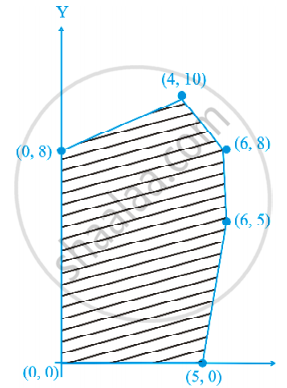
Corner points of the feasible region for an LPP are (0, 2), (3, 0), (6, 0), (6, 8) and (0, 5). Let F = 4x + 6y be the objective function. The Minimum value of F occurs at ______.
Refer to Question 32, Maximum of F – Minimum of F = ______.
In a LPP, the linear inequalities or restrictions on the variables are called ____________.
In a LPP if the objective function Z = ax + by has the same maximum value on two corner points of the feasible region, then every point on the line segment joining these two points give the same ______ value.
If the feasible region for a LPP is unbounded, maximum or minimum of the objective function Z = ax + by may or may not exist.
In a LPP, the minimum value of the objective function Z = ax + by is always 0 if the origin is one of the corner point of the feasible region.
In a LPP, the maximum value of the objective function Z = ax + by is always finite.
In the given graph, the feasible region for an LPP is shaded. The objective function Z = 2x – 3y will be minimum at:

For an objective function Z = ax + by, where a, b > 0; the corner points of the feasible region determined by a set of constraints (linear inequalities) are (0, 20), (10, 10), (30, 30) and (0, 40). The condition on a and b such that the maximum Z occurs at both the points (30, 30) and (0, 40) is:
In a linear programming problem, the constraints on the decision variables x and y are x − 3y ≥ 0, y ≥ 0, 0 ≤ x ≤ 3. The feasible region:
In linear programming, optimal solution ____________.
In Corner point method for solving a linear programming problem, one finds the feasible region of the linear programming problem, determines its corner points, and evaluates the objective function Z = ax + by at each corner point. Let M and m respectively be the largest and smallest values at corner points. In case feasible region is unbounded, M is the maximum value of the objective function if ____________.
If two corner points of the feasible region are both optimal solutions of the same type, i.e., both produce the same maximum or minimum.
In a LPP, the objective function is always ____________.
Maximize Z = 7x + 11y, subject to 3x + 5y ≤ 26, 5x + 3y ≤ 30, x ≥ 0, y ≥ 0.
The feasible region for an LPP is shown shaded in the figure. Let Z = 3x - 4y be the objective function. Minimum of Z occurs at ____________.

Which statement best describes a Linear Programming Problem (LPP)?
In the expression \[Z=250x+75y\], which quantities are the decision variables?
Which statement defines an Optimisation Problem?
Which inequality is one of the given resource constraints in the formulation with objective function \[Z=250x+75y\]?
Which set gives the complete non-negative restrictions for the profit-maximization formulation?
Linear Programming is a method of optimisation under which type of constraints?
What is the name of the quantity to be optimised in linear programming?
What are the unknown quantities in a Linear Programming Problem called?
