Advertisements
Advertisements
प्रश्न
A departmental head has three jobs and four subordinates. The subordinates differ in their capabilities and the jobs differ in their work
contents. With the help of the performance matrix given below, find out which of the four subordinates should be assigned which jobs ?
| Subordinates | Jobs | ||
| I | II | III | |
| A | 7 | 3 | 5 |
| B | 2 | 7 | 4 |
| C | 6 | 5 | 3 |
| D | 3 | 4 | 7 |
Advertisements
उत्तर
As the problem is unbalanced a dummy · job IV is introduced with zero performance as, the for:
| I | II | III | IV | |
| A | 7 | 3 | 5 | 0 |
| B | 2 | 7 | 4 | 0 |
| C | 6 | 5 | 3 | 0 |
| D | 3 | 4 | 7 | 0 |
As minimum element of each row is 'O' hence minimum element of each column is subtracted from all the elements of that column,
| I | II | III | IV | |
| A | 5 | 0 | 2 | 0 |
| B | 0 | 4 | 1 | 0 |
| C | 4 | 2 | 0 | 0 |
| D | 1 | 1 | 4 | 0 |
All the zeros of the above matrix a re covered with minimum number of lines is as below :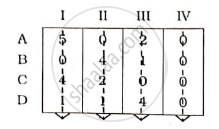
As the number of lines covering zeros is equal to the number of rows and columns. hence the optional solution is obtained it is as shown below :
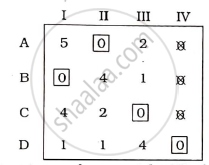
As D gets a dummy job N, hence the assignment is as shown below :
A → Job II
B → Job I
C → Job III
and performance is 3 + 2 + 3 = 8 units
APPEARS IN
संबंधित प्रश्न
Solve the following maximal assignment problem :
| Branch Manager | Monthly Business ( Rs. lakh) | |||
| A | B | C | D | |
| P | 11 | 11 | 9 | 9 |
| Q | 13 | 16 | 11 | 10 |
| R | 12 | 17 | 13 | 8 |
| S | 16 | 14 | 16 | 12 |
A job production unit has four jobs A, B, C, D which can be manufactured on each of the four machines P, Q, R and S. The processing cost of each job for each machine is given in the following table:
| Jobs | Machines (Processing Cost in ₹) |
|||
| P | Q | R | S | |
| A | 31 | 25 | 33 | 29 |
| B | 25 | 24 | 23 | 21 |
| C | 19 | 21 | 23 | 24 |
| D | 38 | 36 | 34 | 40 |
Find the optimal assignment to minimize the total processing cost.
The assignment problem is said to be unbalance if ______
Choose the correct alternative :
In an assignment problem if number of rows is greater than number of columns then
The objective of an assignment problem is to assign ______.
Fill in the blank :
When an assignment problem has more than one solution, then it is _______ optimal solution.
Fill in the blank :
An _______ is a special type of linear programming problem.
In an assignment problem, if number of column is greater than number of rows, then a dummy column is added.
Solve the following problem :
A dairy plant has five milk tankers, I, II, III, IV and V. These milk tankers are to be used on five delivery routes A, B, C, D and E. The distances (in kms) between the dairy plant and the delivery routes are given in the following distance matrix.
| I | II | III | IV | V | |
| A | 150 | 120 | 175 | 180 | 200 |
| B | 125 | 110 | 120 | 150 | 165 |
| C | 130 | 100 | 145 | 160 | 175 |
| D | 40 | 40 | 70 | 70 | 100 |
| E | 45 | 25 | 60 | 70 | 95 |
How should the milk tankers be assigned to the chilling center so as to minimize the distance travelled?
Choose the correct alternative:
The assignment problem is generally defined as a problem of ______
State whether the following statement is True or False:
In assignment problem each worker or machine is assigned only one job
Give mathematical form of Assignment problem
Three jobs A, B and C one to be assigned to three machines U, V and W. The processing cost for each job machine combination is shown in the matrix given below. Determine the allocation that minimizes the overall processing cost.
| Machine | ||||
| U | V | W | ||
| Jobs | A | 17 | 25 | 31 |
| B | 10 | 25 | 16 | |
| C | 12 | 14 | 11 | |
(cost is in ₹ per unit)
A computer centre has got three expert programmers. The centre needs three application programmes to be developed. The head of the computer centre, after studying carefully the programmes to be developed, estimates the computer time in minitues required by the experts to the application programme as follows.
| Programmers | ||||
| P | Q | R | ||
| Programmers | 1 | 120 | 100 | 80 |
| 2 | 80 | 90 | 110 | |
| 3 | 110 | 140 | 120 | |
Assign the programmers to the programme in such a way that the total computer time is least.
Assign four trucks 1, 2, 3 and 4 to vacant spaces A, B, C, D, E and F so that distance travelled is minimized. The matrix below shows the distance.
| 1 | 2 | 3 | 4 | |
| A | 4 | 7 | 3 | 7 |
| B | 8 | 2 | 5 | 5 |
| C | 4 | 9 | 6 | 9 |
| D | 7 | 5 | 4 | 8 |
| E | 6 | 3 | 5 | 4 |
| F | 6 | 8 | 7 | 3 |
Choose the correct alternative:
The solution for an assignment problem is optimal if
Choose the correct alternative:
In an assignment problem involving four workers and three jobs, total number of assignments possible are
A job production unit has four jobs P, Q, R, and S which can be manufactured on each of the four machines I, II, III, and IV. The processing cost of each job for each machine is given in the following table:
| Job | Machines (Processing cost in ₹) |
|||
| I | II | III | IV | |
| P | 31 | 25 | 33 | 29 |
| Q | 25 | 24 | 23 | 21 |
| R | 19 | 21 | 23 | 24 |
| S | 38 | 36 | 34 | 40 |
Find the optimal assignment to minimize the total processing cost.
Five wagons are available at stations 1, 2, 3, 4 and 5. These are required at 5 stations I, II, III, IV and V. The mileage between various stations are given in the table below. How should the wagons be transported so as to minimize the mileage covered?
| I | II | III | IV | V | |
| 1 | 10 | 5 | 9 | 18 | 11 |
| 2 | 13 | 9 | 6 | 12 | 14 |
| 3 | 7 | 2 | 4 | 4 | 5 |
| 4 | 18 | 9 | 12 | 17 | 15 |
| 5 | 11 | 6 | 14 | 19 | 10 |
