Advertisements
Advertisements
प्रश्न
A block and tackle system of pulleys has a velocity ratio of 4.
- Draw a labelled diagram of the system indicating clearly the direction of the load and effort.
- Calculate the potential energy of the load 100 kgf lifted by this pulley to a height 5 m. (g = 10 ms−2)
Advertisements
उत्तर
a. Pulley drawn correctly with support.
Correct connection of tackle, Marking load and effort with correct direction and tension.

b. U = mgh
= 100 × 10 × 5
= 5000 J
APPEARS IN
संबंधित प्रश्न
A pulley system with VR = 4 is used to lift a load of 175 kgf through a vertical height of 15 m. The effort required is 50 kgf in the downward direction. (g = 10 N kg-1)
Calculate:
- Distance moved by the effort
- Work done by the effort
- M.A. of the pulley system
- Efficiency of the pulley system
From the diagram given below. answer the question that follows:
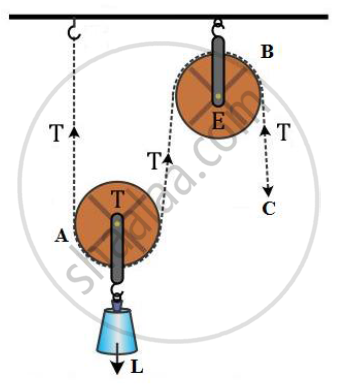
- What kind of pulleys are A and B?
- State the purpose of pulley B.
- What effort has to be applied at C just raise the load L = 20 kgf?
(Neglect the weight of pulley A and friction)
A pulley system has three pulleys. A load of 120 N is overcome by applying an effort of 50 N. Calculate the Mechanical Advantage and Efficiency of this system.
Give a reason for the following:
In a single fixed pulley, the velocity ratio is always more than the mechanical advantage.
Name a machine which is used to:
change the direction of force applied.
A type of single pulley is very often used as a machine even though it does not give any gain in mechanical advantage. For what purpose is such a pulley used?
What is the relation between the mechanical advantage and the number of strands of string used to support the load, in a ‘block and tackle’ set-up?
What is a pulley?
Draw a diagram of a single fixed pulley and obtain expressions for its:
(i) Mechanical advantage,
(ii) Velocity ratio, and
(iii) Efficiency, in the ideal case.
