Advertisements
Advertisements
प्रश्न
What is the relation between the mechanical advantage and the number of strands of string used to support the load, in a ‘block and tackle’ set-up?
Advertisements
उत्तर
The mechanical advantage is equal to the number of strands of string, used to support the load, only if the ‘block and tackle set up’ can be assumed to be ideal (absence of friction, etc.) and the lower blocks of pulleys have negligible weight. Both these conditions cannot be satisfied in actual practice. Hence, in practical situations, the M.A. of a ‘block and tackle set up’ is always less than the fire number of strands of string used to support the load.
संबंधित प्रश्न
A boy uses a single fixed pulley to lift a load of 50 kgf to some height. Another boy uses a single movable pulley to lift the same load to the same height. Compare the effort applied by them. Give a reason to support your answer.
Select the correct alternative:
A pulley is used because of it
What should be the gear ration of a car : equal to 1, less than 1 or greater than 1, while ascending a hill ?
Name the type of single pulley that can act as a force multiplier. Draw a labelled diagram of the pulley mentioned by you.
Differentiate between a single fixed pulley and a single movable pulley.
The mechanical advantage of an ideal single movable pulley is ______.
The diagram below shows a pulley arrangement :
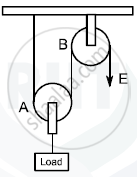
(i) Copy the diagram and mark the direction of tension on each strand of the string.
(ii) What is the velocity ratio of the arrangement ?
(iii) If the tension acting on the string is T, then what is the relationship between T and effort E ?
(iv) If the free end of the string moves through distance x, find the distance by which the load is raised.
In the alongside the figure of two pulleys shown a system in which one pulley is fixed and the other is movable. What is the velocity ratio of the system?
An effort of 600 N is needed to lift a weight of 1000 N. What are the mechanical advantage and efficiency of the pulley system?
Draw the diagram of a single movable pulley and obtain its mechanical advantage, velocity ratio, and efficiency.
A boy lifts a load of 40 kgf through a vertical height of 2m in 5s by using a single fixed pulley when he applies an effort of 48 kgf. Calculate:
(i) the mechanical advantage, and
(ii) the efficiency of the pulley. Why is the efficiency of the pulley is not 100%?
(iii) the energy gained by the load in 5s, and
(iv) the power developed by the boy in raising the load.
