Topics
Basic Concepts in Economics
- Branches of Science
- Natural Science
- Social Science
- Concept of Economics
- Kautilya's Views on Economics
- Types of Economic Systems
- Capitalism
- Socialism
- Mixed Economy
- Introduction to Microeconomics and Macroeconomics
- Microeconomics
- Basic Concepts of Microeconomics > Want
- Basic Concepts of Microeconomics > Goods and Services
- Basic Concepts of Microeconomics > Utility
- Basic Concepts of Microeconomics > Value
- Basic Concepts of Microeconomics > Wealth
- Microeconomics > Personal Income
- Basic Concepts of Microeconomics > Personal Disposable Income
- Microeconomics > Economic Activity
- Types of Income
- Concept of Economic Good
- Macroeconomics
- Cyclical Unemployment
- Difference Between Economic Growth and Economic Development
Money
Partition Values
The Economy of Maharashtra
- Formation and Economic Progress of Maharashtra
- Administrative Divisions of Maharashtra
- Important Features of the Economy of Maharashtra
- Economic Development of Maharashtra
- Agricultural Sector
- Industrial Growth in Maharashtra
- Service Sector
- Core Areas of Service Sector
- Economic Infrastructure of Maharashtra
- Social Infrastructure of Maharashtra
- Measures for Social Infrastructure: Education
- Measures for Social Infrastructure: Health Services
- Co – operative Movement in Maharashtra
- Symbols of Educational Schemes in India
- Tourism in Maharashtra
- Hospitality
- Entertainment Industry
Rural Development in India
Population in India
- Concept of Population in India
- Trends in Population Growth
- Theories of Population Growth
- Population Explosion in India
- Types of Population Based on Resource Availability
- Birth Rate
- Death Rate
- Survival Rate
- Legal Age of Marriage for Males and Females in Different Countries
- The Population as a Human Resource
- Role of Human Resources in Economic Development
Unemployment in India
- Concept of Unemployment
- Important Terms of Employment and Unemployment
- Types of Unemployment
- Rural Unemployment
- Urban Unemployment
- Extent of Unemployment in India
- State-Wise Unemployment Rates in India
- Causes of Unemployment
- General Measures to Reduce Unemployment
- Effects of Unemployment
- Government Measures for Employment Generation
Poverty in India
- Concept of Poverty in India
- Prof. Amartya Sen’s Views on Poverty
- Multi-dimensional Poverty
- Key Concepts of Poverty
- Countries with Highest Extreme Poverty Rates
- Poverty Line
- Informal Sector and Related Activities
- Income Pyramid
- Types of Poverty
- Extent of Poverty in India
- Estimates of Poverty
- Causes of Poverty
- Effects of Poverty
- Sustainable Development Goals
- Understanding Maharashtra’s Tri Colour Family Ration Cards
- Eradication of Poverty
- Poverty Alleviation Programmes and Their Target Sectors
- Tracking Anti-Poverty Efforts
Economic Policy of India since 1991
- Economic Transition of India
- Main Objectives of the Economic Policy of 1991
- Features of the Economic Policy of 1991
- Public Bank Vs Private Banks Vs Foreign Banks
- Components of New Economic Policy
- Liberalisation
- Privatisation
- Globalisation
- Evaluation of the Economic Policy of 1991
- Corporate Social Responsibility
Economic Planning in India
- India’s Planning Commission
- Economic Planning in India
- Overview of the Bombay, People’s, and Gandhian Plans
- Features of Economic Planning
- Five Year Plans (FYP)
- 12th Five Year Plan (2012-2017)
- Levels of National Family Health Survey (NFHS)
- NITI Aayog (National Institution for Transforming India)
- Planning Commission VS NITI Aayog
- Meaning
- Types of Urban Unemployment
- Educated Unemployment
- Industrial Unemployment
- Key Point Summary
Maharashtra State Board: Class 11
Meaning
Urban unemployment happens when people living in cities and towns are unable to find work even though they want a job and are ready for employment. This is a major issue in developing countries like India.
Maharashtra State Board: Class 11
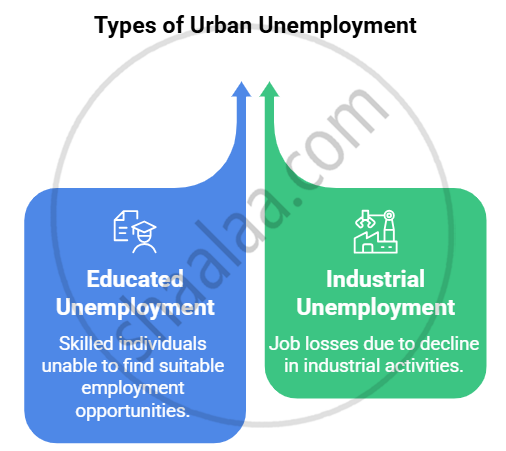
Types of Urban Unemployment
Maharashtra State Board: Class 11
Educated Unemployment
When educated people (matriculates, graduates, postgraduates) cannot find jobs. This is due to several factors: too many youth pursuing general education, few job openings, a preference for office jobs, a lack of skills for industry, and limited awareness about alternative career paths.
Maharashtra State Board: Class 11
Industrial Unemployment
Unemployment in city industries. This affects both skilled and unskilled workers. Causes include slow factory growth, population increase, poor training, outdated skills, badly placed industries, and limited worker mobility.
- Technological Unemployment:
Changes in technology (like robots and computers) mean fewer factory jobs. Workers without updated skills lose jobs. - Frictional Unemployment:
Temporary joblessness happens when factories stop due to machine breakdowns, strikes, shortages, or power cuts. - Cyclical Unemployment:
Caused by changes in the business cycle. During a downturn, demand falls, companies slow down production, and workers lose jobs. - Structural Unemployment:
Major changes in the economy lead to job losses. Factories might shift to new places or need new skills, so workers with old skills become unemployed. For example, the shift from horse carts to rickshaws, or manual typing replaced by computers.
Maharashtra State Board: Class 11
Key Point Summary
- Urban unemployment means city-dwellers are ready for work but jobless.
- Educated and industrial unemployment are common types.
- Technology, business cycles, and skill mismatch are key causes.
- Solutions require better training, adaptability, and awareness.
