Topics
Mathematical Logic
- Concept of Statements
- Truth Value of Statement
- Logical Connective, Simple and Compound Statements
- Statement Patterns and Logical Equivalence
- Tautology, Contradiction, and Contingency
- Duality
- Quantifier and Quantified Statements in Logic
- Negations of Compound Statements
- Converse, Inverse, and Contrapositive
- Algebra of Statements
- Application of Logic to Switching Circuits
- Overview of Mathematical Logic
Matrices
- Elementry Transformations
- Properties of Matrix Multiplication
- Application of Matrices
- Applications of Determinants and Matrices
- Overview of Matrices
Trigonometric Functions
- Trigonometric Equations and Their Solutions
- Solutions of Triangle
- Inverse Trigonometric Functions
- Overview of Trigonometric Functions
Pair of Straight Lines
- Combined Equation of a Pair Lines
- Homogeneous Equation of Degree Two
- Angle between lines represented by ax2 + 2hxy + by2 = 0
- General Second Degree Equation in x and y
- Equation of a Line in Space
- Overview of Pair of Straight Lines
Vectors
Line and Plane
- Vector and Cartesian Equations of a Line
- Distance of a Point from a Line
- Distance Between Skew Lines and Parallel Lines
- Equation of a Plane
- Angle Between Planes
- Coplanarity of Two Lines
- Distance of a Point from a Plane
- Overview of Line and Plane
Linear Programming
Differentiation
- Differentiation
- Derivatives of Composite Functions - Chain Rule
- Geometrical Meaning of Derivative
- Derivatives of Inverse Functions
- Logarithmic Differentiation
- Derivatives of Implicit Functions
- Derivatives of Parametric Functions
- Higher Order Derivatives
- Overview of Differentiation
Applications of Derivatives
- Applications of Derivatives in Geometry
- Derivatives as a Rate Measure
- Approximations
- Rolle's Theorem
- Lagrange's Mean Value Theorem (LMVT)
- Increasing and Decreasing Functions
- Maxima and Minima
- Overview of Applications of Derivatives
Indefinite Integration
Definite Integration
- Definite Integral as Limit of Sum
- Integral Calculus
- Methods of Evaluation and Properties of Definite Integral
- Overview of Definite Integration
Application of Definite Integration
- Application of Definite Integration
- Area Bounded by the Curve, Axis and Line
- Area Between Two Curves
- Overview of Application of Definite Integration
Differential Equations
- Differential Equations
- Order and Degree of a Differential Equation
- Formation of Differential Equations
- Homogeneous Differential Equations
- Linear Differential Equations
- Application of Differential Equations
- Solution of a Differential Equation
- Overview of Differential Equations
Probability Distributions
- Random Variables and Its Probability Distributions
- Types of Random Variables
- Probability Distribution of Discrete Random Variables
- Probability Distribution of a Continuous Random Variable
- Variance of a Random Variable
- Expected Value and Variance of a Random Variable
- Overview of Probability Distributions
Binomial Distribution
- Bernoulli Trial
- Binomial Distribution
- Mean of Binomial Distribution (P.M.F.)
- Variance of Binomial Distribution (P.M.F.)
- Bernoulli Trials and Binomial Distribution
- Overview of Binomial Distribution
- Introduction of Distance of a Point from a Line
- Distance between two parallel lines
Notes
Let L : Ax + By + C = 0 be a line, whose distance from the point P `(x_1, y_1)` is d. Draw a perpendicular PM from the point P to the line L in the Fig.
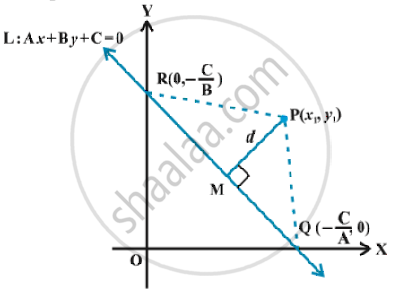
the line meets the x-and y-axes at the points Q and R, respectively. Then, coordinates of the points are `Q (-C/A,0)` and `R (0,-C/B)`. Thus the area of the triangle PQR is given by
area
`(triangle PQR)=1/2PM .QR`, which gives
PM=`(2 area (triangle PQR))/(QR)` ...(1)
Also, area `(triangle PQR) = 1/2 |x_1(0+C/B)+(-C/A)(-C/B-y_1)+0(y_1-0)|`
=`1/2|x_1C/B+y_1C/A +C_2/(AB)|`
or `2area(trianglePQR) = |C/(AB)|.|Ax_1 + By_1+C| `
and QR = `sqrt((0+C/A)^2 + (C/B-0)^2) = |C/(AB)| sqrt(A^2+B^2)`
Substituting the values of area (∆PQR) and QR in (1), we get
PM = `|Ax_1+By_1+C|/sqrt(A_2+B_2)`
or
d=`|Ax_1+By_1+C|/sqrt(A_2+B_2)`.
Thus, the Thus, the perpendicular distance (d) of a line Ax + By+ C = 0 from a point`(x_1, y_1)` is given by
d=`|Ax_1+By_1+C|/sqrt(A_2+B_2)`
Distance between two parallel lines :
The slopes of two parallel lines are equal. Therefore, two parallel lines can be taken in the form
y = mx+c_1 ...(1)and
y = mx +c_2 ...(2)
Line (1) will intersect x-axis at the point
A`(-c_1/m,0)` as shown in fig.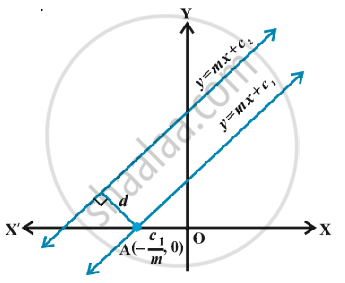
Distance between two lines is equal to the length of the perpendicular from point A to line (2). Therefore, distance between the lines (1) and (2) is
`|(-m)(-c_1/m)+(-c_2)|/sqrt(1+m_2) or d = |c_1-c_2|/sqrt(1+m_2)`
Thus, the distance d between two parallel lines y= mx+ `c_1` and ` y= mx c_2` = + is given by
d = `|c_1-c_2|sqrt(1+m_2)`.
If lines are given in general form, i.e., `Ax + By + C_1` = 0 and `Ax + By + C_2 `= 0,
then above formula will take the form d =` |c_1-C_2|/sqrt(A_2+B_2)`.
