Advertisements
Advertisements
प्रश्न
Find the co-ordinates of the point, which divides the line segment joining the points A(2, − 6, 8) and B(− 1, 3, − 4) externally in the ratio 1 : 3.
Advertisements
उत्तर
Let `bara` and `barb` be the position vectors of the points A and B respectively.
Then, `bara = 2hati −6hatj + 8hatk` and `barb = −hati +3hatj −4hatk`
Let R( `barr` ) be the point which divides the line segment joining the points A and B externally in the ratio 1 : 3.
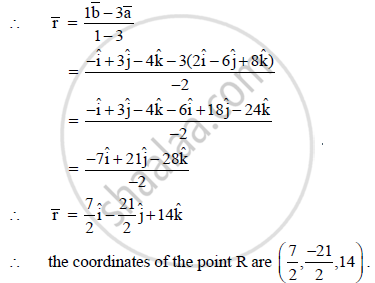
APPEARS IN
संबंधित प्रश्न
Find the distance of the point (–1, 1) from the line 12(x + 6) = 5(y – 2).
Find perpendicular distance from the origin to the line joining the points (cosΘ, sin Θ) and (cosΦ, sin Φ).
If sum of the perpendicular distances of a variable point P (x, y) from the lines x + y – 5 = 0 and 3x – 2y+ 7 = 0 is always 10. Show that P must move on a line.
Find the distance of the point (2, 5) from the line 3x + y + 4 = 0 measured parallel to the line 3x − 4y+ 8 = 0.
Find the equation of a line perpendicular to the line \[\sqrt{3}x - y + 5 = 0\] and at a distance of 3 units from the origin.
Find the distance of the point (4, 5) from the straight line 3x − 5y + 7 = 0.
Find the perpendicular distance of the line joining the points (cos θ, sin θ) and (cos ϕ, sin ϕ) from the origin.
Find the distance of the point of intersection of the lines 2x + 3y = 21 and 3x − 4y + 11 = 0 from the line 8x + 6y + 5 = 0.
What are the points on X-axis whose perpendicular distance from the straight line \[\frac{x}{a} + \frac{y}{b} = 1\] is a ?
Show that the product of perpendiculars on the line \[\frac{x}{a} \cos \theta + \frac{y}{b} \sin \theta = 1\] from the points \[( \pm \sqrt{a^2 - b^2}, 0) \text { is }b^2 .\]
If sum of perpendicular distances of a variable point P (x, y) from the lines x + y − 5 = 0 and 3x − 2y + 7 = 0 is always 10. Show that P must move on a line.
Determine the distance between the pair of parallel lines:
y = mx + c and y = mx + d
Determine the distance between the pair of parallel lines:
4x + 3y − 11 = 0 and 8x + 6y = 15
Write the value of θ ϵ \[\left( 0, \frac{\pi}{2} \right)\] for which area of the triangle formed by points O (0, 0), A (a cos θ, b sin θ) and B (a cos θ, − b sin θ) is maximum.
Write the distance between the lines 4x + 3y − 11 = 0 and 8x + 6y − 15 = 0.
If the lines x + ay + a = 0, bx + y + b = 0 and cx + cy + 1 = 0 are concurrent, then write the value of 2abc − ab − bc − ca.
Write the locus of a point the sum of whose distances from the coordinates axes is unity.
The distance between the orthocentre and circumcentre of the triangle with vertices (1, 2), (2, 1) and \[\left( \frac{3 + \sqrt{3}}{2}, \frac{3 + \sqrt{3}}{2} \right)\] is
Area of the triangle formed by the points \[\left( (a + 3)(a + 4), a + 3 \right), \left( (a + 2)(a + 3), (a + 2) \right) \text { and } \left( (a + 1)(a + 2), (a + 1) \right)\]
The line segment joining the points (1, 2) and (−2, 1) is divided by the line 3x + 4y = 7 in the ratio ______.
Distance between the lines 5x + 3y − 7 = 0 and 15x + 9y + 14 = 0 is
A plane passes through (1, - 2, 1) and is perpendicular to two planes 2x - 2y + z = 0 and x - y + 2z = 4. The distance of the plane from the point (1, 2, 2) is ______.
The shortest distance between the lines
`bar"r" = (hat"i" + 2hat"j" + hat"k") + lambda (hat"i" - hat"j" + hat"k")` and
`bar"r" = (2hat"i" - hat"j" - hat"k") + mu(2hat"i" + hat"j" + 2hat"k")` is
If the tangent to the curve y = 3x2 - 2x + 1 at a point Pis parallel toy = 4x + 3, the co-ordinates of P are
If P(α, β) be a point on the line 3x + y = 0 such that the point P and the point Q(1, 1) lie on either side of the line 3x = 4y + 8, then _______.
Find the distance between the lines 3x + 4y = 9 and 6x + 8y = 15.
Show that the locus of the mid-point of the distance between the axes of the variable line x cosα + y sinα = p is `1/x^2 + 1/y^2 = 4/p^2` where p is a constant.
The distance of the point of intersection of the lines 2x – 3y + 5 = 0 and 3x + 4y = 0 from the line 5x – 2y = 0 is ______.
A point equidistant from the lines 4x + 3y + 10 = 0, 5x – 12y + 26 = 0 and 7x + 24y – 50 = 0 is ______.
The ratio in which the line 3x + 4y + 2 = 0 divides the distance between the lines 3x + 4y + 5 = 0 and 3x + 4y – 5 = 0 is ______.
The value of the λ, if the lines (2x + 3y + 4) + λ (6x – y + 12) = 0 are
| Column C1 | Column C2 |
| (a) Parallel to y-axis is | (i) λ = `-3/4` |
| (b) Perpendicular to 7x + y – 4 = 0 is | (ii) λ = `-1/3` |
| (c) Passes through (1, 2) is | (iii) λ = `-17/41` |
| (d) Parallel to x axis is | λ = 3 |
The point of intersection of the diagonals of the rectangle whose sides are contained in the lines x = 8, x = 10, y = 11, and y =12 is
