Advertisements
Chapters
2: Locating Places on Earth
3: Movements of the Earth
4: Structure of the Earth
5: Rocks
6: Landforms of the Earth
▶ 7: Earthquakes
8: Volcanoes
9: Weathering and Denudation
10: Hydrosphere
11: Composition and Structure of Atmosphere
12: Insolation
13: Atmospheric Pressure and Winds
14: Humidity
15: Pollution-Types and Sources
16: Effects of Pollution
17: Pollution—Preventive Measures
18: Natural Regions of the World
*: Map Based Questions
![Rachna Sapra solutions for जिओग्राफी [अंग्रेजी] कक्षा ९ आईसीएसई chapter 7 - Earthquakes - Shaalaa.com](/images/geography-english-class-9-icse_6:e1464ff004d844649e81e9e1e11e08a5.jpg "Rachna Sapra solutions for जिओग्राफी [अंग्रेजी] कक्षा ९ आईसीएसई chapter 7 - Earthquakes")
Advertisements
Solutions for Chapter 7: Earthquakes
Below listed, you can find solutions for Chapter 7 of CISCE Rachna Sapra for जिओग्राफी [अंग्रेजी] कक्षा ९ आईसीएसई.
Rachna Sapra solutions for जिओग्राफी [अंग्रेजी] कक्षा ९ आईसीएसई 7 Earthquakes SOLVE AND SCORE [Pages 67 - 69]
Multiple Choice Questions (MCQs):
Japan which lies in the Ring of Fire experiences frequent earthquakes. As it is an island country, it experiences a typical phenomenon which is a result of an earthquake taking place under the ocean. What is this phenomena called?
Landslides
Tsunamis
Avalanches
Cyclones
Which of the following is not a seismic wave?
P waves
S wave
L waves
T waves
During the Gujarat earthquake, the maximum destruction took place in the Bhuj district. This means the ______ of the earthquake was located in Bhuj. Choose the correct answer.
Seismic focus
Epicentre
Нуросеntre
Fault
Which scale is used by media to describe the intensity of the earthquake?
Richter Scale
Modified Mercalli Intensity Scale
Metric Scale
Secondary Scale
Identify the instrument shown in the picture.
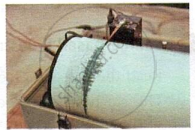
Hydrograph
Thermometer
Polygraph
Seismograph
The ocean around which the ring of fire lies is ______.
Pacific Ocean
Indian Ocean
Atlantic Ocean
Southern Ocean
About how many tremors of different strength occur every year?
One lakh
One million
Half million
In thousands
Which one among the following countries does not lie in a seismic zone?
Japan
Nepal
India
UK
When the tectonic plates slide against each other, their movement forms ______.
Convergent boundary
Divergent boundary
Transform boundary
Plate boundary
Нуроcentre is the other name of ______.
Seismic focus
Epicentre
Core
Primary waves
Shear stress is the term associated with ______.
Convergent boundary
Divergent boundary
Transform boundary
None of these
Which of the following is not a human cause of earthquake?
Mining
Volcanic activity
Chemical explosion
Dam construction
Which seismic waves are most destructive?
P waves
S waves
L waves
None of these
The mid oceanic ridge is the site of most of the volcanic eruptions which take place under the oceans. Which type of plate boundary is formed at the crest of the mid oceanic ridge?
Convergent boundary
Divergent boundary
Transform boundary
None of these
The Himalayas are young fold mountains. They have been formed as a result of the movement of two tectonic plates. Which type of plate movement results in the formation of fold mountains?
Converging movement
Diverging movement
Transform movement
None of these
Assertion-Reason Based Questions: Four options are given for each question. Choose the correct option for your answer.
Assertion (A): Earthquakes are caused due to the release of energy.
Reason (R): The energy travels inside the Earth in the form of seismic waves.
Both A and R are true and R is the correct reason for A.
Both A and R are true but R is not the correct reason for А.
A is true and R is false.
A is false and R is true.
Assertion (A): The most common cause of earthquakes is the movement of tectonic plates.
Reason (R): The tectonic plates are in constant motion.
Both A and R are true and R is the correct reason for A.
Both A and R are true but R is not the correct reason for А.
A is true and R is false.
A is false and R is true.
Assertion (A): The P waves cause the maximum damage.
Reason (R): The amplitude of L waves is the highest.
Both A and R are true and R is the correct reason for A.
Both A and R are true but R is not the correct reason for А.
A is true and R is false.
A is false and R is true.
Assertion (A): About 20% of the earthquakes occur in the Alpine Himalayan mountain belt.
Reason (R): The Alpine Himalayan mountain belt is located at the convergence of tectonic plates.
Both A and R are true and R is the correct reason for A.
Both A and R are true but R is not the correct reason for А.
A is true and R is false.
A is false and R is true.
Assertion (A): Earthquake waves have been an important source of information about the interior of the earth.
Reason (R): Earthquake waves originate from the seismic focus.
Both A and R are true and R is the correct reason for A.
Both A and R are true but R is not the correct reason for А.
A is true and R is false.
A is false and R is true.
Source-based Questions:
Read the passage given below and answer the following questions.
|
The earthquakes experienced in the Himalayan region are caused due to the convergent boundary formed due to the movement of the Indian plate into the Eurasian plate. You will be amazed to know that the Indian plate was originally located at about 50° S latitude and has moved northward to its present location on the Earth. The divergent plate boundary formed due to the movements in the Mid oceanic ridge is the main cause of earthquakes under the sea. Mid oceanic ridge measures about 70,000 km and lies in the middle of the five oceans. Volcanic eruptions are another major cause of earthquakes. In fact the earthquakes and the volcanoes go hand in hand, since one may lead to another. There are also some human factors which may cause earthquakes. These are generally minor in nature. The mining and quarrying activities, the chemical and nuclear explosions, building of dams and reservoirs, using the dynamite for construction of roads in the mountainous region, etc. are some of the human factors. These are felt locally only. |
- Name the two tectonic plates whose convergent boundaries led to the formation of the himalayas.
- What is the cause of earthquakes that take place under the oceans?
- Earthquakes and volcanoes go hand in hand. What does this mean?
- Name two human activities which may cause local earthquakes.
Answer the following questions.
Which instrument is used to record waves generated by an earthquake?
What is seismology?
Define ‘focus and epicentre of an earthquake’.
How many types of waves are generated by an earthquake? Name them.
What is the main cause of earthquake?
Give an example of a quake lake.
Name five countries which are most prone to earthquake.
What is the ring of fire?
Describe if there are any constructive benefits of earthquake. Give example.
Mention the three most seismically sensitive regions of the world.
What is a tsunami?
What causes a tsunami?
What causes an earthquake? Explain.
Name the two types of scales used to measure the earthquakes.
Suggest some preparedness measures against earthquake.
Mention the three types of movements shown by the tectonic plates.
Give the example of three types of plate movements.
Distinguish between primary waves and secondary waves.
Which type of seismic waves are most destructive? Why?
Give any two destructive effects of earthquakes.
Mention the range of mercalli scale.
Mention the range of richter scale.
What is mid-oceanic ridge?
Name any five countries which lie in the ‘Ring of Fire’.
Name any five mountain ranges which belong to the Alpine-Himalayan belt.
Define plate tectonics.
Solutions for 7: Earthquakes
Rachna Sapra solutions for जिओग्राफी [अंग्रेजी] कक्षा ९ आईसीएसई chapter 7 - Earthquakes
Shaalaa.com has the CISCE Mathematics जिओग्राफी [अंग्रेजी] कक्षा ९ आईसीएसई CISCE solutions in a manner that help students grasp basic concepts better and faster. The detailed, step-by-step solutions will help you understand the concepts better and clarify any confusion. Rachna Sapra solutions for Mathematics जिओग्राफी [अंग्रेजी] कक्षा ९ आईसीएसई CISCE 7 (Earthquakes) include all questions with answers and detailed explanations. This will clear students' doubts about questions and improve their application skills while preparing for board exams.
Further, we at Shaalaa.com provide such solutions so students can prepare for written exams. Rachna Sapra textbook solutions can be a core help for self-study and provide excellent self-help guidance for students.
Concepts covered in जिओग्राफी [अंग्रेजी] कक्षा ९ आईसीएसई chapter 7 Earthquakes are .
Using Rachna Sapra जिओग्राफी [अंग्रेजी] कक्षा ९ आईसीएसई solutions Earthquakes exercise by students is an easy way to prepare for the exams, as they involve solutions arranged chapter-wise and also page-wise. The questions involved in Rachna Sapra Solutions are essential questions that can be asked in the final exam. Maximum CISCE जिओग्राफी [अंग्रेजी] कक्षा ९ आईसीएसई students prefer Rachna Sapra Textbook Solutions to score more in exams.
Get the free view of Chapter 7, Earthquakes जिओग्राफी [अंग्रेजी] कक्षा ९ आईसीएसई additional questions for Mathematics जिओग्राफी [अंग्रेजी] कक्षा ९ आईसीएसई CISCE, and you can use Shaalaa.com to keep it handy for your exam preparation.
