Advertisements
Chapters
2: Locating Places on Earth
3: Movements of the Earth
4: Structure of the Earth
5: Rocks
6: Landforms of the Earth
7: Earthquakes
8: Volcanoes
9: Weathering and Denudation
10: Hydrosphere
11: Composition and Structure of Atmosphere
▶ 12: Insolation
13: Atmospheric Pressure and Winds
14: Humidity
15: Pollution-Types and Sources
16: Effects of Pollution
17: Pollution—Preventive Measures
18: Natural Regions of the World
*: Map Based Questions
![Rachna Sapra solutions for जिओग्राफी [अंग्रेजी] कक्षा ९ आईसीएसई chapter 12 - Insolation - Shaalaa.com](/images/geography-english-class-9-icse_6:e1464ff004d844649e81e9e1e11e08a5.jpg "Rachna Sapra solutions for जिओग्राफी [अंग्रेजी] कक्षा ९ आईसीएसई chapter 12 - Insolation")
Advertisements
Solutions for Chapter 12: Insolation
Below listed, you can find solutions for Chapter 12 of CISCE Rachna Sapra for जिओग्राफी [अंग्रेजी] कक्षा ९ आईसीएसई.
Rachna Sapra solutions for जिओग्राफी [अंग्रेजी] कक्षा ९ आईसीएसई 12 Insolation SOLVE AND SCORE [Pages 120 - 123]
Multiple Choice Questions (MCQs):
Earth receives 1 part out of ______ parts of solar radiation.
2,00,000
20,00,000
20,00,00,000
2,000,000,000
The energy given out by the Sun in the solar system is called ______.
Solar radiation
Insolation
Terrestrial radiation
Albedo
The solar energy which reaches the Earth is ______.
Infrared waves
Ultraviolet rays
PAR
All of these.
The ______ % of insolation is absorbed by the atmosphere.
14
34
51
35
In the absence of atmosphere:
Earth would have been very hot during the day
Very cold at night
Both Earth would have been very hot during the day & very cold at night
Neither Earth would have been very hot during the day nor very cold at night
Which of the following does not form part of Albedo?
Clouds
Ice
Human beings
Water bodies
The process of heating, which takes place when the bodies are in physical contact with each other is called ______.
Conduction
Convection
Radiation
Advection
1 calorie per gram per 1°C is the specific heat of ______.
Land
Air
Water
None of these.
Choose the incorrect statement.
Insolation is more over oceans than on continents.
Insolation is less on equator.
Insolation is more in tropics.
Insolation is more in summers than winters.
During which period of the day the Sun’s rays make the highest angle of incidence?
Morning
Noon
Afternoon
Evening
Which of the following heat zones receives the smallest solar footprint?
Torrid
Temperate
Frigid
All receive equal.
In which of the following heat zones there are long periods when the Sun rays are not received at all?
Torrid
Temperate
Frigid
None of these.
The phenomena of inversion of temperature takes place in ______.
Mountains
Plains
Deserts
Coastal area
Kanpur is hotter than Mumbai due to the ______.
Latitude
Altitude
Distance from sea
Ocean currents
Which type of soil absorbs the maximum insolation?
Alluvial
Red
Black
Laterite
Assertion-Reason Based Questions:
Assertion (A): Forests are much cooler than deserts.
Reason (R): Vegetation reflects back the insolation.
Both A and R are true, and R is the correct reason for A.
Both A and R are true, but R is not the correct reason for A.
A is true, and R is false.
A is false, and R is true.
Assertion (A): Coastal places experience moderate temperatures.
Reason (R): Coastal places experience land and sea breezes.
Both A and R are true, and R is the correct reason for A.
Both A and R are true, but R is not the correct reason for A.
A is true, and R is false.
A is false, and R is true.
Assertion (A): The process of conduction heats up the lower layers of the atmosphere.
Reason (R): The lower layers of the atmosphere are in contact with the land.
Both A and R are true, and R is the correct reason for A.
Both A and R are true, but R is not the correct reason for A.
A is true, and R is false.
A is false, and R is true.
Assertion (A): Cloudy days are cool, while the cloudy nights are cooler.
Reason (R): Clouds trap the heat.
Both A and R are true, and R is the correct reason for A.
Both A and R are true, but R is not the correct reason for A.
A is true, and R is false.
A is false, and R is true.
Assertion (A): The temperature decreases with increasing altitude.
Reason (R): The lower layers of the atmosphere are denser due to the presence of CO2 and water vapour.
Both A and R are true, and R is the correct reason for A.
Both A and R are true, but R is not the correct reason for A.
A is true, and R is false.
A is false, and R is true.
Source-based Questions:
Read the graph to answer the following questions.

- Which type of climate experiences a constantly high temperature?
- Which type of climate experiences the lowest range of temperature?
- Which type of climate experiences the highest range of temperature?
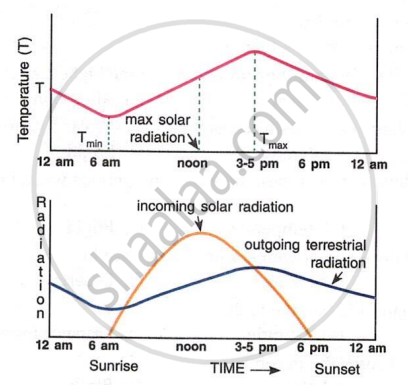
- At what time of the day is the highest temperature recorded?
- At what time of the day is the maximum insolation received?
- The two time records are not the same. Explain the reason for the difference.
Answer the following questions.
What is the major source of atmospheric heat?
Define conduction.
Define the following term:
Torrid zone
What is the location of the frigid zone in the Northern Hemisphere?
What do you mean by insolation?
Give two points of importance of insolation.
Explain the term heat budget.
Explain the term albedo.
Name the three processes by which the Earth’s atmosphere is heated.
Define the term isotherm.
Define the term Normal Lapse Rate.
Explain the role of the nature of soil in determining the temperature of a place.
Name the instrument used to measure the atmospheric temperature.
Why deserts have higher range of temperature than the coastal areas?
What is a maritime climate?
Give one example of a maritime climate.
What do you mean by the diurnal range of temperature?
Between the cities of Mumbai and Jaisalmer, which place will have a higher diurnal range of temperature? Why?
What is a continental type of climate?
Give one example of a continental type of climate from India.
What is the local wind ‘Loo’?
In which season and parts of India does ‘Loo’ blow?
Why are the south-facing slopes in the Northern Hemisphere warmer than the north-facing slopes?
Although the Earth constantly receives huge solar radiation, yet temperatures remain moderate in most parts of the world. Give geographical reasons.
Why the Earth does not receive 100% of the Insolation?
How does the Earth maintain its heat budget?
Explain the role of ocean currents in modifying the climate of a place.
Nainital and Delhi are almost at the same latitude, yet there is a lot of difference in their climate. Give reasons.
Why are the oceans comparatively cooler than the land? Give a reason.
Imagine and discuss what will be the climate of India if there were no Himalayas.
How do the winds modify the temperature of a place?
What is the inversion of temperature?
Under what conditions does the inversion of temperature apply?
List out the various factors influencing the temperature of a place.
Why are the slanting rays less effective than the vertical rays in heating up the atmosphere?
What is meant by ‘normal lapse rate’?
Give the Normal Lapse Rate value.
Give reasons why coastal climates are equable.
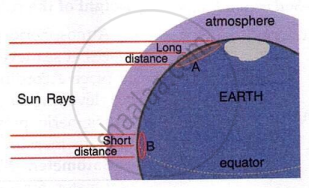
Study the given diagram and tell which of the two places (A and B) will record higher temperatures. Give reasons to support your answer.
Solutions for 12: Insolation
Rachna Sapra solutions for जिओग्राफी [अंग्रेजी] कक्षा ९ आईसीएसई chapter 12 - Insolation
Shaalaa.com has the CISCE Mathematics जिओग्राफी [अंग्रेजी] कक्षा ९ आईसीएसई CISCE solutions in a manner that help students grasp basic concepts better and faster. The detailed, step-by-step solutions will help you understand the concepts better and clarify any confusion. Rachna Sapra solutions for Mathematics जिओग्राफी [अंग्रेजी] कक्षा ९ आईसीएसई CISCE 12 (Insolation) include all questions with answers and detailed explanations. This will clear students' doubts about questions and improve their application skills while preparing for board exams.
Further, we at Shaalaa.com provide such solutions so students can prepare for written exams. Rachna Sapra textbook solutions can be a core help for self-study and provide excellent self-help guidance for students.
Concepts covered in जिओग्राफी [अंग्रेजी] कक्षा ९ आईसीएसई chapter 12 Insolation are .
Using Rachna Sapra जिओग्राफी [अंग्रेजी] कक्षा ९ आईसीएसई solutions Insolation exercise by students is an easy way to prepare for the exams, as they involve solutions arranged chapter-wise and also page-wise. The questions involved in Rachna Sapra Solutions are essential questions that can be asked in the final exam. Maximum CISCE जिओग्राफी [अंग्रेजी] कक्षा ९ आईसीएसई students prefer Rachna Sapra Textbook Solutions to score more in exams.
Get the free view of Chapter 12, Insolation जिओग्राफी [अंग्रेजी] कक्षा ९ आईसीएसई additional questions for Mathematics जिओग्राफी [अंग्रेजी] कक्षा ९ आईसीएसई CISCE, and you can use Shaalaa.com to keep it handy for your exam preparation.
