Advertisements
Chapters
Geography
2: Shaping of the Earth’s Surface
3: Atmosphere and Climate
History
4: Early Humans and Beginning of Civilisation
5: State and Society up to 1000 CE
Political Science
6: Democracy
▶ 7: Elections
Economics
8: Building Blocks in Economics: The Problem of Choice
9: The Price Puzzle: What Drives the Market
![NCERT solutions for सोशल साइंस अन्डर्स्टैन्डिंग सोसाइटी इंडिया एण्ड बिऑन्ड पार्ट १ [अंग्रेजी] कक्षा ९ chapter 7 - Elections - Shaalaa.com](/images/social-science-understanding-society-india-and-beyond-part-1-english-class-9_6:459c35e86f274147a517b882e2baab81.jpg "NCERT solutions for सोशल साइंस अन्डर्स्टैन्डिंग सोसाइटी इंडिया एण्ड बिऑन्ड पार्ट १ [अंग्रेजी] कक्षा ९ chapter 7 - Elections")
Advertisements
Solutions for Chapter 7: Elections
Below listed, you can find solutions for Chapter 7 of CBSE NCERT for सोशल साइंस अन्डर्स्टैन्डिंग सोसाइटी इंडिया एण्ड बिऑन्ड पार्ट १ [अंग्रेजी] कक्षा ९.
NCERT solutions for सोशल साइंस अन्डर्स्टैन्डिंग सोसाइटी इंडिया एण्ड बिऑन्ड पार्ट १ [अंग्रेजी] कक्षा ९ 7 Elections Intext Questions [Pages 161 - 178]
The Big Questions
Why are elections essential to a democratic system?
How do electoral systems shape political representation?
How do electoral rules ensure fairness?
What role do institutions play in ensuring free and fair elections?
What role do laws play in ensuring free and fair elections?
What challenges do elections face in practice, and how can these challenges affect democracy?
LET’S EXPLORE
Different democracies use different electoral systems. Make groups of 5–6 students. Each group will select six countries from different continents. Prepare and present a case study on the type of electoral system(s) operating in those countries, and discuss their latest election results of those countries.
DON’T MISS OUT
Article 82 of the Constitution of India mandates the establishment of a Delimitation Commission. India has had four Delimitation Commissions in 1952, 1963, 1973, and 2002. Can you find out the reason for the long interval between 1973 and 2002 with the help of your teacher?
THINK ABOUT IT
You will turn 18 in a few years. As a responsible citizen, you should register yourself as a voter. Find out the various steps of the procedure for registration and the list of required documents for the same. Discuss, with anyone who has just turned 18 and has registered as a voter, the ease or difficulty faced in the voter registration process.
LET’S EXPLORE
- Do you know what ETPBS is?
ETPBS stands for Electronically Transmitted Postal Ballot System. It enables service voters to cast their vote on an electronically received postal ballot from their preferred location, which is outside their originally assigned voting constituency.
- Find out who are classified as service voters and who can vote usinETPBS?
LET'S MAP
Choose any three states (including yours). Find the symbols of state parties belonging to those states and plot them on the given map of India. List down their major agenda, as mentioned in their manifesto in the latest Lok Sabha/Vidhan Sabha/Local Body Elections.
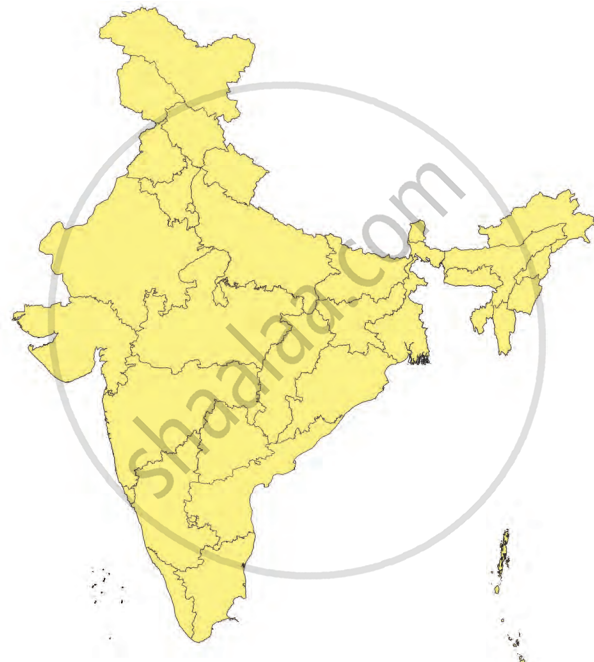
Form groups of 4–6 students. Identify and compare the policy preferences on the following parameters for two political parties in the last Lok Sabha Elections using credible sources like party manifestos, newspapers, etc. Present the points of comparison in a poster using bullet points, symbols, colour coding, etc.
| Policy area | Party’s viewpoint | Any policy/law that aligns with the party’s viewpoint | Source |
| Education | |||
| National security | |||
| Social welfare | |||
| Environment | |||
| Economy | |||
| Health |
LET’S EXPLORE
Find out the number of state parties. You may visit the website of ECI.
Find out the number of Registered Unrecognised Political Parties (RUPP). You may visit the website of ECI.
Find out the name and the composition (number and name of the national and state parties) of the alliances that won in the following elections to the Lok Sabha.
| Year | Alliance Won | National parties | State parties |
| 1977 | |||
| 1999 | |||
| 2004 | |||
| 2009 | |||
| 2014 | |||
| 2019 | |||
| 2024 |
LET’S ANALYSE
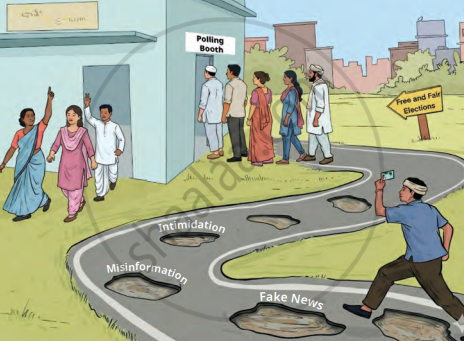
Look at the road to free and fair elections above Fig. Fill in the empty potholes with some more challenges after discussing them with your teachers and parents. How can we overcome these challenges?
NCERT solutions for सोशल साइंस अन्डर्स्टैन्डिंग सोसाइटी इंडिया एण्ड बिऑन्ड पार्ट १ [अंग्रेजी] कक्षा ९ 7 Elections Questions and activities [Pages 179 - 182]
What reform has been introduced by the ECI to make voting more inclusive for the following group?
People with Disabilities
What reform has been introduced by the ECI to make voting more inclusive for the following group?
Service Voters
What reform has been introduced by the ECI to make voting more inclusive for the following group?
Senior Citizens - 60 years and above; and 80 years and above
What reform has been introduced by the ECI to make voting more inclusive for the following group?
Prisoners
What reform has been introduced by the ECI to make voting more inclusive for the following group?
Persons in preventive detention
What are the various functions of the Election Commission of India? Which of these functions is most important for the conduct of free and fair elections? Explain.
Elections are the soul of a democracy. Do you agree? Why or why not?
Explain at least three differences between the national and state/regional political parties.
Why should you vote? Arrange the following in the descending order of your choice. Discuss the reasons for your choice.
- Opportunity to choose my representative
- Makes me a responsible person
- Opportunity to change the non-performing representative
- Strengthens democracy
What is the Special Intensive Revision (SIR) initiative of the ECI?
Explain the objectives and the necessity of conducting SIR.
Match the political party name with its symbol.
| Political Parties Name | Symbol |
| Aam Aadmi Party (AAP) |  |
| Bharatiya Janata Party (BJP) |  |
| Bahujan Samaj Party (BSP) |  |
| Communist Party of India (Marxist) [CPI (M)] |  |
| Indian National Congress (INC) |  |
| National People’s Party (NPP) |  |
Read the case study below and answer the following questions.
| Ishani and her mother were in the local market, day before the state assembly elections. She noticed wall writing and campaign posters pasted everywhere. Large groups of campaigners were distributing pamphlets and raising slogans in support of the respective candidates. Ishani has turned 18 and will be voting for the first time. She had registered to vote through the ECI’s online portal. The next morning, she, along with her mother and her disabled elder brother, went to the polling station, which was well guarded by the police personnel. A wheelchair was made available to them, and volunteers guided them to the polling booth. Inside the polling booth, there were only three people who were performing all duties. Ishani had forgotten her voter ID card and Aadhaar card, but she was surprised as no one asked for them. After casting her vote, she was also able to see the VVPAT slip. While leaving, she wondered how the police personnel vote, as they must be on duty from early morning till late evening. When she went home, she narrated her entire experience to her 89-year-old grandmother, who cast her vote from home. |
- What initiatives were taken by the ECI to enable the voters to cast their vote?
- If Ishani was allowed to vote even without carrying her voter ID card or Aadhaar card, which other document might she be carrying that is valid for voting?
- Cite the examples of violations of the Model Code of Conduct.
- Give a suitable title to the passage.
- Find out how the police and army personnel cast their votes.
A comparative chart of three countries is given below. Based on the information given in the chart, answer the questions.
| Country A | Country | Country C | |
| Political Dimension | Written constitution, periodic elections, voting rights, party system varies from two-party to multi-party | Written constitution, periodic elections, voting rights, one political party. | Written constitution, monarchy, no voting rights, no political party. |
| Economic Dimension | Average standard of living | Above-average standard of living. | High standard of living. |
- What is the difference between having a voting right in a country with a multi-party system and another with a single-party system?
- In which of the above countries would you like to stay and why?
State the challenges in conducting free and fair elections.
On the Stage.
Elections are to be held in your school for the posts of Head Girl, Head Boy, and Sports Captain. Assume the roles of an Election Commissioner, Returning Officer, Polling Agent, Candidate, Campaigner, Polling Officer, Police Personnel, and a Journalist, and perform their roles while ensuring free, fair, and transparent elections.
Try and make videos or audios on topics like: My Vote My Nation; No Voter to be Left Behind; How to Eliminate the Ill of Money Power, etc.
| Select one national or state political party. Using authentic and reliable sources such as the Election Commission of India (ECI) website, the official website of the selected political party, and newspapers. Prepare a comparative chart of the last two State Legislative Assembly elections. The chart should include the following details for the chosen party: |
- Some promises made in the Election manifesto
- Percentage of votes polled
- Number of seats won
- Number of women who contested
- Number of women candidates elected
Present the data for both elections in a clear and comparative format, citing all sources used.
Do you think ‘One Nation, One Election’ can improve the efficiency of the electoral process? Divide the class and discuss into two groups one to examine its potential advantages and the other to analyse its limitations.
Solutions for 7: Elections
NCERT solutions for सोशल साइंस अन्डर्स्टैन्डिंग सोसाइटी इंडिया एण्ड बिऑन्ड पार्ट १ [अंग्रेजी] कक्षा ९ chapter 7 - Elections
Shaalaa.com has the CBSE Mathematics सोशल साइंस अन्डर्स्टैन्डिंग सोसाइटी इंडिया एण्ड बिऑन्ड पार्ट १ [अंग्रेजी] कक्षा ९ CBSE solutions in a manner that help students grasp basic concepts better and faster. The detailed, step-by-step solutions will help you understand the concepts better and clarify any confusion. NCERT solutions for Mathematics सोशल साइंस अन्डर्स्टैन्डिंग सोसाइटी इंडिया एण्ड बिऑन्ड पार्ट १ [अंग्रेजी] कक्षा ९ CBSE 7 (Elections) include all questions with answers and detailed explanations. This will clear students' doubts about questions and improve their application skills while preparing for board exams.
Further, we at Shaalaa.com provide such solutions so students can prepare for written exams. NCERT textbook solutions can be a core help for self-study and provide excellent self-help guidance for students.
Concepts covered in सोशल साइंस अन्डर्स्टैन्डिंग सोसाइटी इंडिया एण्ड बिऑन्ड पार्ट १ [अंग्रेजी] कक्षा ९ chapter 7 Elections are .
Using NCERT सोशल साइंस अन्डर्स्टैन्डिंग सोसाइटी इंडिया एण्ड बिऑन्ड पार्ट १ [अंग्रेजी] कक्षा ९ solutions Elections exercise by students is an easy way to prepare for the exams, as they involve solutions arranged chapter-wise and also page-wise. The questions involved in NCERT Solutions are essential questions that can be asked in the final exam. Maximum CBSE सोशल साइंस अन्डर्स्टैन्डिंग सोसाइटी इंडिया एण्ड बिऑन्ड पार्ट १ [अंग्रेजी] कक्षा ९ students prefer NCERT Textbook Solutions to score more in exams.
Get the free view of Chapter 7, Elections सोशल साइंस अन्डर्स्टैन्डिंग सोसाइटी इंडिया एण्ड बिऑन्ड पार्ट १ [अंग्रेजी] कक्षा ९ additional questions for Mathematics सोशल साइंस अन्डर्स्टैन्डिंग सोसाइटी इंडिया एण्ड बिऑन्ड पार्ट १ [अंग्रेजी] कक्षा ९ CBSE, and you can use Shaalaa.com to keep it handy for your exam preparation.
