Advertisements
Chapters
Geography
2: Shaping of the Earth’s Surface
3: Atmosphere and Climate
History
4: Early Humans and Beginning of Civilisation
5: State and Society up to 1000 CE
Political Science
6: Democracy
7: Elections
Economics
8: Building Blocks in Economics: The Problem of Choice
▶ 9: The Price Puzzle: What Drives the Market
![NCERT solutions for सोशल साइंस अन्डर्स्टैन्डिंग सोसाइटी इंडिया एण्ड बिऑन्ड पार्ट १ [अंग्रेजी] कक्षा ९ chapter 9 - The Price Puzzle: What Drives the Market - Shaalaa.com](/images/social-science-understanding-society-india-and-beyond-part-1-english-class-9_6:459c35e86f274147a517b882e2baab81.jpg "NCERT solutions for सोशल साइंस अन्डर्स्टैन्डिंग सोसाइटी इंडिया एण्ड बिऑन्ड पार्ट १ [अंग्रेजी] कक्षा ९ chapter 9 - The Price Puzzle: What Drives the Market")
Advertisements
Solutions for Chapter 9: The Price Puzzle: What Drives the Market
Below listed, you can find solutions for Chapter 9 of CBSE NCERT for सोशल साइंस अन्डर्स्टैन्डिंग सोसाइटी इंडिया एण्ड बिऑन्ड पार्ट १ [अंग्रेजी] कक्षा ९.
NCERT solutions for सोशल साइंस अन्डर्स्टैन्डिंग सोसाइटी इंडिया एण्ड बिऑन्ड पार्ट १ [अंग्रेजी] कक्षा ९ 9 The Price Puzzle: What Drives the Market Intext Questions [Pages 195 - 208]
The Big Questions
What are the factors that influence the demand for and supply of goods and services in a market?
How are prices of goods and services determined through demand and supply interactions?
What is market equilibrium?
Does market equilibrium exist in the real world?
How and why does the government intervene in the market?
DON’T MISS OUT
Did you notice that the market demand curve is flatter than Srivalli’s individual demand curve? Why is that?
THINK ABOUT IT
What happens when you consume the first mango? It tastes delicious, right? The second one is good? The third one and so on? You are barely interested in eating mangoes by this point. Why do you think this happens?
LET’S EXPLORE
Create your own demand schedule for buying notebooks at different prices. At what price would you buy the most? At what price would you stop buying altogether? What could be the reason behind your choices?
Ask your family members if they postponed or advanced buying any product because of future expectations of changes in price.
LET’S EXPLORE
What happens to the supply of a product in case of a change in the cost of inputs, discovery of an alternate input, depletion of resources, change in weather, disaster, etc.? Discuss in class using examples of diverse goods and services.
LET’S ANALYSE
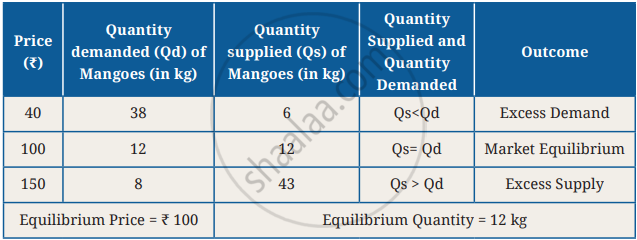
Using data from the table, plot the demand and supply curves at the three prices, i.e., ₹40, ₹100, and ₹150. Identify and mark excess demand and supply on the graph. Think about how equilibrium could be reached in these scenarios.
THINK ABOUT IT
Can you think of another real-life example (other than hotels) where prices change frequently? Explain why the prices keep changing.
Our choices today affect future resources. For example, high demand for fast fashion, overfishing and overuse of groundwater can harm future supply. So, should we focus only on short-term gains, or also think about long-term sustainability? How could this affect the market equilibrium?
THINK ABOUT IT
Have you ever seen or heard of the government fixing prices or wages (for example, bus fares, medicines, or minimum wages)? Share an example and why you think it was done.
LET’S EXPLORE
From your surroundings, list two goods or services that are provided by the government (for example: roads, streetlights, parks, police, and so on). Choose one of the goods you listed and answer:
- Who does benefit from it?
- Why would it be difficult for a private company to provide this service on its own?
- Imagine the government stops providing this good or service; what problems might people in your area face?
LET’S RECALL
In the chapter ‘Democracy’, you have read that a democratic government is accountable to the people and is expected to act in their interest.
- According to you, how should a democratic government decide when and how much it should intervene in markets to protect people’s welfare?
- Whose voices should a democratic government consider while making such decisions consumers, producers, workers, or others? Why?
NCERT solutions for सोशल साइंस अन्डर्स्टैन्डिंग सोसाइटी इंडिया एण्ड बिऑन्ड पार्ट १ [अंग्रेजी] कक्षा ९ 9 The Price Puzzle: What Drives the Market Questions and activities [Pages 210 - 213]
An increase in income always leads to a rise in demand for goods. Defend or refute, giving reasons for the same.
If petrol prices double, what happens to the demand for diesel cars?
If petrol prices double, what happens to demand for electric cars?
If petrol prices double, what happens to demand for car accessories?
If petrol prices double, what happens to demand for public transport?
A farmer traditionally irrigates fields manually (labour-intensive). He installs drip irrigation (a technology upgrade) that reduces water use by 40 per cent and increases yield by 30 per cent. How does this affect?
- His cost of production
- His willingness to supply at different prices
- The overall market supply if many farmers adopt this technology
During online festival sales, the prices of many products are very low. Use the concept of demand and supply to explain why the sellers sell at such a low price. What happens to the equilibrium when the price is lowered? Does this benefit only consumers or sellers as well? Explain.
Suppose the government sets a maximum sale price for an essential vaccine below the market-driven price. What is likely to happen? Choose from the options below and elucidate your point.
Surplus
Shortage
No effect
Fall in demand
The government levies higher taxes on products such as tobacco and alcohol to promote healthier choices among citizens. Can you find out other goods where price controls have been set in place? What are the reasons for the same?
Can excessive government regulation hurt markets? Explain with suitable examples.
In the table below, different prices of guava are given.
- Think and write how much guava you will buy at each price.
- Ask the same question to three of your friends and fill in the table.
- Also make a graph for each one of you and one final graph for the total quantity.
| Price | You | Friend 1 | Friend 2 | Friend 3 | Total |
| ₹100/kg | |||||
| ₹80/kg | |||||
| ₹50/kg | |||||
| ₹20/kg |
Visit the nearby vegetable market and try to find answers to the following questions.
- Who decides the prices of different vegetables in the vegetable market?
- Sometimes the prices of a few vegetables is too high, and sometimes too low. Why is this?
- The price of tomatoes is high in the morning and eventually gets lower by the evening. Have you ever noticed this? Comment.
Categorise the following combination of goods into substitute goods and complementary goods.
- Movie ticket in the cinema hall and popcorn
- Eraser and pencil
- Laptop and computer
- Air conditioner and cooler
- Notebook and pen
- Apple and banana
- Mobile and earphones
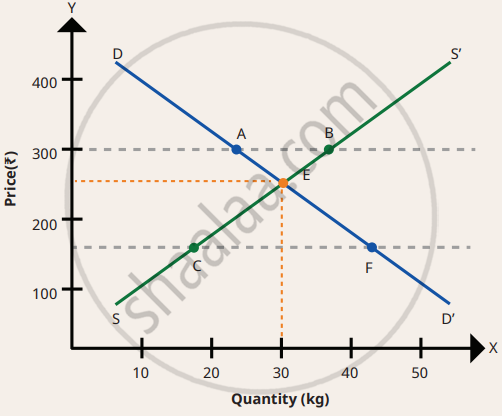
Shows the demand curve DD’ and supply curve SS’. Based on the figure, answer the following questions:
- What does point E represent in this market?
- What is the equilibrium price and equilibrium quantity at point E?
- Point A lies on DD’. Point B lies on SS’. What do the points A and B indicate about demand and supply? What does the gap between A and B (both on the upper dashed price line) represent?
- Point F lies on DD’. Point C lies on SS’. What do the points F and C indicate about demand and supply? What does the gap between C and F (both on the lower dashed price line) represent?
- If the price stays at the lower dashed line, what could happen next in a free market?
Draw a market equilibrium graph using the following demand schedule.
| Price (₹) | 10 | 20 | 30 | 40 | 50 |
| Q.D. (kg) | 5 | 10 | 15 | 20 | 25 |
| Q.S. (kg) | 25 | 20 | 15 | 10 | 5 |
- Plot the demand and supply curve using the above data.
- Identify the equilibrium price and quantity.
- Observe the above data and analyse what happens if the price is set at ₹20 or ₹40.
Solutions for 9: The Price Puzzle: What Drives the Market
NCERT solutions for सोशल साइंस अन्डर्स्टैन्डिंग सोसाइटी इंडिया एण्ड बिऑन्ड पार्ट १ [अंग्रेजी] कक्षा ९ chapter 9 - The Price Puzzle: What Drives the Market
Shaalaa.com has the CBSE Mathematics सोशल साइंस अन्डर्स्टैन्डिंग सोसाइटी इंडिया एण्ड बिऑन्ड पार्ट १ [अंग्रेजी] कक्षा ९ CBSE solutions in a manner that help students grasp basic concepts better and faster. The detailed, step-by-step solutions will help you understand the concepts better and clarify any confusion. NCERT solutions for Mathematics सोशल साइंस अन्डर्स्टैन्डिंग सोसाइटी इंडिया एण्ड बिऑन्ड पार्ट १ [अंग्रेजी] कक्षा ९ CBSE 9 (The Price Puzzle: What Drives the Market) include all questions with answers and detailed explanations. This will clear students' doubts about questions and improve their application skills while preparing for board exams.
Further, we at Shaalaa.com provide such solutions so students can prepare for written exams. NCERT textbook solutions can be a core help for self-study and provide excellent self-help guidance for students.
Concepts covered in सोशल साइंस अन्डर्स्टैन्डिंग सोसाइटी इंडिया एण्ड बिऑन्ड पार्ट १ [अंग्रेजी] कक्षा ९ chapter 9 The Price Puzzle: What Drives the Market are .
Using NCERT सोशल साइंस अन्डर्स्टैन्डिंग सोसाइटी इंडिया एण्ड बिऑन्ड पार्ट १ [अंग्रेजी] कक्षा ९ solutions The Price Puzzle: What Drives the Market exercise by students is an easy way to prepare for the exams, as they involve solutions arranged chapter-wise and also page-wise. The questions involved in NCERT Solutions are essential questions that can be asked in the final exam. Maximum CBSE सोशल साइंस अन्डर्स्टैन्डिंग सोसाइटी इंडिया एण्ड बिऑन्ड पार्ट १ [अंग्रेजी] कक्षा ९ students prefer NCERT Textbook Solutions to score more in exams.
Get the free view of Chapter 9, The Price Puzzle: What Drives the Market सोशल साइंस अन्डर्स्टैन्डिंग सोसाइटी इंडिया एण्ड बिऑन्ड पार्ट १ [अंग्रेजी] कक्षा ९ additional questions for Mathematics सोशल साइंस अन्डर्स्टैन्डिंग सोसाइटी इंडिया एण्ड बिऑन्ड पार्ट १ [अंग्रेजी] कक्षा ९ CBSE, and you can use Shaalaa.com to keep it handy for your exam preparation.
