Advertisements
Chapters
1: Elementary Theory of Demand
2: Elasticity of Demand
▶ 3: Theory of Supply
Unit II - Factors of Production : Basic Concepts
4: Factors of Production
Unit III - Alternative Market Structures : Basic Concepts
5: Nature and Structure of Markets
Unit IV - The State and Economic Development
6: The State and Economic Development
Unit V - Money and Banking : Basic Concepts
7: Meaning and Functions of Money
8: Commercial Banks
9: Central Banks
10: Inflation
![Goyal Brothers Prakashan solutions for इकॉनॉमिक एप्लिकेशन्स [अंग्रेजी] कक्षा १० आईसीएसई chapter 3 - Theory of Supply - Shaalaa.com](/images/economic-applications-english-class-10-icse_6:4e056063b64247cab65a92e42cef2973.jpg "Goyal Brothers Prakashan solutions for इकॉनॉमिक एप्लिकेशन्स [अंग्रेजी] कक्षा १० आईसीएसई chapter 3 - Theory of Supply")
Advertisements
Solutions for Chapter 3: Theory of Supply
Below listed, you can find solutions for Chapter 3 of CISCE Goyal Brothers Prakashan for इकॉनॉमिक एप्लिकेशन्स [अंग्रेजी] कक्षा १० आईसीएसई.
Goyal Brothers Prakashan solutions for इकॉनॉमिक एप्लिकेशन्स [अंग्रेजी] कक्षा १० आईसीएसई 3 Theory of Supply NUMERICAL QUESTIONS [Pages 69 - 70]
When price of a commodity fall by 20%, the quantity supplied decreases by 25%. Find out its price elasticity of supply.
When price of a product increases by 30% its quantity supplied rises by 15%. What is the elasticity of supply of the commodity?
If price of a commodity rises from ₹ 10 per kg to 12 per kg, the quantity supplied expands from 500 kg to 600 kg. What is elasticity of supply?
The price of a commodity is ₹ 12 per unit and its quantity supplied is 500 units. When its price rises to 15 per unit, its quantity supplied rises to 650 units. Calculate its price elasticity of supply. Is its supply elastic?
If the price of a commodity falls from ₹ 60 per unit to ₹ 58 per unit, its supply contracts from 400 units to 300 units. Find out its elasticity of supply.
Price of a commodity increases by ₹ 5 per unit and due to this, supply increases from 100 units to 150 units. Determine price elasticity of supply, if original price was ₹ 25 per units.
A fall in price of a firm’s product results in a fall in its supply by 40 per cer cent. Its price elasticity of supply is 1.6. Calculate the percentage fall in its price.
Price elasticity of supply of a good is 2. By what percentage should its price rise so that its supply rises by 30 per cent?
The price elasticity of supply of a good is 0.8. Its price rises by 50 percent. Calculate the percentage increase in its supply.
Goyal Brothers Prakashan solutions for इकॉनॉमिक एप्लिकेशन्स [अंग्रेजी] कक्षा १० आईसीएसई 3 Theory of Supply QUESTIONS [Pages 71 - 80]
Multiple Choice Questions
Following is an essential feature of supply:
Total quantity of a product available for sale at a particular point of time.
Quantity of a product offered for sale at a certain price.
Supply is a stock variable.
All the above
Which one of the following is not a feature of supply?
Price of the commodity
Period of time
Willingness to buy
Quantity of the commodity
Other things remaining unchanged, change in supply due to increase in price is called ______.
Contraction of supply
Expansion of supply
Decrease in supply
Increase in supply
The diagram shows the supply of cotton clothes which of the following would be the case of movement from A to B?
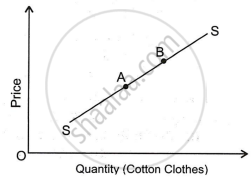
An increase in price of cotton clothes
An increase in price of silk clothes
An improvement in technology
An increase in the number of producers
Law of supply states that ______.
There is direct relation between price and supply.
There is inverse relation between price and supply.
There is direct and proportionate relation between price and supply.
None of these
Law of supply does not apply to ______.
Agricultural goods
Perishable goods
Both (a) and (b)
Neither (a) nor (b)
The law of supply is based on the assumption of ______.
Constant technology
The commodity is divisible
The prices of factors of production remain constant
All the above
Due to installation of a machine with latest technology, the cost of production has decreased. It will lead to ______.
Expansion in supply
Increase in supply
Contraction in supply
Decrease in supply
In case of ______, supply falls at the same price.
Decrease in supply
Contraction in supply
Increase in supply
Expansion in supply
The following supply curve shifts from SS to S1S1. It may be due to ______.
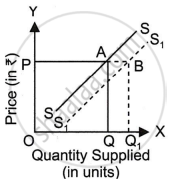
Decrease in Taxes
Upgradation of technology
Fall in the price of inputs
All of these
Which of the following does not cause shift of supply curve of a good?
Price of input
Price of the good
Goods and Services Tax
Subsidy
Which of the following factor may cause decrease in supply.
Fall in price of given product
Fall in price of factors of product
Decrease in number of firms
Expected fall in the price of given product in future
Increase or decrease in supply means ______.
shift of supply curve
movement along the supply curve
elastic supply
None of these
Identify the incorrect statement from the following:
Supply is always stated with reference to some price.
The amount supplied of a commodity will be different at different prices.
Supply is related to point of time.
Supply is different from stock.
What is the degree of elasticity of supply in the diagram?
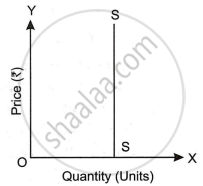
Infinity
One
Zero
None of these
A 10 per cent increase in price of a good causes 5 per cent increase in its quantity supplied, elasticity of supply will be ______.
Inelastic
Elastic
Perfectly elastic
Perfectly inelastic
When price of a·product rises by 10% its quantity supplied also rises by 10%. Find out price elasticity.
Zero
Infinity
1
10
Which of the following does not cause shift of supply curve of a good?
Price of input
Price of the good
Goods and Services Tax
Subsidy
Which of the following measures of price elasticity shows elasticity shows elastic supply?
0
0.5
1.0
1.5
In case of ______, supply curve is a vertical straight line parallel to the Y-axis.
Perfectly Elastic Supply
Unitary Elastic Supply
Perfectly Inelastic Supply
Less Elastic Supply
What are the values of (i), (ii) and (iii). Assume that there are only 3 firms in the market.
| Price (in ₹) | Firm A (units) | Firm B (units) | Firm C (units) | Market supply (units) |
| 10 | 0 | 25 | 10 | 35 |
| 20 | 10 | 30 | (ii) | 60 |
| 30 | (i) | 35 | 25 | 80 |
| 40 | 30 | 40 | 40 | (iii) |
| 50 | 40 | 45 | 50 | 135 |
20, 20, and 80
10, 20, and 110
20, 30, and 135
20, 20, and 110
If price elasticity of supply is greater than 1, then supply is said be elastic.
True
False
Match the following and select the correct option.
| Column I | Column II |
| (i) Expansion of supply | (A) Rightward shift of supply curve |
| (ii) Increase in supply | (B) Upward movement along a supply curve |
| (iii) Decrease in supply | (C) Downward movement along a supply curve |
| (iv) Contraction in supply | (D) Leftward shift of supply curve |
(i) A, (ii) B, (iii) D, (iv) C
(i) B, (ii) C, (iii) A, (iv) B
(i) B, (ii) A, (iii) D, (iv) C
(i) C, (ii) D, (iii) A, (iv) B
- Price elasticity of supply of a good is 0.8, its supply is said to be inelastic.
- If the quantity supplied of a commodity remain the same whatever its price supply is said to perfectly inelastic.
Both (i) and (ii) are true
Both (i) and (ii) are false
Statement (i) is false and statement (ii) is true
Statement (i) is true and statement (ii) is false
The given supply schedule represents ______.
| Price (₹) | 20 | 20 |
| Supply (Units) | 100 | 120 |
Expansion in supply
Increase in supply
Contraction in supply
Decrease in supply
The given diagram is a case of ______ supply.

Less Elastic Supply
Highly Elastic Supply
Unitary Elastic Supply
Perfectly Elastic Supply
What are the values of (i) and (ii)
Market Supply Schedule (Supposing that there are only 2 firms - A and B in the market)
| Price (₹) | Quantity Supplied | ||
| By A | By B | Market | |
| 4 | 10,000 | 6,000 | (ii) ______ |
| 5 | 12,000 | 10,000 | 22,000 |
| 6 | 15,000 | (i) ______ | 30,000 |
| 7 | 18,000 | 20,000 | 38,000 |
| 8 | 20,000 | 25,000 | 45,000 |
16,000 and 15000
15,000 and 16,000
15,000 and 20,000
10,000 and 16,000
Choose the correct term for the given definition.
The ratio between the percentage change in supply to a percentage change in price.
Law of demand
Law of supply
Elasticity of demand
Elasticity of supply
Which of the following statements are true?
The cost of production will increase if
- The government gives subsidies
- The firm uses obsolete technology
- The price of diesel increases
only (i) and (ii)
only (ii) and (iii)
only (i) and (iii)
All (i), (ii) and (iii)
Match the following and select the correct option.
| Column I | Column II |
| (i) Expansion of supply | (A) Prices are expected to fall in future |
| (ii) Decrease in supply | (B) Fall in prices |
| (iii) Contraction of supply | (C) Prices are expected to rise in future |
| (iv) Increase in supply | (D) Rise in prices |
(i) C, (ii) A, (iii) D, (iv) B
(i) D, (ii) A, (iii) B, (iv) C
(i) B, (ii) A, (iii) D, (iv) C
(i) D, (ii) C, (iii) B, (iv) A
A relatively inelastic supply curve implies ______.
There is no change in price but quantity supplied changes.
A small change in price brings about a larger change in quantity supplied.
A large change in price brings about a small change in quantity supplies.
Although there is change in price, quantity supplied remains constant.
What does the following table indicate?
| Price in (₹) | Quantity supplied in kg |
| 10 | 15 |
| 20 | 40 |
An extension of supply
A contraction of supply
An upward shift of supply curve
A downward shift of supply curve
When an entrepreneur introduces a new technique or a new product, it is called ______.
Invention
Innovation
Expansion
Inspiration
When the price increases by 50% and the supply increases only by 5% the price elasticity of supply of that commodity will be ______.
E1 > 1
ES = 1
E1 < 1
E1 = 0
The quantity of a commodity which a seller is ready to offer for sale at a given price and at a given time. This defines ______.
Elasticity of supply
Law of Supply
Supply
Extension of supply
Identify the elasticities of the supply curves given below.
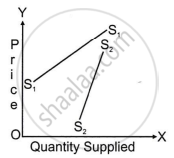
S1 : Relatively elastic: S2 : Relatively inelastic
S1 : Perfectly elastic: S2 : Perfectly inelastic
S1 : Relatively inelastic, S2 : Relatively elastic
S1 : Perfectly inelastic : S2 : Unitary elastic
The Law of Supply states that other things being constant ______.
when the quantity supplied rises, price falls.
when the price falls, quantity supplied rises.
when the quantity supplied rises, price rises.
when the price falls, quantity supplied falls.
If the price elsaticity of supply is 1 and the percentage change in price is 10, then the percentage change in quatity supplied should be ______.
10
Greater than 10
Le.sser than 10
1
What will the following cause
| Price in Rs. | Quantity supplied in Kgs. |
| 10 | 15 |
| 20 | 40 |
An extension of supply curve.
A constraction of supply curve.
A downward shift of supply curve.
An upward shift of supply curve.
When a straight-line supply curve passes through the origin, the elasticity of supply will be ______.
Unitary elastic
Relatively elastic
Relatively inelastic
Perfectly elastic
A change in the price of a good ______.
shifts the good's supply curve but does not cause a movement along it.
does not shift the good's supply curve but causes a movement along it.
shifts the good's supply curve and also causes a movement along it.
neither shifts the good's supply curve nor causes a movement along it.
Elasticity of supply is measured by:
`(ΔQ)/PxxQ/(ΔP)`
`(ΔP)/PxxQ/(ΔQ)`
`(ΔP)/(ΔQ)xxQ/(P)`
`(ΔQ)/QxxP/(ΔP)`
Pick the option which does not belong to the group.
Price of a commodity
Cost of Inputs
Income of the consumer
Level of technology
An extension of supply curve of Product X occurs when ______.
The price of the product increases
The price of its inputs increases
The price of the product decreases
The price of its substitute decreases
Supply always refers to a specific desired quantity which a seller is willing to ______.
Sell
Purchase
Store
None of these
When a straight-line supply curve cuts the y-axis, the elasticity of supply will be ______.
Elastic
Inelastic
Unitary elastic
Perfectly inelastic
What will be the effect of raising production subsidies on the supply of a commodity?
Downward movement along with the supply curve.
Leftward shift of supply curve.
Rightward shift of supply curve.
Upward movement along the supply curve.
When the percentage change in the quantity supplied of a commodity is exactly equal to the percentage change in its price it is known as ______.
Unitary elastic supply
Relatively inelastic supply
Relatively elastic supply
Perfectly inelastic supply
A linear supply curve starting from the origin making an angle of 75 degree with X-axis will have ______.
Relatively elastic supply
Relatively inelastic supply
Perfectly elastic supply
Unitary elastic supply
If Government of India bans the production of plastic bags, how will the supply curve be affected?
The supply curve would shift to the right.
The supply curve would shift to the left.
The supply curve would not shift in any direction.
The supply would become vertical.
The continuous rain and lack of fresh supply have affected the availability of tomatoes in India during June - July 2023. What will be the impact on the supply curve for tomatoes?
Supply curve will shift to the right.
Upward movement along the supply curve.
Supply curve will shift to the left.
Downward movement along the supply curve.

Identify the elasticity of supply (es) of S1, S2 and S3 supply curves:
All have es > 1
All have es < 1
All have es = 1
All have es = 0
Identify the value of elasticity of supply for the supply curve OS and S1S2.
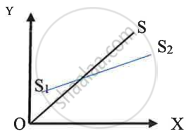
OS > 1, S1S2 < 1
OS < 1, S1S2 > 1
OS < 1, S1S2 = 1
OS = 1, S1S2 > 1
Due to cyclonic effect in an area, the sea level covers a number of rice fields in that area. This reduces productivity of land. How will this affect the supply curve of rice of that region?
Downward movement along the supply curve
Supply curve shifts to the leftward side
Upward movement along the supply curve
Supply curve shifts to the rightward side
If an increase in output by the firms in an industry causes only a slight increase or decrease in cost per unit, supply will be ______.
Perfectly elastic
Relatively elastic
Perfectly inelastic
Relatively inelastic
Assertion-Reasoning & Matching Based Questions
Identify the correct sequence of alternatives given in Column II by matching them with respective terms in Column I:
| Column I | Column II |
| A. Perfectly Inelastic | (i) Es > 1 |
| B. Perfectly Elastic | (ii) Es < 1 |
| C. Inelastic | (iii) Es = 0 |
| D. Highly Elastic | (iv) Es = infinity |
Choose the correct alternative:
A. (iv), B. (i), C. (iii), D. (ii)
A. (ii), B. (iii) c. (i), D. (iv)
A (iii), B. (iv), C. (ii) D. (i)
A. (i), B. (ii), c. (iv), D. (iii)
Read the following statements carefully and choose the correct alternative:
Statement (1): Increase in supply results from a fall in the price, other things being equal.
Statement (2): Contraction in supply results from a rise in price, other things being equal.
Statement 1 is true and statement 2 is false.
Statement 2 is true and statement 1 is false.
Both the statements are true.
Both the statements are false.
Read the following statements - Assertion (A) and Reason (R). Choose one of the correct alternatives given below:
Assertion (A): In case of perfectly inelastic supply, supply curve is a vertical straight line supply curve.
Reason (R): Supply does not change with change in price in case of Es = 0.
Both Assertion (A) and Reason (R) are true and Reason (R) is the correct explanation of Assertion (A).
Both Assertion (A) and Reason (R) are true and Reason (R) is not the correct explanation of Assertion (A).
Assertion (A) is true but Reason (R) is false.
Assertion (A) is false but Reason (R) is true.
Assertion (A): Law of Supply is a qualitative statement.
Reason (R): Law of Supply indicates the magnitude of change in the quantity supplied.
Both Assertion (A) and Reason (R) are true and Reason (R) is the correct explanation of Assertion (A).
Both Assertion (A) and Reason (R) are true and Reason (R) is not the correct explanation of Assertion (A).
Assertion (A) is true but Reason (R) is false.
Assertion (A) is false but Reason (R) is true.
Short Answer Type Questions
Define the term supply.
Differentiate between supply and stock.
Mention the impact of advanced technology on the supply of a commodity.
Explain how the supply of a commodity is affected by the prices of other related commodities. Give suitable examples.
A farmer grows rice and wheat. How will an increase in the price of rice affect the supply of wheat?
State the law of supply.
Mention two assumptions of the law of supply.
Give two reasons for the positive slope of the supply curve.
Construct an imaginary individual supply schedule. Draw an individual supply curve based on an imaginary individual supply schedule.
Derive market supply schedule and curve from the following hypothetical individual supply schedules of two firms A and B.
| Price | SA | SB |
| 2 | 10 | 7 |
| 3 | 12 | 8 |
| 4 | 14 | 9 |
What is extension in supply? Show it diagrammatically.
| Price (₹ Per unit) | 0 | 1 | 2 | 3 | 4 | 5 | 6 | 7 | 8 |
| Supply (units) | 0 | 0 | 2 | 4 | 6 | 8 | 10 | 12 | 14 |
Draw the supply curve of the following situation:
Elasticity of supply = 0
Draw supply curve of the following situation:
Elasticity of supply = ∞
What do you understand by shifts of the supply curve?
Point out two factors that lead to increase in supply.
Mention two factors which cause decrease in supply.
What effect does increased input price have on the supply of a commodity? Draw a diagram to explain of your answer.
If the government of India levies excise duty on sugar, in which direction will the supply of sugar shift?
If the government of India levies excise duty on wheat, in which direction will the supply curve of wheat shift? Explain with the help of a diagram.
Define elasticity of supply.
When is the supply of a commodity is called elastic?
Draw a straight line supply showing elasticity greater than one.
Price of a product increases by 2%. As a result, its supply rises by 4%. What is elasticity of supply of the commodity?
The coefficient of elasticity of a commodity is 0.4. What percentage change in supply will take place if its price rises 20%?
With the help of a formula calculate the elasticity of supply from the following table:
| Price | Quantity supplied |
| 10 | 200 |
| 15 | 225 |
Draw and briefly explain a perfectly inelastic supply curve.
The quantity of a commodity supplied increases by 25% when its price rises by 10%. Calculate price elasticity of supply.
The price of a commodity rises from ₹ 20 to ₹ 40 Consequently, its supply increases from 100 units to 400 units. Calculate price elasticity of supply.
Draw and briefly explain a perfectly elastic supply curve.
If the price of a commodity increases by 50% and its supply increases by 25% then calculate the price elasticity of supply following the percentage method. Identify the degree of price elasticity.
Long Answer Type Questions
What are the factors on which the supply of a commodity depends? Discuss them briefly.
State and explain the law of supply with the help of a diagram.
Discuss any two exceptions to the law of supply.
Derive market supply schedule and curve from the following hypothetical individual supply schedules of two firms A and B.
| Price | SA | SB |
| 2 | 10 | 7 |
| 3 | 12 | 8 |
| 4 | 14 | 9 |
Discuss any two exceptions to the law of supply.
With the help of a diagram state whether supply of a good is directly or inversely related to price?
What are the factors on which the supply of a commodity depends? Discuss them briefly.
Distinguish between a change in quantity supplied and a change in supply.
Define increase in supply.
Point out important factors that lead to increase in supply.
Distinguish between expansion of supply and increase in supply.
With the help of a diagram define decrease in supply.
Discuss four factors which determine decrease in supply phenomenon.
Distinguish between contraction and decrease in supply.
Construct an imaginary individual supply schedule. Draw an individual supply curve based on an imaginary individual supply schedule.
Distinguish between contraction in supply and increase in supply of a commodity.
Define elasticity of supply.
Explain any four determinants of elasticity of supply.
How is elasticity of supply measured according to the percentage method?
Give the meaning of perfectly elastic supply.
Draw and briefly explain a perfectly inelastic supply curve.
Define price elasticity of supply.
Draw the supply curve showing price elasticity of supply equal to one.
Draw the supply curve showing price elasticity of supply greater than one.
Draw the supply curve showing price elasticity of supply less than one.
Draw the supply curve of the following situation:
Elasticity of supply = 0
Define price elasticity of supply.
Draw and briefly explain a perfectly elastic supply curve.
Draw and briefly explain a perfectly inelastic supply curve.
Indicate the degree of elasticity on the supply curve given below:
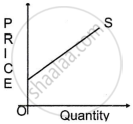
Indicate the degree of elasticity on the supply curve given below:
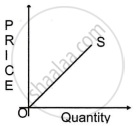
Explain any four determinants of elasticity of supply.
Draw and briefly explain a perfectly elastic supply curve.
Draw and explain the following degree of elasticity of supply.
Ep = ∞
Draw and briefly explain a perfectly inelastic supply curve.
Draw and explain the following degree of elasticity of supply.
Ep > 1
What do you understand by supply?
Distinguish between supply and stock.
What does the Law of Supply state?
List two assumptions of this Law of Supply.
What are the factors on which the supply of a commodity depends? Discuss them briefly.
Identify and define the degree of price elasticity of supply from the diagram for the supply curves S1, S2, S3, S4.
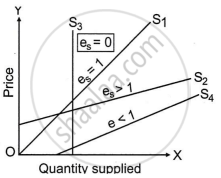
State the law of supply.
Complete the following market supply schedule and give a graphical representation of the same.
| Market Supply Schedule of Firm A and B | |||
| Price per unit (₹) | Quantity supplied (kgs) by | Market Supply (kgs) | |
| Firm A | Firm B | ||
| 5 | 3 | 5 | ? |
| 6 | 6 | 9 | ? |
| 7 | 8 | 12 | ? |
| 8 | 9 | 14 | ? |
Differentiate between supply and stock.
What is meant by elasticity of supply?
Explain graphically the following:
Relatively Elastic Supply
Explain graphically the following:
Unitary Elastic Supply
Explain graphically the following:
Perfectly Elastic Supply
Goyal Brothers Prakashan solutions for इकॉनॉमिक एप्लिकेशन्स [अंग्रेजी] कक्षा १० आईसीएसई 3 Theory of Supply QUESTION BANK [Pages 80 - 85]
Define the term supply.
Differentiate between supply and stock.
What is a supply schedule?
What is market supply?
What is supply function?
State any two factors determining supply.
Define supply curve.
Explain the law of supply.
What is meant by change in quantity supplied?
What is meant by shift in supply curve?
What is meant by extension of supply?
What is meant by contraction of supply?
What causes a downward movement along a supply curve?
What causes an upward movement along the supply curve of a commodity?
What is meant by 'increase' in supply?
What is ‘decrease’ in supply?
How does technological progress affect the supply curve of a firm?
If a farmer grows rice and wheat, how will a decrease in the price of wheat affect the supply curve of rice?
How does the imposition of tax affect the supply curve of a firm?
How does an decrease in price of an input affect the supply curve of a firm?
How does a increase in the number of firms in a market affect the market supply curve?
Define price elasticity of supply.
If the price of a commodity falls by 10% and consequently, the quantity supplied decreases by 20%, what will be its elasticity of supply?
Why does the measure of price elasticity of supply of a good carry plus sign?
What is meant by inelastic supply?
What do you mean by elastic supply?
When is supply of a good unitary elastic?
What is meant by perfectly elastic supply?
What do you mean by perfectly inelastic supply?
Price elasticity of supply of a good is 0.8. Is the supply 'elastic' or 'inelastic', and why?
Why is the supply of eggs inelastic?
Define the term supply.
State the law of supply.
Give two reasons for the positive slope of the supply curve.
Construct an imaginary individual supply schedule. Draw an individual supply curve based on an imaginary individual supply schedule.
State one exception to the law of supply.
Explain the following diagram.
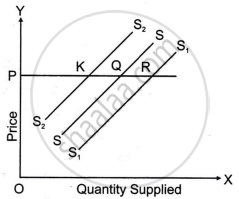
With the help of a diagram, define increase in supply.
Explain any two causes of increase in supply of a commodity.
With the help of a diagram define decrease in supply.
Explain any two causes of decrease in supply of a commodity.
Mention the impact of advanced technology on the supply of a commodity.
What effect does increased input price have on the supply of a commodity? Draw a diagram to explain of your answer.
What are the factors on which the supply of a commodity depends? Discuss them briefly.
Define elasticity of supply.
Explain any four determinants of elasticity of supply.
Explain the percentage method of measuring price elasticity of supply.
Draw the supply curve showing price elasticity of supply equal to one.
Draw the supply curve showing price elasticity of supply less than one.
Draw a straight line supply curve of the following situation.
More than unitary elastic
Draw supply curve of the following situation:
Elasticity of supply = ∞
Draw the supply curve of the following situation:
Elasticity of supply = 0
Solutions for 3: Theory of Supply
Goyal Brothers Prakashan solutions for इकॉनॉमिक एप्लिकेशन्स [अंग्रेजी] कक्षा १० आईसीएसई chapter 3 - Theory of Supply
Shaalaa.com has the CISCE Mathematics इकॉनॉमिक एप्लिकेशन्स [अंग्रेजी] कक्षा १० आईसीएसई CISCE solutions in a manner that help students grasp basic concepts better and faster. The detailed, step-by-step solutions will help you understand the concepts better and clarify any confusion. Goyal Brothers Prakashan solutions for Mathematics इकॉनॉमिक एप्लिकेशन्स [अंग्रेजी] कक्षा १० आईसीएसई CISCE 3 (Theory of Supply) include all questions with answers and detailed explanations. This will clear students' doubts about questions and improve their application skills while preparing for board exams.
Further, we at Shaalaa.com provide such solutions so students can prepare for written exams. Goyal Brothers Prakashan textbook solutions can be a core help for self-study and provide excellent self-help guidance for students.
Concepts covered in इकॉनॉमिक एप्लिकेशन्स [अंग्रेजी] कक्षा १० आईसीएसई chapter 3 Theory of Supply are Concept of Supply, Determinants Or Factors Governing the Supply, Law of Supply, Determinants of Supply, Types of Supply, Concept of Stock, Distinction Between Supply and Stock, Why Does the Supply Curve Slopes Upward to the Right, Distinction Between Change in Quantity Supplied (Or Movement Along Supply Curve and Change in Supply Or Shift of the Supply Curve), Contraction of Supply and Decrease in Supply, Elasticity of Supply, Movement Along the Supply Curve Or Expansion and Contraction of Supply, Difference Between Extension and Increase in Demand.
Using Goyal Brothers Prakashan इकॉनॉमिक एप्लिकेशन्स [अंग्रेजी] कक्षा १० आईसीएसई solutions Theory of Supply exercise by students is an easy way to prepare for the exams, as they involve solutions arranged chapter-wise and also page-wise. The questions involved in Goyal Brothers Prakashan Solutions are essential questions that can be asked in the final exam. Maximum CISCE इकॉनॉमिक एप्लिकेशन्स [अंग्रेजी] कक्षा १० आईसीएसई students prefer Goyal Brothers Prakashan Textbook Solutions to score more in exams.
Get the free view of Chapter 3, Theory of Supply इकॉनॉमिक एप्लिकेशन्स [अंग्रेजी] कक्षा १० आईसीएसई additional questions for Mathematics इकॉनॉमिक एप्लिकेशन्स [अंग्रेजी] कक्षा १० आईसीएसई CISCE, and you can use Shaalaa.com to keep it handy for your exam preparation.
