Advertisements
Advertisements
प्रश्न
If price elasticity of supply is greater than 1, then supply is said be elastic.
विकल्प
True
False
Advertisements
उत्तर
This statement is True.
Explanation:
When the price elasticity of supply is greater than 1, the percentage change in quantity supplied is greater than the percentage change in price. This indicates that supply is elastic, meaning producers are highly responsive to price changes.
APPEARS IN
संबंधित प्रश्न
Draw a well-labelled diagram showing the price elasticity of supply of a commodity starting from the origin.
Draw a perfectly elastic supply curve.
Identify the elasticity of supply for the following with proper reasoning:
Primitive and advanced technology.
Identify the degree of elasticity of supply from the following graph:
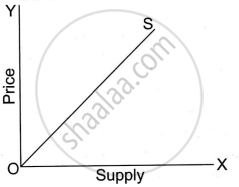
Explain any three factors affecting elasticity of supply.
Identify the elasticity of supply for the following with proper reasoning:
Short run and long run period.
Identify the elasticity of supply for the following with proper reasoning:
Perishable and durable goods.
- Price elasticity of supply of a good is 0.8, its supply is said to be inelastic.
- If the quantity supplied of a commodity remain the same whatever its price supply is said to perfectly inelastic.
Assertion (A): In case of perfectly inelastic supply, supply curve is a vertical straight line supply curve.
Reason (R): Supply does not change with change in price in case of Es = 0.
With the help of a formula calculate the elasticity of supply from the following table:
| Price | Quantity supplied |
| 10 | 200 |
| 15 | 225 |
Price elasticity of supply is likely to be ______ in the long run.
Cotton and cotton seeds are examples of ______ supply.
Draw and briefly explain a perfectly elastic supply curve.
Draw the supply curve showing price elasticity of supply equal to one.
Draw the supply curve showing price elasticity of supply greater than one.
What do you mean by perfectly inelastic supply?
