Advertisements
Advertisements
प्रश्न
How is elasticity of supply measured according to the percentage method?
How is the price elasticity of supply measured?
How can Elasticity of supply be measured?
Advertisements
उत्तर
According to the percentage method, elasticity of supply (Es) is the ratio between the percentage change in quantity supplied and the percentage change in price of the commodity. In fact, this method originated from the definition of price elasticity of supply itself.
Price elasticity of supply = `("Percentage change in quantity supplied")/("Percentage change in its Price")`
Percentage Change in quantity supplied = `"(ΔQ)"/"Q"xx100`
Percentage change in price = `"(ΔP)"/"P"xx100`
Now the percentage formula can be written as
Es= `((ΔQ)/Qxx100)/((ΔP)/Pxx100)`
Cancelling out 100 by 100, we get
Es = `((ΔQ)/Q)/((ΔP)/P)`
When Q = initial quantity
P Initial price
ΔQ = Change in quantity supplied
ΔP = Change in price of the commodity
Notes
Students should refer to the answer according to the question.
APPEARS IN
संबंधित प्रश्न
Identify the elasticity of supply for the following with proper reasoning:
Primitive and advanced technology.
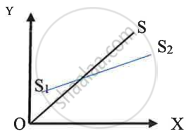
Identify the value of elasticity of supply for the supply curve OS and S1S2.
A 10 per cent increase in price of a good causes 5 per cent increase in its quantity supplied, elasticity of supply will be ______.
If price elasticity of supply is greater than 1, then supply is said be elastic.
Which of the following statements are true?
The cost of production will increase if
- The government gives subsidies
- The firm uses obsolete technology
- The price of diesel increases
When the percentage change in the quantity supplied of a commodity is exactly equal to the percentage change in its price it is known as ______.
Assertion (A): In case of perfectly inelastic supply, supply curve is a vertical straight line supply curve.
Reason (R): Supply does not change with change in price in case of Es = 0.
Define elasticity of supply.
Which of the following measures of price elasticity shows inelastic supply?
When is the supply of a commodity is called elastic?
Price of a product increases by 2%. As a result, its supply rises by 4%. What is elasticity of supply of the commodity?
The coefficient of elasticity of a commodity is 0.4. What percentage change in supply will take place if its price rises 20%?
With the help of a formula calculate the elasticity of supply from the following table:
| Price | Quantity supplied |
| 10 | 200 |
| 15 | 225 |
When there is no change in price, but quality supplied changes, it implies a situation of ______.
Cotton and cotton seeds are examples of ______ supply.
Draw and briefly explain a perfectly inelastic supply curve.
The price of a commodity rises from ₹ 20 to ₹ 40 Consequently, its supply increases from 100 units to 400 units. Calculate price elasticity of supply.
Draw and briefly explain a perfectly elastic supply curve.
If the price of a commodity increases by 50% and its supply increases by 25% then calculate the price elasticity of supply following the percentage method. Identify the degree of price elasticity.
Give the meaning of perfectly elastic supply.
Draw the supply curve showing price elasticity of supply greater than one.
Draw the supply curve showing price elasticity of supply less than one.
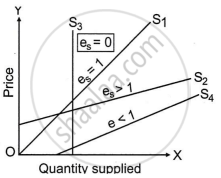
Identify and define the degree of price elasticity of supply from the diagram for the supply curves S1, S2, S3, S4.
What is meant by elasticity of supply?
Using graphs, explain any four types of elasticity of supply.
When is supply of a good unitary elastic?
What do you mean by perfectly inelastic supply?
Price elasticity of supply of a good is 0.8. Is the supply 'elastic' or 'inelastic', and why?
Why is the supply of eggs inelastic?
Draw a straight line supply curve of the following situation.
More than unitary elastic
Draw relatively elastic supply.
