Advertisements
Advertisements
प्रश्न
How is elasticity of supply measured according to the percentage method?
How is the price elasticity of supply measured?
How can Elasticity of supply be measured?
Advertisements
उत्तर
According to the percentage method, elasticity of supply (Es) is the ratio between the percentage change in quantity supplied and the percentage change in price of the commodity. In fact, this method originated from the definition of price elasticity of supply itself.
Price elasticity of supply = `("Percentage change in quantity supplied")/("Percentage change in its Price")`
Percentage Change in quantity supplied = `"(ΔQ)"/"Q"xx100`
Percentage change in price = `"(ΔP)"/"P"xx100`
Now the percentage formula can be written as
Es= `((ΔQ)/Qxx100)/((ΔP)/Pxx100)`
Cancelling out 100 by 100, we get
Es = `((ΔQ)/Q)/((ΔP)/P)`
When Q = initial quantity
P Initial price
ΔQ = Change in quantity supplied
ΔP = Change in price of the commodity
Notes
Students should refer to the answer according to the question.
APPEARS IN
संबंधित प्रश्न
Draw a perfectly inelastic supply curve.
Draw a perfectly elastic supply curve.

Identify the elasticity of supply (es) of S1, S2 and S3 supply curves:
Identify the elasticity of supply for the following with proper reasoning:
Primitive and advanced technology.
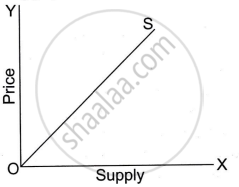
Identify the degree of elasticity of supply from the following graph:
What is the formula for percentage method of calculating price elasticity of supply?
A 10 per cent increase in price of a good causes 5 per cent increase in its quantity supplied, elasticity of supply will be ______.
When price of a·product rises by 10% its quantity supplied also rises by 10%. Find out price elasticity.
Which of the following measures of price elasticity shows elasticity shows elastic supply?
If price elasticity of supply is greater than 1, then supply is said be elastic.
When the price increases by 50% and the supply increases only by 5% the price elasticity of supply of that commodity will be ______.
Elasticity of supply is measured by:
Identify the correct sequence of alternatives given in Column II by matching them with respective terms in Column I:
| Column I | Column II |
| A. Perfectly Inelastic | (i) Es > 1 |
| B. Perfectly Elastic | (ii) Es < 1 |
| C. Inelastic | (iii) Es = 0 |
| D. Highly Elastic | (iv) Es = infinity |
Choose the correct alternative:
Assertion (A): In case of perfectly inelastic supply, supply curve is a vertical straight line supply curve.
Reason (R): Supply does not change with change in price in case of Es = 0.
Price of a product increases by 2%. As a result, its supply rises by 4%. What is elasticity of supply of the commodity?
The coefficient of elasticity of a commodity is 0.4. What percentage change in supply will take place if its price rises 20%?
With the help of a formula calculate the elasticity of supply from the following table:
| Price | Quantity supplied |
| 10 | 200 |
| 15 | 225 |
Price elasticity of supply is likely to be ______ in the long run.
Cotton and cotton seeds are examples of ______ supply.
Draw and briefly explain a perfectly elastic supply curve.
Explain any four determinants of elasticity of supply.
Draw the supply curve showing price elasticity of supply equal to one.
Draw the supply curve showing price elasticity of supply less than one.
Draw and explain the following degree of elasticity of supply.
Ep > 1
Why does the measure of price elasticity of supply of a good carry plus sign?
What is meant by inelastic supply?
When is supply of a good unitary elastic?
What do you mean by perfectly inelastic supply?
Why is the supply of eggs inelastic?
With the help of a suitable diagram, explain the following degree of elasticity of supply.
Es > 1
