Advertisements
Chapters
2: Marketing mix - 4 P's
3: Advertising and Brand Promotion
4: Sales and Selling Process
5: Generally Accepted Accounting Principles (GAAP)
6: Financial Accounting and Reporting
▶ 7: Banking and Bank Transactions
8: Fundamental Concepts of Cost
9: Importance of Human Resources
10: Recruitment, Selection and Training
11: Public Relations
12: Issues of the Environment
![Goyal Brothers Prakashan solutions for कमर्शियल एप्लिकेशन्स [अंग्रेजी] कक्षा १० आईसीएसई chapter 7 - Banking and Bank Transactions - Shaalaa.com](/images/commercial-applications-english-class-10-icse_6:24f6f4a7b9ed4bc7bafe97f5daf365e6.jpg "Goyal Brothers Prakashan solutions for कमर्शियल एप्लिकेशन्स [अंग्रेजी] कक्षा १० आईसीएसई chapter 7 - Banking and Bank Transactions")
Advertisements
Solutions for Chapter 7: Banking and Bank Transactions
Below listed, you can find solutions for Chapter 7 of CISCE Goyal Brothers Prakashan for कमर्शियल एप्लिकेशन्स [अंग्रेजी] कक्षा १० आईसीएसई.
Goyal Brothers Prakashan solutions for कमर्शियल एप्लिकेशन्स [अंग्रेजी] कक्षा १० आईसीएसई 7 Banking and Bank Transactions EXERCISES [Pages 122 - 128]
OBJECTIVE TYPE QUESTIONS.
Which of the following is a Commercial Bank?
SBI
RBI
EXIM
None of these
Concerning the functions of the Central Bank of India, which statement(s) is (are) accurate?
- The Central Bank controls the issuance of currency and manages the country’s monetary policy.
- The Central Bank primarily focuses on maximizing its own profits.
- The Central Bank advises the government to impose restrictions on import and encourages export.
- The Central Bank’s decisions have no impact on the country’s economic stability.
1. & 3.
2. & 4.
Only 1.
3. & 4.
It carries out the country's monetary policy.
Commercial Bank
Central Bank
Specialised Bank
None of these
______ is the apex institution of the country's monetary and banking structure where as ______ is one of the organs of the money market.
Commercial Bank, central bank
Central Bank, commercial bank
Specialised Bank, central bank
Commercial bank, specialised bank
Which of the following is/are correct statement(s)?
Statement 1: The Central Bank can influence the country's economy by adjusting the Cash Reserve Ratio (CRR).
Statement 2: Commercial banks can issue currency notes as long as they meet the reserve requirements set by the Central Bank.
Only Statement 1 is true.
Only Statement 2 is true.
Both statements are true.
Both statements are false.
A bank draft is always dishonoured if there are insufficient funds in the drawer’s account at the time of encashment.
True
False
If the central bank decides to promote economic growth by lowering the bank rate, which of the following is a likely consequence for commercial banks?
They will increase interest rates on loans to maintain profitability.
They will decrease their lending activity to reduce risks.
They will expand their lending activities due to lower borrowing costs.
They will raise the Cash Reserve Ratio to align with central bank policies.
Central bank is owned by the ____ while commercial bank is owned by ______.
Shareholders, shareholders
Government, shareholders
Shareholders, government
None of these
There are two statements given below, marked as Assertion(A) and Reason (R). Read the statements and choose the correct option.
Assertion (A): Commercial banks primarily engage in profit-oriented activities.
Reasoning (R): Commercial banks have the authority to set monetary policies, establish reserve requirements, and conduct financial stability assessments to ensure the sound functioning of the banking system.
A is true but R is false.
A is false but R is true.
Both A and R are true and R explains A.
Both A and R are true but R does not explain A.
Which of the following is/are the function(s) of central bank?
Banker’s bank
Provides overdraft facility to the public.
Receive deposits from the public and business firms.
Provide short-term and medium-term loans to customers.
It means signing on the back of the negotiable instrument with the objective of transferring its ownership.
Endorsement
Pay-in slip
Crossing a cheque
Bank draft
The Statutory Liquidity Ratio (SLR) requires commercial banks to maintain a certain percentage of their liabilities in liquid assets, which can include government securities.
True
False
A commercial bank is considering increasing its lending to small businesses. Which of the following actions by the Central Bank would most likely constrain the bank’s ability to do so?
Reducing the Statutory Liquidity Ratio (SLR).
Increasing the Cash Reserve Ratio (CRR).
Lowering the Bank Rate.
Conducting open market operations to purchase government securities.
A recurring deposit account allows the account holder to withdraw the entire deposited amount along with interest at any time before the maturity period.
True
False
An open cheque is safer than a crossed cheque because it can be cashed by anyone.
True
False
A country is facing economic instability, and the central bank decides to implement strict credit control measures. Which combination of actions is the central bank most likely to take to stabilize the economy?
Increase the bank rate and sell government securities.
Decrease the Cash Reserve Ratio (CRR) and lower the bank rate.
Increase the Statutory Liquidity Ratio (SLR) and buy government securities.
Lower the reserve requirement and reduce the statutory liquidity ratio.
When considering the functions of commercial banks, which statement(s) is (are) correct?
- Commercial banks provide loans and advances to individuals and businesses.
- Commercial banks are solely responsible for issuing currency.
- Commercial banks have no involvement in government transactions.
- Commercial banks play a crucial role in the money creation process through lending.
1. & 3.
2. & 4.
Only 1.
1. & 4.
There are two statements given below, marked as Assertion (A) and Reason (R). Read the statements and choose the correct option.
Assertion (A): One of the primary functions of a central bank is to act as the lender of last resort.
Reasoning (R): Central banks can influence interest rates through their monetary policy decisions, which include changes in the policy rate or reserve requirements.
A is true but R is false.
A is false but R is true.
Both A and R are true and R explains A.
Both A and R are true but R does not explain A.
Central bank regulates credit through ______.
Open market operations
Bank rate
Reserve requirements
All of these
______ are the main types of bank accounts.
Current
Recurring
Fixed deposit accounts
All of these
A bank offers the following options to its customers:
- Fixed Deposit Account: 7% interest, withdrawal only after maturity.
- Savings Account: 4% interest, withdrawal anytime.
- Recurring Deposit Account: 6% interest, regular monthly deposits.
Which account type should a customer choose if they need to withdraw money regularly and also want to maximize interest?
Fixed Deposit Account
Savings Account
Recurring Deposit Account
None of the above
An ______ is a cheque which is payable across the counter of the bank.
Open cheque
Pay-in slip
Crossed cheque
Bank draft
In this account, the account holder is required to deposit a specific amount every month. After the expiry of the specified period, the depositor gets back his money together with interest thereon.
Current account
Recurring deposit account
Saving account
None of these
Which of the following options is/are correct statement(s)?
Statement 1: The Reserve Bank of India (RBI) acts as the banker’s bank and manages the country’s monetary policy.
Statement 2: The Industrial Finance Corporation of India (IFCI) is responsible for controlling the country’s monetary policy.
Only Statement 1 is correct.
Only Statement 2 is correct.
Both statements are correct.
Both statements are incorrect.
______ is a Banker’s Bank.
Commercial Bank
Agricultural Bank
Exchange Bank
Central Bank
In this type of account, no cheque book is issued to the account holder:
Fixed Deposit account
Open account
Saving Deposit account
Current account
A bank is a ______ which collects money from the public in the form of deposits and lends the same to the borrowers.
company
Reserve bank
government organisation
Lender of the last resort
ATM means ______.
Any Time Money
Amount Transaction Message
Auto Transfer Money
Automated Teller Machine
The ______ is an extract or copy of the customer’s account in the bank’s ledger as on a particular date.
Passbook
Pay-in-slip book
Cheque book
Withdrawal form
Central bank is the sole ______ of the country’s foreign currency reserve.
Dealer
Consumer
Custodian
User
______ is not a legal tender and the creditor may refuse to accept it.
Bank Draft
Cheque
Overdraft
Cash
Identify an example of Nationalized Bank ______.
Union Bank of India and State Bank of India
Citi Bank and HDFC Bank
ICICI Bank and Axis Bank
American Express Bank and Yes Bank
Private Banks are the banks which are ______.
owned and controlled by government.
owned and controlled by private businessmen.
owned and controlled by foreign banks.
owned by central Bank and managed by government.
Time Deposit account is also known as ______.
Recurring Deposit account
Current account
Saving Deposit account
Fixed Deposit account
There are two statements given below, marked as Assertion (A) and Reason (R). Read the statements and choose the correct option.
Assertion (A): Central Bank and Commercial Banks have distinct roles in economy.
Reasoning (R): Central Bank controls money supply and sets policy. Commercial Banks take deposits and make loans to customers.
A is true but R is false.
A is false but R is true.
Both A and R are true and R explains A.
Both A and R are true but R does not explain A.
The central bank settles the claims of commercial banks is called ______.
Banking facility
Ledger facility
Clearing House facility
Accounts facility
Which account holder gets Overdraft facility?
Saving Bank account
Current account
Recurring deposit
Fixed deposit account
Public Banks are the banks which are ______.
owned and controlled by the Government.
owned and controlled by private businessmen.
owned and controlled by foreign banks.
owned by central bank.
India’s foreign exchange reserves climbed to a record of $651.5 billion by the end of last week demonstrating resilience despite uncertain geopolitics.
With reference to the above, name the institution that is authorised to monitor such reserves in our country.
Central Bank of India
State Bank of India
Citi Bank
Indian Bank
With reference to Savings Deposit Account, which statement is correct?
Depositors need to deposit a specific amount every month.
There are restrictions on number of withdrawals in a week.
Overdraft facility is available.
There are restrictions on the number of deposits that can be made in a week.
Which of these is not a function of Central bank?
Controlling credit
Credit creation
Providing Clearing house facility
Maintenance of Exchange rate
Commercial banks act as trustees and executors for their customers. This is a/an ______ function of Commercial bank.
General utility
Agency
Marketing
Public Relations
SHORT-ANSWER QUESTIONS.
A demand draft is preferable to a cheque. Justify either for or against.
Explain in brief moral suasion as a tool of credit control.
What do you mean by Industrial Banks?
What are the two main functions of a commercial bank?
How does the Central Bank control credit through SLR?
What are current accounts?
What are the advantages of ’Account Payee‘ crossing of a cheque?
What are open market operations of a Central Bank?
Distinguish between:
Fixed Deposit Account and Recurring Deposite Account.
What is meant by Discounting of a Bill of Exchange?
Distinguish between:
cash credit and loan.
What is a Recurring Deposit Account?
What is the term used for a cheque that can be encashed across the counter of the bank?
"A cheque is an inconvenient method of making payments". Justify for or against.
List/Mention any two/three circumstances under which a bank can refuse payment or dishonour a cheque.
Explain Bank Rate Policy as a tool of Credit Control.
“A crossed cheque is a safer mode of payment as compared to an open. cheque.” Justify.
How do exchange banks help in financing foreign trade?
Distinguish between saving account and current account.
What does a pay-in-slip contain?
Why was EXIM Bank set up in India?
Write any two differences between:
Central Bank and Commercial Bank
With the help of an example, explain the clearing house functions of RBI.
“Banking is a relationship-oriented industry.” Give two reasons either for or against.
State one point of difference between Cash Credit and Overdraft.
State one point of difference between Cash Credit and Overdraft.
"The central bank is the lender of the last resort." Explain.
Distinguish between:
Fixed Deposit Account and Recurring Deposite Account.
What is a bank draft?
Write about any three general utility functions of Commercial Bank.
State one difference between cheque and bank draft.
“Bank draft cannot get dishonomed.” Justify for or against.
Commercial Banks are the lender of the last resort.
List any two functions of the central bank.
An account holder of a Bank maintains a Passbook. Write any two features of it.
Write a short note on informative advertising.
Write a short note on an automated teller machine.
LONG-ANSWER QUESTIONS.
What is meant by the central bank of a country?
Explain in brief four methods usually adopted by the central bank to control credit in the country.
What is a commercial bank?
Explain main functions of commercial bank.
What is a Central Bank?
Bring out the importance of a central bank by making special reference to the functions it performs.
Explain in brief four methods usually adopted by the central bank to control credit in the country.
What are the different types of deposit accounts that can be opened in a commercial bank? Briefly explain them.
Differentiate between Savings Deposit and Current Deposit.
Distinguish between:
Fixed Deposit Account and Recurring Deposite Account.
Explain the different types of accounts in which a bank may receive deposits.
Explain the different types of schemes through which a bank may receive time deposits.
With the help of an example, explain the clearing house functions of RBI.
Show the importance of “banker’s clearing house” in modern banking.
Distinguish between the Central Bank and the Commercial Bank.
Describe the procedure to be followed to open a bank account.
Differentiate between current deposit account and fixed deposit account.
How does the central bank use the SLR to exercise credit control in a country?
How does the central bank use the credit rationing to exercise credit control in a country?
Write a short note on the importance of a cheque.
Write a short note on the primary functions of commercial banks.
Explain Cash Reserve Ratio.
Explain Statutory Liquidity Ratio.
Distinguish between a cheque and bill of exchange.
Describe the procedure to be followed to open a bank account.
Explain any five functions of the Reserve Bank of India.
List any two functions of the central bank.
Explain any two lending money functions of commercial banks.
What is a Recurring Deposit Account?
Explain briefly the five agency functions of a commercial bank.
State two advantages of a bank account.
Describe the advantages of opening a bank account.
With reference to the secondary functions of a Commercial Bank, explain the general utility function.
What are the advantages of payment by cheque?
Distinguish between the following:
Cheque & Bank Overdraft
State one difference between cheque and bank draft.
Give two agency functions of commercial banks.
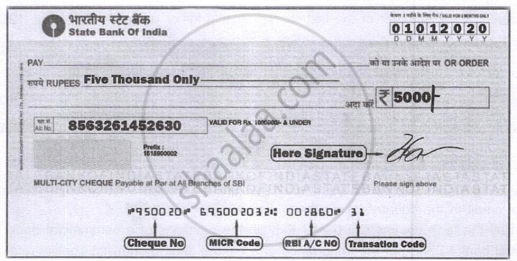
Study the image. Explain any five conditions for the refusal of the same by the bank.
Goyal Brothers Prakashan solutions for कमर्शियल एप्लिकेशन्स [अंग्रेजी] कक्षा १० आईसीएसई 7 Banking and Bank Transactions QUESTION BANK [Pages 128 - 129]
What do you mean by Industrial Banks?
Mention any two agency functions/services of a commercial bank.
What is a savings deposit?
What is a current account?
How is discounting of a bill of exchange a form of bank lending?
Justify the following sentence for or against and give a reason:
A bank cannot refuse payment of a cheque.
“The central bank is a banker’s bank.” Explain.
What is a bank draft?
Why is a bank draft a safe mode of money transfer?
Distinguish between:
cash credit and loan.
State one point of difference between Cash Credit and Overdraft.
Distinguish between.
Cheque book and Passbook
Give two differences between stale cheque and post-dated cheque.
Explain any two lending money functions of commercial banks.
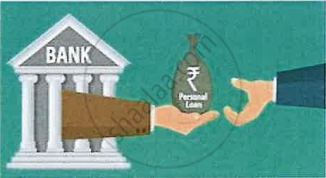
Study the picture below and explain any two of its functions.
Solutions for 7: Banking and Bank Transactions
Goyal Brothers Prakashan solutions for कमर्शियल एप्लिकेशन्स [अंग्रेजी] कक्षा १० आईसीएसई chapter 7 - Banking and Bank Transactions
Shaalaa.com has the CISCE Mathematics कमर्शियल एप्लिकेशन्स [अंग्रेजी] कक्षा १० आईसीएसई CISCE solutions in a manner that help students grasp basic concepts better and faster. The detailed, step-by-step solutions will help you understand the concepts better and clarify any confusion. Goyal Brothers Prakashan solutions for Mathematics कमर्शियल एप्लिकेशन्स [अंग्रेजी] कक्षा १० आईसीएसई CISCE 7 (Banking and Bank Transactions) include all questions with answers and detailed explanations. This will clear students' doubts about questions and improve their application skills while preparing for board exams.
Further, we at Shaalaa.com provide such solutions so students can prepare for written exams. Goyal Brothers Prakashan textbook solutions can be a core help for self-study and provide excellent self-help guidance for students.
Concepts covered in कमर्शियल एप्लिकेशन्स [अंग्रेजी] कक्षा १० आईसीएसई chapter 7 Banking and Bank Transactions are Types of Bank Accounts, Functions of Commercial Bank, Central Bank, Banking, Types of Bank, Meaning of Central Bank, Types of Bank Deposit Accounts, Procedure of Opening a Bank Account, Operating a Bank Account, Advantages of Bank Account, Types of Cheques, Crossing of Cheques, Bank Draft, Travellers' Cheque, Central Bank as a Controller of Credit, Cheque.
Using Goyal Brothers Prakashan कमर्शियल एप्लिकेशन्स [अंग्रेजी] कक्षा १० आईसीएसई solutions Banking and Bank Transactions exercise by students is an easy way to prepare for the exams, as they involve solutions arranged chapter-wise and also page-wise. The questions involved in Goyal Brothers Prakashan Solutions are essential questions that can be asked in the final exam. Maximum CISCE कमर्शियल एप्लिकेशन्स [अंग्रेजी] कक्षा १० आईसीएसई students prefer Goyal Brothers Prakashan Textbook Solutions to score more in exams.
Get the free view of Chapter 7, Banking and Bank Transactions कमर्शियल एप्लिकेशन्स [अंग्रेजी] कक्षा १० आईसीएसई additional questions for Mathematics कमर्शियल एप्लिकेशन्स [अंग्रेजी] कक्षा १० आईसीएसई CISCE, and you can use Shaalaa.com to keep it handy for your exam preparation.
