Advertisements
Advertisements
The stopping potential in a photoelectric experiment is linearly related to the inverse of the wavelength (1/λ) of the light falling on the cathode. The potential difference applied across an X-ray tube is linearly related to the inverse of the cutoff wavelength (1/λ) of the X-ray emitted. Show that the slopes of the lines in the two cases are equal and find its value.
(Use Planck constant h = 6.63 × 10⁻³⁴ Js= 4.14 × 10⁻¹⁵ eVs, speed of light c = 3 × 10⁸ m/s.)
Concept: undefined >> undefined
Suppose a monochromatic X-ray beam of wavelength 100 pm is sent through a Young's double slit and the interference pattern is observed on a photographic plate placed 40 cm away from the slit. What should be the separation between the slits so that the successive maxima on the screen are separated by a distance of 0.1 mm?
Concept: undefined >> undefined
Advertisements
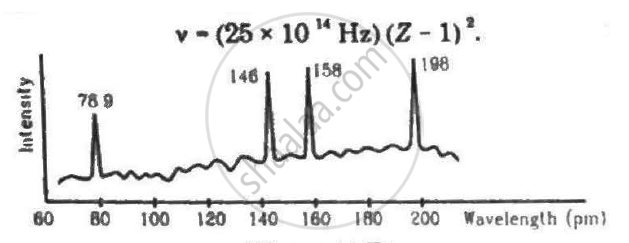
Continuous X-rays are made to strike a tissue paper soaked with polluted water. The incoming X-rays excite the atoms of the sample by knocking out the electrons from the inner shells. Characteristic X-rays are analysed and the intensity is plotted against the wavelength. Assuming that only Kα intensities are detected, list the elements present in the sample from the plot. Use Moseley's equation v − (25 × 1014Hz)(Z − 1)2.
(Use Planck constant h = 6.63 × 10⁻³⁴ Js= 4.14 × 10⁻¹⁵ eVs, speed of light c = 3 × 10⁸ m/s.)
Concept: undefined >> undefined
Let Fpp, Fpn and Fnn denote the magnitudes of the net force by a proton on a proton, by a proton on a neutron and by a neutron on a neutron respectively. neglect gravitational force. When the separation is 1 fm.
Concept: undefined >> undefined
Two protons are kept at a separation of 10 nm. Let Fn and Fe be the nuclear force and the electromagnetic force between them.
Concept: undefined >> undefined
If a constant force acts on a particle, its acceleration will ______________ .
Concept: undefined >> undefined
A charged particle is projected at a very high speed perpendicular to a uniform magnetic field. The particle will _____________ .
Concept: undefined >> undefined
A particular particle created in a nuclear reactor leaves a 1 cm track before decaying. Assuming that the particle moved at 0.995c, calculate the life of the particle (a) in the lab frame and (b) in the frame of the particle.
Concept: undefined >> undefined
How is amplitude modulation achieved?
Concept: undefined >> undefined
The frequencies of two side bands in an AM wave are 640 kHz and 660 kHz respectively. Find the frequencies of carrier and modulating signal. What is the bandwidth required for amplitude modulation?
Concept: undefined >> undefined
Define the term 'amplitude modulation'
Concept: undefined >> undefined
Explain any two factors which justify the need for modulating a low frequency base-band signal.
Concept: undefined >> undefined
A long straight wire of a circular cross-section of radius ‘a’ carries a steady current ‘I’. The current is uniformly distributed across the cross-section. Apply Ampere’s circuital law to calculate the magnetic field at a point ‘r’ in the region for (i) r < a and (ii) r > a.
Concept: undefined >> undefined
What is meant by term ‘modulation’? Draw a block diagram of a simple modulator for obtaining an AM signal.
Concept: undefined >> undefined
Why is frequency modulation preferred over amplitude modulation for transmission of music?
Concept: undefined >> undefined
Two sources are called coherent if they produce waves ______________ .
Concept: undefined >> undefined
Two coherent sources of different intensities send waves which interfere. The ratio of maximum intensity to the minimum intensity is 25. The intensities of the sources are in the ratio ______.
Concept: undefined >> undefined
Two coherent point sources S1 and S2, vibrating in phase, emit light of wavelength \[\lambda.\] The separation between the sources is \[2\lambda.\] Consider a line passing through S2 and perpendicular to the line S1 S2. What is the smallest distance from S2 where a minimum intensity occurs?
Concept: undefined >> undefined
In Ampere's \[\oint \vec{B} \cdot d \vec{l} = \mu_0 i,\] the current outside the curve is not included on the right hand side. Does it mean that the magnetic field B calculated by using Ampere's law, gives the contribution of only the currents crossing the area bounded by the curve?
Concept: undefined >> undefined
A long, straight wire carries a current. Is Ampere's law valid for a loop that does not enclose the wire, or that encloses the wire but is not circular?
Concept: undefined >> undefined
