Advertisements
Advertisements
प्रश्न
How is amplitude modulation achieved?
Advertisements
उत्तर
Amplitude modulation is the process of varying the amplitude of the carrier signal in accordance with the amplitude of the message signal.
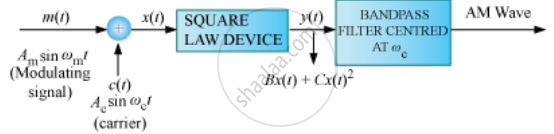
Amplitude modulated signals can be produced by adding the carrier signal with the message signal and passing the resultant signal through a square law device (eg: FET). Then the signal from the square law device is passed through band pass filter to allow only the signals centered at carrier frequencies to pass. The output of the band pass filter is power amplified and transmitted by the antenna.
संबंधित प्रश्न
Explain any two factors that justify the need of modulating a low-frequency signal.
What is meant by term ‘modulation’? Draw a block diagram of a simple modulator for obtaining an AM signal.
Why is frequency modulation preferred over amplitude modulation for transmission of music?
In amplitude modulation ______.
A message signal of frequency ωm is superposed on a carrier wave of frequency ωc to get an amplitude modulated wave (AM). The frequency of the AM wave will be ______.
Why is a AM signal likely to be more noisy than a FM signal upon transmission through a channel?
Draw the plot of amplitude versus ‘ω’ for an amplitude modulated wave whose carrier wave (ωc) is carrying two modulating signals, ω1 and ω2 (ω2 > ω1).
- Is the plot symmetrical about ωc? Comment especially about plot in region ω < ωc.
- Extrapolate and predict the problems one can expect if more waves are to be modulated.
- Suggest solutions to the above problem. In the process can one understand another advantage of modulation in terms of bandwidth?
An audio signal vm = 20sin2π(1500t) amplitude modulates a carrier vc = 80 sin 2π (100,000t). The value of percent modulation is ______.
The maximum and minimum voltage of an amplitude modulated signal are 60 V and 20 V respectively. The percentage modulation index will be ______.
A signal of 5 kHz frequency is amplitude modulated on a carrier wave of frequency 2 MHz. The frequencies of the resultant signal are ______.
