हिंदी

(English Medium) ICSE Class 9 - CISCE Question Bank Solutions

Advertisements
[object Object]
[object Object]
विषयों
मुख्य विषय
अध्याय

Please select a subject first

Advertisements
Advertisements
< prev  6441 to 6460 of 12032  next > 

In triangle ABC ; D and E are mid-points of the sides AB and AC respectively. Through E, a straight line is drawn parallel to AB to meet BC at F.
Prove that BDEF is a parallelogram. If AB = 16 cm, AC = 12 cm and BC = 18 cm,
find the perimeter of the parallelogram BDEF.

[12] Mid-point and Its Converse [ Including Intercept Theorem]
Chapter: [12] Mid-point and Its Converse [ Including Intercept Theorem]
Concept: undefined >> undefined

In triangle ABC; M is mid-point of AB, N is mid-point of AC and D is any point in base BC. Use the intercept Theorem to show that MN bisects AD.

[12] Mid-point and Its Converse [ Including Intercept Theorem]
Chapter: [12] Mid-point and Its Converse [ Including Intercept Theorem]
Concept: undefined >> undefined

Advertisements

If the quadrilateral formed by joining the mid-points of the adjacent sides of quadrilateral ABCD is a rectangle,
show that the diagonals AC and BD intersect at the right angle.

[12] Mid-point and Its Converse [ Including Intercept Theorem]
Chapter: [12] Mid-point and Its Converse [ Including Intercept Theorem]
Concept: undefined >> undefined

A ladder 13 m long rests against a vertical wall. If the foot of the ladder is 5 m from the foot of the wall, find the distance of the other end of the ladder from the ground.

[13] Pythagoras Theorem [Proof and Simple Applications with Converse]
Chapter: [13] Pythagoras Theorem [Proof and Simple Applications with Converse]
Concept: undefined >> undefined

A man goes 40 m due north and then 50 m due west. Find his distance from the starting point.

[13] Pythagoras Theorem [Proof and Simple Applications with Converse]
Chapter: [13] Pythagoras Theorem [Proof and Simple Applications with Converse]
Concept: undefined >> undefined

In ΔABC,  Find the sides of the triangle, if:

  1. AB =  ( x - 3 ) cm, BC = ( x + 4 ) cm and AC = ( x + 6 ) cm
  2. AB = x cm, BC = ( 4x + 4 ) cm and AC = ( 4x + 5) cm
[13] Pythagoras Theorem [Proof and Simple Applications with Converse]
Chapter: [13] Pythagoras Theorem [Proof and Simple Applications with Converse]
Concept: undefined >> undefined

In the figure: ∠PSQ = 90o, PQ = 10 cm, QS = 6 cm and RQ = 9 cm. Calculate the length of PR.

[13] Pythagoras Theorem [Proof and Simple Applications with Converse]
Chapter: [13] Pythagoras Theorem [Proof and Simple Applications with Converse]
Concept: undefined >> undefined

In the given figure, ∠B = 90°, XY || BC, AB = 12 cm, AY = 8cm and AX : XB = 1 : 2 = AY : YC.

Find the lengths of AC and BC.

[13] Pythagoras Theorem [Proof and Simple Applications with Converse]
Chapter: [13] Pythagoras Theorem [Proof and Simple Applications with Converse]
Concept: undefined >> undefined

In the given figure, AB//CD, AB = 7 cm, BD = 25 cm and CD = 17 cm;
find the length of side BC.

[13] Pythagoras Theorem [Proof and Simple Applications with Converse]
Chapter: [13] Pythagoras Theorem [Proof and Simple Applications with Converse]
Concept: undefined >> undefined

The given figure shows a quadrilateral ABCD in which AD = 13 cm, DC = 12 cm, BC = 3 cm and ∠ABD = ∠BCD = 90o. Calculate the length of AB.

[13] Pythagoras Theorem [Proof and Simple Applications with Converse]
Chapter: [13] Pythagoras Theorem [Proof and Simple Applications with Converse]
Concept: undefined >> undefined

Two poles of heights 6 m and 11 m stand vertically on a plane ground. If the distance between their feet is 12 m;
find the distance between their tips.

[13] Pythagoras Theorem [Proof and Simple Applications with Converse]
Chapter: [13] Pythagoras Theorem [Proof and Simple Applications with Converse]
Concept: undefined >> undefined

If the sides of the triangle are in the ratio 1: `sqrt2`: 1, show that is a right-angled triangle.

[13] Pythagoras Theorem [Proof and Simple Applications with Converse]
Chapter: [13] Pythagoras Theorem [Proof and Simple Applications with Converse]
Concept: undefined >> undefined

AD is drawn perpendicular to base BC of an equilateral triangle ABC. Given BC = 10 cm, find the length of AD, correct to 1 place of decimal.

[13] Pythagoras Theorem [Proof and Simple Applications with Converse]
Chapter: [13] Pythagoras Theorem [Proof and Simple Applications with Converse]
Concept: undefined >> undefined

In triangle ABC, AB = AC = x, BC = 10 cm and the area of the triangle is 60 cm2.
Find x.

[13] Pythagoras Theorem [Proof and Simple Applications with Converse]
Chapter: [13] Pythagoras Theorem [Proof and Simple Applications with Converse]
Concept: undefined >> undefined

In triangle ABC, given below, AB = 8 cm, BC = 6 cm and AC = 3 cm. Calculate the length of OC.


[13] Pythagoras Theorem [Proof and Simple Applications with Converse]
Chapter: [13] Pythagoras Theorem [Proof and Simple Applications with Converse]
Concept: undefined >> undefined

In the following figure, AD is perpendicular to BC and D divides BC in the ratio 1: 3.
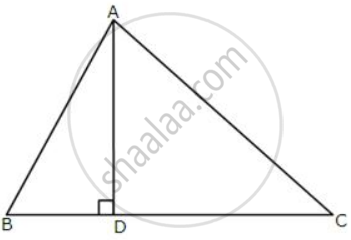
Prove that : 2AC2 = 2AB2 + BC2

[13] Pythagoras Theorem [Proof and Simple Applications with Converse]
Chapter: [13] Pythagoras Theorem [Proof and Simple Applications with Converse]
Concept: undefined >> undefined

In triangle ABC, AB = AC and BD is perpendicular to AC.

Prove that: BD2 − CD2 = 2CD × AD

[13] Pythagoras Theorem [Proof and Simple Applications with Converse]
Chapter: [13] Pythagoras Theorem [Proof and Simple Applications with Converse]
Concept: undefined >> undefined

In the figure, given below, AD ⊥ BC.
Prove that: c2 = a2 + b2 - 2ax.

[13] Pythagoras Theorem [Proof and Simple Applications with Converse]
Chapter: [13] Pythagoras Theorem [Proof and Simple Applications with Converse]
Concept: undefined >> undefined

In triangle ABC, angle A = 90o, CA = AB and D is the point on AB produced.
Prove that DC2 - BD2 = 2AB.AD.

[13] Pythagoras Theorem [Proof and Simple Applications with Converse]
Chapter: [13] Pythagoras Theorem [Proof and Simple Applications with Converse]
Concept: undefined >> undefined

In equilateral Δ ABC, AD ⊥ BC and BC = x cm. Find, in terms of x, the length of AD.

[13] Pythagoras Theorem [Proof and Simple Applications with Converse]
Chapter: [13] Pythagoras Theorem [Proof and Simple Applications with Converse]
Concept: undefined >> undefined
< prev  6441 to 6460 of 12032  next > 
Advertisements
Share
Notifications

Englishहिंदीमराठी


      Forgot password?
Use app×