Advertisements
Advertisements
The critical angle for glass-air is 45° for the light of yellow colour. State whether it will be less than, equal to, or more than 45° for (i) ref light, (ii) blue light?
Concept: undefined >> undefined
The refractive index of air with respect to glass is expressed as `""_g μ_a=sin i /sin r`.
- Write down a similar expression for aμg in terms of the angles i and r.
- If angle r = 90°, what is the corresponding angle i called?
- What is the physical significance of the angle i in part (b)?
Concept: undefined >> undefined
Advertisements
The refractive index of glass is 1.5. From a point P inside a glass block, draw rays PA, PB and PC incident on the glass air surface at an angle of incidence 30°, 42° and 60° respectively.
- In the diagram show the approximate direction of these rays as they emerge out of the block.
- What is the angle of refraction for the ray PB?
`("Take" sin 42° =2/3)`
Concept: undefined >> undefined
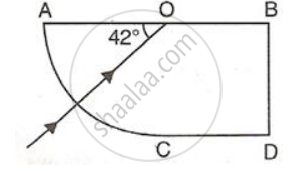
A ray of light enters a glass slab ABDC as shown in figure and strikes at the centre O of the circular part AC of the slab. The critical angle of glass is 42°. Complete the path of the ray till it emerges out from the slab. Mark the angles in the diagram wherever necessary.
Concept: undefined >> undefined
How is heat capacity of a body related to specific heat capacity of its substance?
Concept: undefined >> undefined
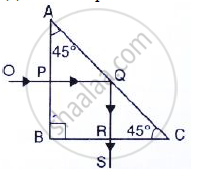
A ray of light OP passes through a right angles prism as shown in the adjacent diagram.
(a) State the angles of incidence at the faces AC and BC.
(b) Name the phenomenon which the ray suffers at the face AC.
Concept: undefined >> undefined
A total reflecting right angled isosceles prism can be used to deviate a ray of light through:
(a) 30° (b) 60° (c) 75° (d) 90°.
Concept: undefined >> undefined
An electromagnetic radiation is used for photography in fog. [2]
(i) Identify the radiation.
(ii) Why is this radiation mentioned by you, ideal for this purpose ?
Concept: undefined >> undefined
(i) What is the relation between the refractive index of water with respect to air `("_aμ_\text(w))` and the refractive index of air with respect to water `("_\text(w)μ_ a)` .
(ii) If the refractive index of water with respect to air `("_aμ_\text(w))` is`5/3`. Calculate the refractive index of air with respect to water `("_\text(w)μ_ a)` .
Concept: undefined >> undefined
The diagram below shows a pulley arrangement :
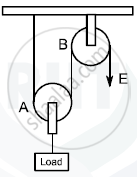
(i) Copy the diagram and mark the direction of tension on each strand of the string.
(ii) What is the velocity ratio of the arrangement ?
(iii) If the tension acting on the string is T, then what is the relationship between T and effort E ?
(iv) If the free end of the string moves through distance x, find the distance by which the load is raised.
Concept: undefined >> undefined
The diagram below shows a dual control switch circuit connected to a bulb.
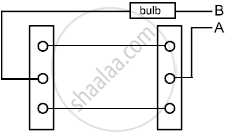
(i) Copy the diagram and complete it so that the bulb is switched ON.
(ii) Out of A and B which one is the live wire and which one is the neutral wire ?
Concept: undefined >> undefined
What is the use of a fixed pulley?
Concept: undefined >> undefined
The diagram below shows a pulley arrangement.
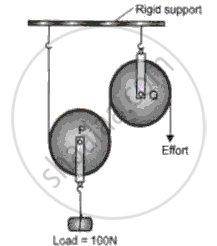
(i) In the diagram, mark the direction of the forces due to tension, acting on the pulley P.
(ii) What is the purpose of the pulley Q?
(iii) If the tension is T newton, deduce the relation between T and E.
(iv) Calculate the velocity ratio of the arrangement.
(v) Assuming that the efficiency of the system is 100%, what is the mechanical advantage?
(vi) Calculate the value of E
Concept: undefined >> undefined
What is a block and tackle system of pulleys?
Concept: undefined >> undefined
Concept: undefined >> undefined
Concept: undefined >> undefined
Name the type of single pulley that can act as a force multiplier. Draw a labeled diagram of the pulley mentioned by you.
Concept: undefined >> undefined
Give a reason for the following:
In a single fixed pulley, the velocity ratio is always more than the mechanical advantage.
Concept: undefined >> undefined
Give reason for the following:
The efficiency of a pulley is always less than 100%
Concept: undefined >> undefined
Give reason for the following:
In case of a block and tackle system, the mechanical advantage increases with the increase in the number of pulleys.
Concept: undefined >> undefined
